
Induction Heating for Steel Tubes: Where It Works, Why It Matters, and What to Watch Out For
Induction heating for steel tubes is commonly used when a production process needs heat in a specific area, not over the whole part. It is used in tube forming, bending, brazing, welding preparation, stress relieving, hardening, and preheating.
The reason manufacturers choose it is simple: it can heat a steel tube quickly and focus the heat where it is needed. That makes it more useful than furnace heating or flame heating in many production lines, especially when the process needs consistency and repeatability.
This article explains where induction heating for steel tubes is actually useful, what it does well, and what must be checked before a system is chosen.
Video: Steel tube induction heating demonstration — controlled heating zone on the middle section.
This video shows a steel tube being heated in the middle section. The full heating zone turns red, showing that the heat is concentrated in the target area rather than spread across the entire tube.
1. How Induction Heating for Steel Tubes Works
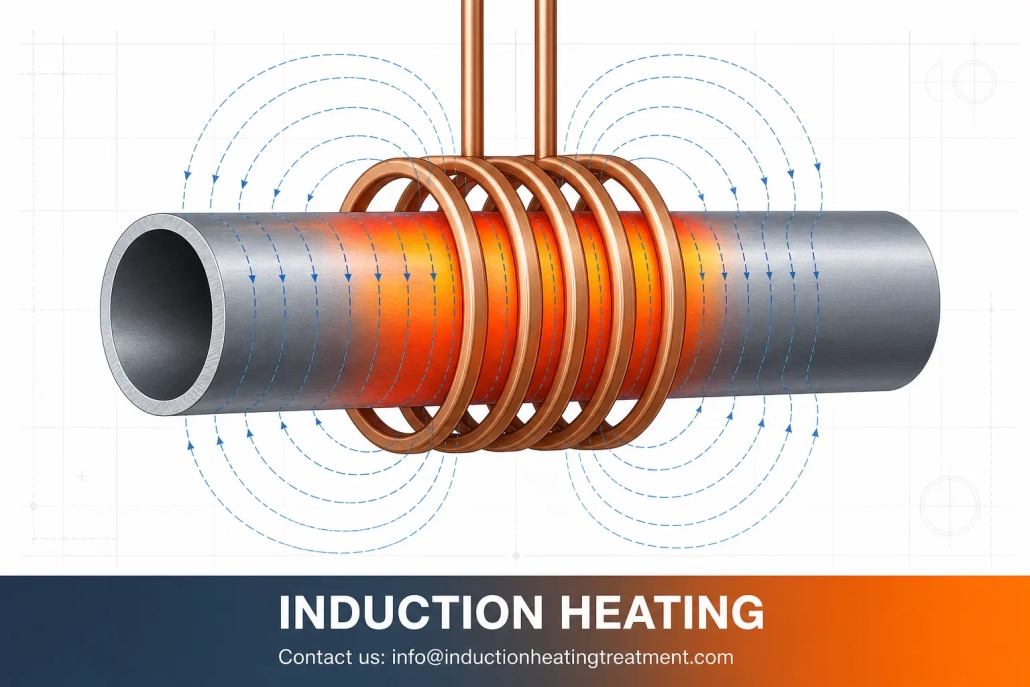
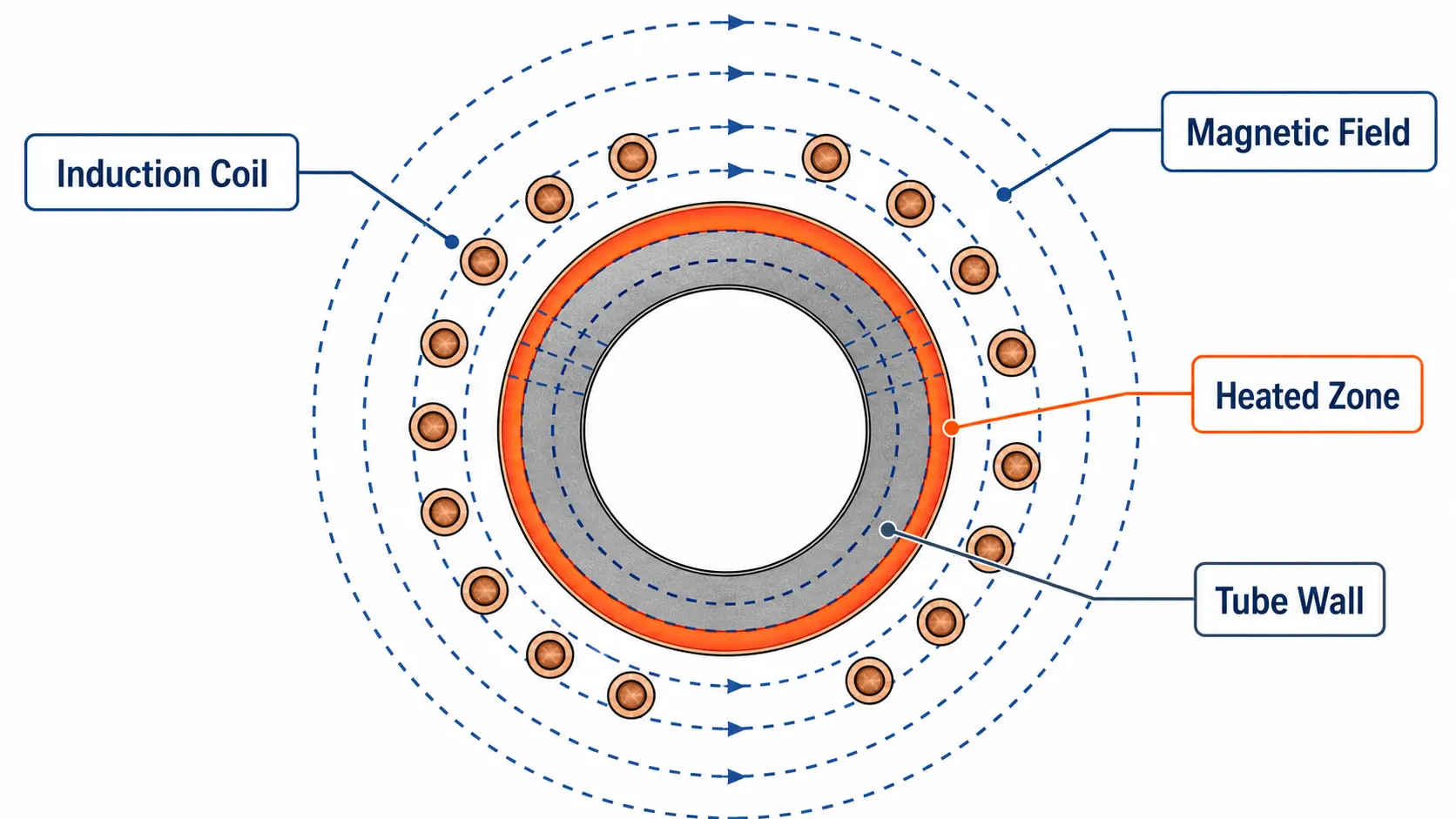
Induction heating uses an alternating magnetic field to generate heat directly in the steel tube. A coil is placed around the tube or around the section that needs to be heated. The tube itself becomes the heat source.
The practical advantage is not the theory. It is the result: heat can be put into a specific section of the tube without heating the entire part first.
That matters when the process only needs one zone heated, such as:
The tube end, the middle section, a joint area, a bend zone, a weld seam
2. Common Applications for Steel Tube Heating
Tube end heating for forming: Tube end heating is used before flaring, swaging, upsetting, expanding, or other forming steps. Only the end section is heated so the rest of the tube stays less affected. This is useful when the next process depends on a consistent softening of the heated zone.
Tube bending: In tube bending, heat is applied to the area that will be formed. This helps the tube bend more predictably and reduces the risk of cracking. This is one of the clearest use cases for induction heating because the heating zone can be placed exactly where it is needed.
Brazing and joint heating: Induction heating is often used for tube assemblies that need brazed joints. The coil focuses heat on the joint area so the filler material can flow properly. This is especially useful when the rest of the assembly should not be overheated.
Weld seam annealing and stress relieving: After welding, the seam area may need further heat treatment to reduce stress or improve the condition of the welded section. Induction heating can focus on the seam while the tube moves through the line. This works best when the tube path and coil position are stable.
Surface hardening: Some tube applications require a harder surface for wear resistance. Induction heating can be used to heat the outer layer quickly, followed by cooling. This is a more specialized use case, but it is common in parts that must resist wear during service.
Preheating before welding or coating: Preheating helps prepare the tube for later processing. It can improve process stability and reduce thermal shock. This is often chosen when a production line needs better consistency than flame heating can provide.
3. Why Manufacturers Use It
It heats only the required area. That is the main reason. If the process only needs one section heated, there is no reason to heat the rest of the tube.
It is faster than many traditional methods. Induction does not waste time heating a large furnace space or waiting for the whole part to warm up.
It is easier to repeat. Once the system is set up correctly, it can produce the same result more consistently than manual heating.
It fits automation better. Induction systems can be built into production lines with conveyors, rollers, rotary handling, robots, and temperature control systems.
It can reduce manual dependence. This matters in production environments where operator-to-operator variation causes quality problems.
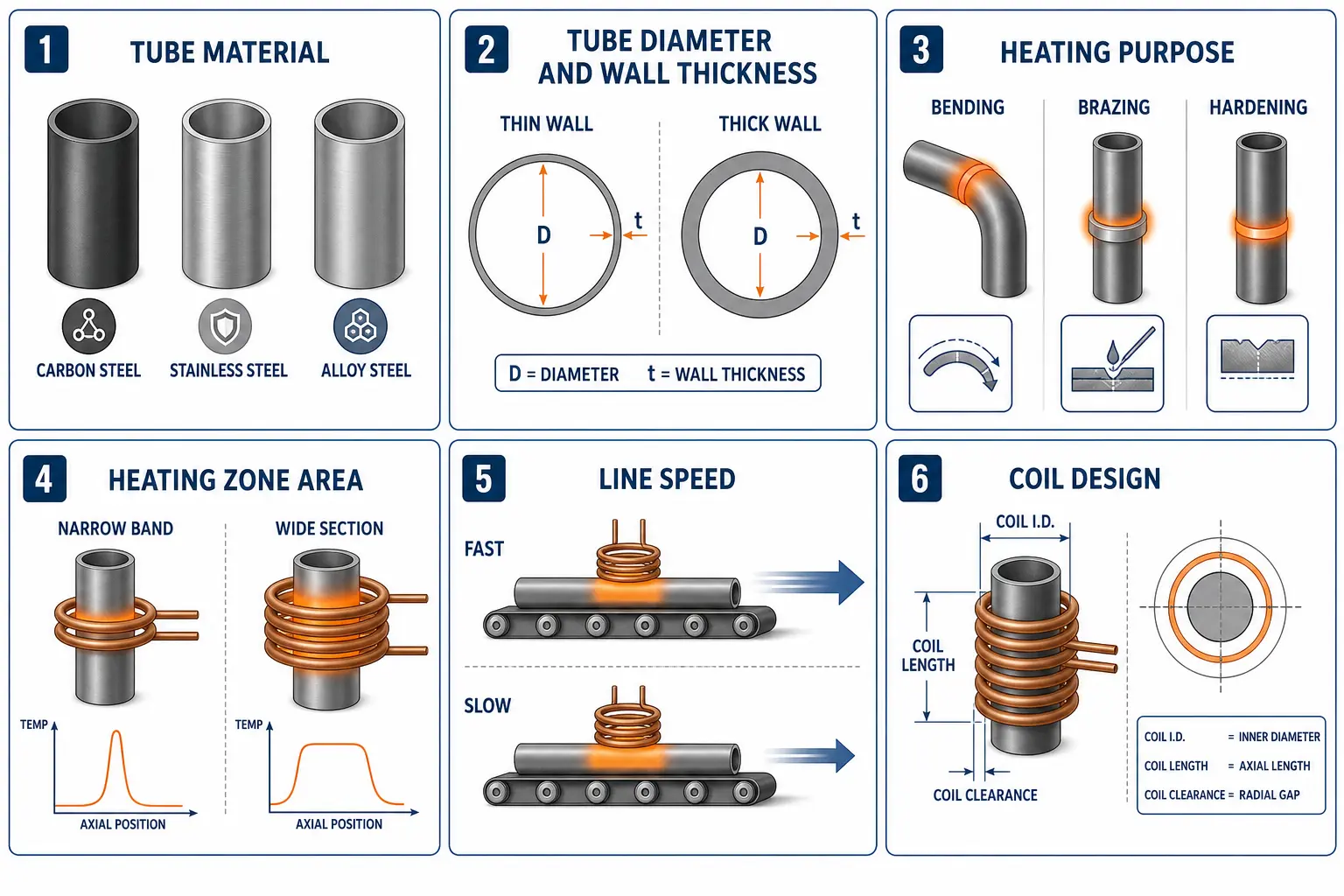
4. What Affects the Result
This part matters more than the marketing claim. A lot of induction projects fail because the process and the equipment are not matched properly.
| Factor | What to Watch For |
|---|---|
| Tube material | Different steels do not behave the same way. Carbon steel, stainless steel, and alloy steel can all react differently to induction heating. If the material is not confirmed early, the heating result may be unstable. |
| Tube size and wall thickness | A thin tube reacts differently from a thick tube. Thin-wall tubes heat faster and can overheat more easily. Thick-wall tubes need more effort to heat through properly. |
| Heating purpose | The target is different depending on the job: bending, brazing, preheating, hardening, stress relieving. If the purpose is unclear, the setup will likely be wrong. |
| Heating area | A short local heating area and a longer heating section require different coil designs and different process control. |
| Line speed or cycle time | The heating process must fit the actual production rhythm. If the tube moves too quickly, heating may be incomplete. If it moves too slowly, output drops. |
| Coil design | The coil determines where the heat goes. Poor coil design gives poor results, even if the power supply is good. |
5. Equipment Considerations
A real induction system for steel tubes is not just a power supply. It usually includes:
Power supply. Needs to match the application. A system that is too weak will not keep up. A system that is poorly controlled may create uneven heating.
Coil.
Cooling system. Cooling is not optional. The coil and power electronics need it to run reliably.
Controls.
Handling system.
Temperature monitoring. If temperature matters to the process, it should be measured, not guessed.
Safety protections.
Handling and positioning: If the tube moves in the wrong place, the heating result changes. The system must keep the tube aligned with the coil.
Maintenance and safety: This is often ignored until later, which is a mistake. Hoses, fittings, coils, sensors, and guards all need maintenance access.
6. Common Problems
1. Heating is uneven. Usually caused by poor alignment, inconsistent part position, or a bad coil setup.
2. Thin tubes overheat. This happens when heat is applied too aggressively or control is poor.
3. Thick tubes do not heat enough inside. The surface may look hot while the inside is still too cool for the process.
4. Surface oxidation appears. Steel heated in air will oxidize. Induction reduces exposure time, but it does not automatically eliminate oxidation.
5. Coils wear out too early. Often caused by poor cooling, water quality issues, vibration, or accidental contact.
7. When Induction Heating Is a Good Fit
Induction heating is a good choice when the process needs:
|
Good Fit — localized heating — fast heating — repeatable heating — easier automation |
Less Attractive — production volume is low — product types change too often — the process needs long soak time — the heating area is too variable to control well |
In practice, the decision should be based on sample testing, not assumptions.
Key Takeaway: Induction heating for steel tubes is useful when the process needs controlled, localized heating and the production line needs repeatable results. It is not a universal solution, but for the right application it is often faster, cleaner, and easier to automate than furnace or flame heating. The real question is not whether it can heat steel tubes. It can. The real question is whether it fits the tube size, material, heating target, and production method.
FAQ
Q: Can induction heating be used on stainless steel tubes?
A: Yes, but stainless steel may behave differently from carbon steel, so the process must be matched to the material.
Q: Is induction heating better than furnace heating?
A: Not always. It is usually better for localized heating and production lines, while furnace heating may be better for larger batches or long soak processes.
Q: What should be checked before choosing an induction system?
A: The tube material, size, heating purpose, production speed, and handling method should all be checked first.
Get an Application Review for Steel Tube Heating
Share your tube material, size, heating purpose, and production flow. Our engineering team can help assess whether induction heating is a suitable approach for your process.


