
How to Select an Induction Hardening System: 8 Critical Factors for Manufacturers
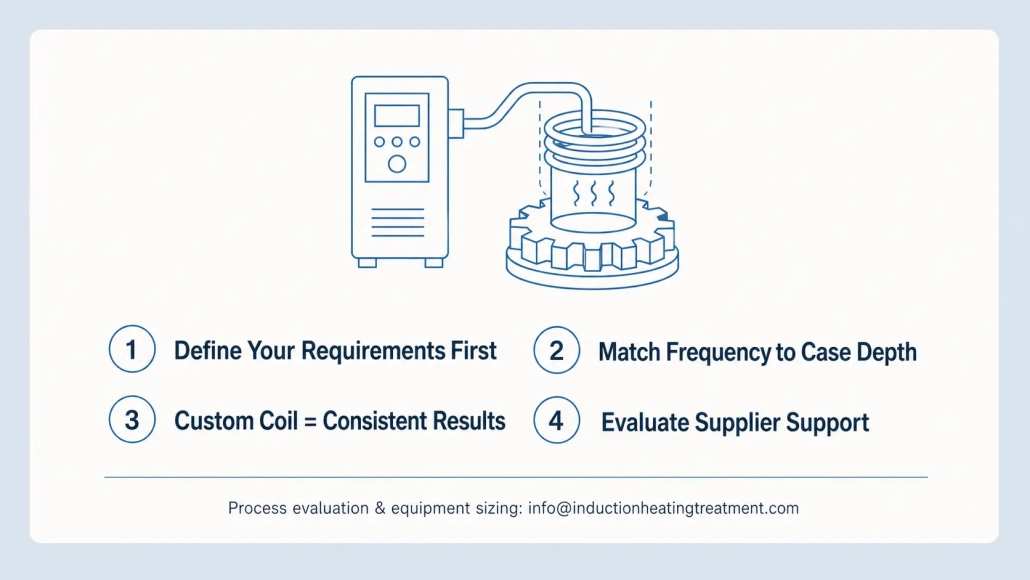
Selecting an induction hardening system is not a one-spec decision. Power rating alone tells you very little. The right system depends on your workpiece geometry, target case depth, throughput, and how well the supplier understands your process — not just their own equipment.
Get any of these wrong, and you end up with inconsistent hardness, coil burn-through, or a machine that sits idle half the shift. This guide walks through the eight factors that actually determine whether a system delivers reliable results — or becomes a bottleneck on your line.
1. Start with Your Workpiece, Not the Machine
Too many shops start by comparing kilowatts and price tags. Flip that. Start with what you are hardening.
Nail down these six data points before you talk to any supplier:
— Workpiece type and geometry (shaft, gear, bearing race, CV joint)
— Material grade
— Target surface hardness (HRC range)
— Required case depth
— Annual production volume
— Target cycle time per part
A system sized for shallow gear hardening at 0.8 mm case depth will fall short on a 6 mm shaft application. Defining the part first keeps you from buying a machine that is either overkill or underpowered.
2. Pick the Right Heating Method
Two approaches dominate production hardening, and they suit different workpieces.
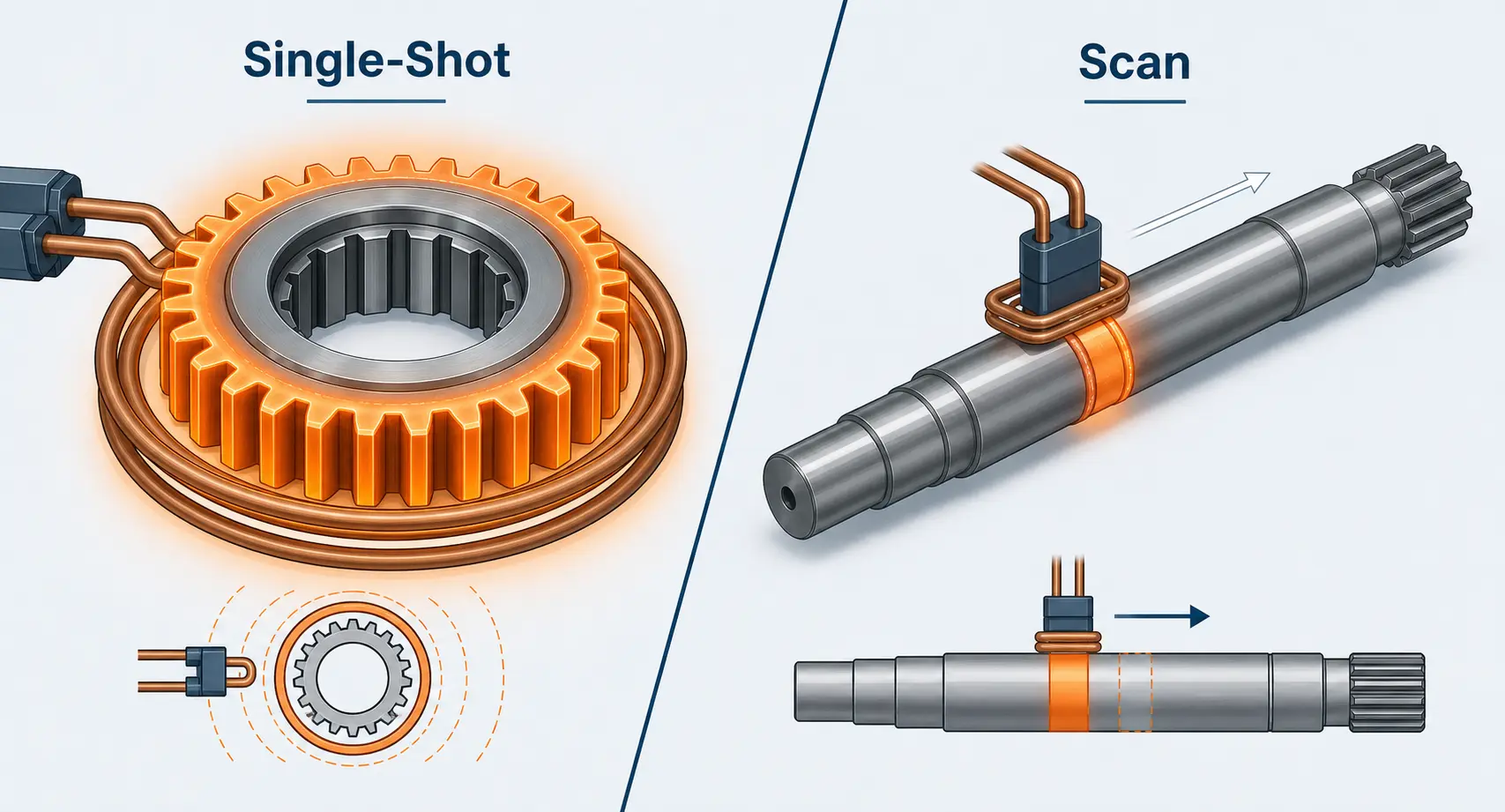
Single-shot hardening heats the entire target zone at once using a stationary coil that surrounds the part. It delivers excellent uniformity and short cycle times — ideal for gears, bearing rings, and flanged components where the hardened zone is compact.
Scan hardening moves the coil progressively along the workpiece while quenching follows right behind it. This is the go-to method for long shafts, guide rails, and rollers, where heating the entire surface at once would demand an impractically large power supply.
Lock in the method early. It shapes everything downstream: coil geometry, power requirements, quench design, and how the part is fixtured.
| Factor | Single-Shot Hardening | Scan Hardening |
|---|---|---|
| Best for | Gears, bearing rings, flanged parts — compact hardening zones | Long shafts, guide rails, rollers — extended hardening zones |
| Cycle time | Short — entire zone heated at once | Longer — coil travels along the part progressively |
| Heating uniformity | Excellent — stationary coil surrounds the part | Depends on coil geometry and scan speed control |
| Power requirement | Higher — must energize the full zone simultaneously | Lower — only heats a narrow band at any moment |
| Coil complexity | Moderate — multi-turn ring or profiled coil | Lower — single-turn or pancake coil, simpler construction |
| Equipment cost | Higher upfront investment | Typically lower — smaller power supply required |
3. Match Power and Frequency to the Job
Power governs how fast you heat. Frequency governs how deep the heat penetrates. The two must be evaluated together — neither tells the full story alone.
Higher frequencies (100–500 kHz) concentrate energy near the surface, producing shallow case depths of 0.5–1.5 mm. Medium frequencies (1–10 kHz) drive current deeper, suitable for case depths of 2 mm and above on larger parts. For deep case hardening beyond 5 mm, frequencies below 3 kHz are typical.
The common mistake is chasing higher power while neglecting frequency. A 200 kW system at the wrong frequency will produce worse results than a properly matched 100 kW unit. If you want a deeper dive into power selection, we have covered that separately.
4. The Coil Makes or Breaks the Process
No power supply — however advanced — can fix a poorly designed coil. The coil is where electromagnetic energy becomes heat. Its geometry determines heating uniformity, efficiency, and whether you hit consistent hardness from part to part.
When you evaluate a supplier, press them on the coil:
— Is it designed around your specific workpiece, or is it an off-the-shelf shape?
— Can they show you thermal simulation or past results on similar geometries?
— How is cooling integrated into the coil body?
— What is the typical coil life, and how quickly can you get replacements?
A custom coil costs more upfront but pays for itself in reduced scrap, faster cycles, and fewer hardening defects caused by uneven heating.
5. Cooling Is Not an Afterthought
Induction hardening couples heating and quenching in a single process. You can nail the heating profile and still ruin the part if quench flow is uneven, delayed, or insufficient.
Look at three things on the quench side: spray pattern coverage, flow stability under continuous operation, and quench delay consistency. A half-second delay drift between cycles is enough to shift hardness outside spec.
Beyond the workpiece, the cooling system also protects the coil and power electronics. Undersized cooling leads to coil burn-through, IGBT failures, and unplanned downtime that costs far more than the cooling upgrade would have.
6. Automation Features You Actually Need
Even a manually loaded station benefits from process automation on the control side. At minimum, look for:
— Recipe management with stored parameters per part number
— Real-time power and frequency monitoring with alarm outputs
— PLC communication for integration with upstream and downstream stations
— Production data logging for traceability
These are not luxuries. Recipe management alone eliminates setup errors when operators switch between part families, and data logging gives you the paper trail that automotive and aerospace customers increasingly demand.
7. Judge the Supplier, Not Just the Spec Sheet
A machine that looks perfect on a datasheet means little if the supplier cannot support it. Before you commit, verify that the supplier offers:
— Sample testing on your actual parts (not just reference workpieces)
— Coil design and process development as part of the package
— On-site commissioning and operator training
— Spare parts availability with documented lead times
A supplier with application engineering depth will often deliver better results with mid-range hardware than a box-seller offering premium specs and zero process support.
8. Four Mistakes That Derail Purchasing Decisions
Buying by power rating alone. A 300 kW system with a poor coil produces worse parts than a 150 kW system with a well-engineered coil and the right frequency match.
Skipping sample testing. Never buy without running your own parts through the system first. What works on a demo gear may not transfer to your geometry, your material, or your cycle-time target.
Treating the coil as a commodity. A generic coil is the fastest path to uneven hardness, low efficiency, and premature failure. Budget for custom coil engineering from day one.
Ignoring flexibility. If your product mix includes multiple part families, a system that handles only one geometry will age poorly. Ask about quick-change coil mounts, recipe storage capacity, and whether the power supply can drive different coil types without reconfiguration.
Key Takeaway
An induction hardening system is a process investment, not a commodity purchase. The best system is rarely the most powerful or the cheapest — it is the one whose power, frequency, coil design, cooling, and control architecture are all dialed into your parts and your production reality. Induction heating fundamentals are the same everywhere, but application engineering is what determines whether a system earns its place on your floor.
Q: What information should I send to an induction hardening equipment supplier?
A: Send workpiece drawings, material grade, target hardness and case depth, annual volume, and cycle time. If you can ship sample parts, do it — nothing replaces a real process trial.
Q: Can one system handle multiple part types?
A: Yes — with dedicated coils per part family and a control system that stores separate recipes. A flexible platform with quick-change fixturing saves floor space and capital compared to running multiple single-purpose machines.
Q: Is higher power always better?
A: No. Excess power makes temperature control harder and raises operating cost without improving results. Size power to your largest part family and fastest required cycle — anything beyond that is waste.
Need Help Sizing an Induction Hardening System?
Send us your workpiece drawings and requirements. We will run a sample test and recommend a system matched to your parts — not a one-size-fits-all quote.


