
Riscaldamento a induzione di billette in ottone per forgiatura: Selezione delle leghe, Controllo della temperatura e qualità della formatura
In brass billet induction heating, a billet may reach the specified temperature at the induction heater outlet and still arrive at the forging die in an unsuitable condition. The surface may be hotter than the interior, the temperature measurement may be affected by oxidation, or the billet may lose too much heat while waiting for the press.
These problems become more significant when a forging line handles short billets at a regular production rate. Tempo di riscaldamento, billet movement and press timing all influence the condition of the metal when deformation begins.
Brass alloy selection adds another consideration. Conventional forging brass and newer low-lead copper alloys do not necessarily respond to the same heating conditions, even when their published hot-working temperature ranges overlap.
For brass valve bodies, pipe fittings and other hot-forged components, induction heating therefore needs to be evaluated as part of the forging process, rather than as an isolated heating operation.
2. What Happens When a Brass Billet Is Too Cold or Too Hot?
3. Heating Short Brass Billets Without Excessive Temperature Differences
4. Why Measuring Brass Temperature Can Be Difficult
5. Automated Heating Depends on More Than the Induction Power Supply
6. Is the Problem Caused by Heating or by Forging?
7. Establishing the Heating Process for a New Brass Forging
1. The Brass Alloy Determines the Starting Temperature Range
Brass is a group of copper-zinc alloys with different compositions and hot-working characteristics. Treating all brass billets as interchangeable can lead to problems when material specifications change.
Two useful examples are C37700 forging brass and C69300 ECO BRASS.
1.1 C37700: Conventional Forging Brass
UNS C37700 is a lead-containing brass widely associated with hot-forged components, including valve bodies, fittings and hardware.
Il Copper Development Association lists its hot-working temperature range as approximately 650–815°C (1200–1500°F).
C37700 is well suited to hot forming, but that published range is not a complete forging specification. The temperature selected for production must also suit the billet dimensions, die geometry and amount of deformation required.
Ad esempio, a relatively simple forging and a component with deep cavities or thin sections may require different forming conditions, despite using the same alloy.
1.2 C69300: Low-Lead ECO BRASS
C69300 is a copper-zinc-silicon alloy used in applications such as plumbing fittings, connectors and valve components.
Il Copper Development Association gives a hot-working range of approximately 650–825°C (1202–1517°F).
That range overlaps substantially with C37700. It would be easy to conclude that the two materials can be heated using similar settings.
Tuttavia, the alloy manufacturer provides more specific guidance.
In its ECO BRASS technical information, Mitsubishi Materials identifies approximately 700–760°C as a suitable hot-forging temperature interval associated with low deformation resistance.
The narrower recommendation highlights the difference between a material’s general hot-working range and the temperature window selected for a particular forging process.
C69300 also differs substantially from C37700 in electrical properties. At room temperature, the published electrical conductivity is approximately 8% IACS for C69300, compared with 27% IACS for C37700.
These values matter when considering electromagnetic heating behavior, although the actual response also depends on temperature, billet dimensions, frequency and inductor design.
A change from C37700 to C69300 should therefore trigger a review of the heating cycle and forging conditions. Copying the original temperature setting into a new recipe is not sufficient.
2. What Happens When a Brass Billet Is Too Cold or Too Hot?
The effect of billet temperature becomes visible during deformation.
If the billet enters the die below its suitable working temperature, the material generally offers greater resistance to deformation. Thin sections and detailed cavities can become difficult to fill, while the press and tooling experience higher forming loads.
Incomplete filling, tuttavia, does not prove that the billet was too cold. Insufficient billet volume, unsuitable tooling or excessive friction can produce similar results.
The opposite problem is excessive heating.
Unnecessarily high temperatures or prolonged exposure can increase surface oxidation and alter the condition of the material entering the die. In condizioni sufficientemente severe, zinc-related oxidation or surface depletion may also become relevant.
The extent of these effects depends on the alloy, temperatura, exposure time and surrounding atmosphere. They should not be assumed to occur during every normal brass forging cycle.
Heating temperature also affects the consistency of successive forgings.
Consider a line in which most billets reach the press immediately after heating, but occasional billets remain in the transfer mechanism during brief interruptions. Their temperatures at the start of forging will not necessarily be the same, even if the heater operates with an unchanged power setting.
Differences in material flow, flash formation or cavity filling may then appear between otherwise similar parts.
The useful temperature target is consequently the one that produces the required material condition when forging starts. A heater-outlet reading is only one part of that assessment.
3. Heating Short Brass Billets Without Excessive Temperature Differences
Brass forging commonly uses short cylindrical blanks cut from rod stock. Their diameter and length affect both the heating cycle and the temperature distribution inside the metal.
Durante il riscaldamento a induzione, the distribution of induced current is influenced by the electromagnetic field and the electrical properties of the workpiece. Thermal conduction then redistributes the heat.
A short heating cycle does not guarantee that the surface, center and ends of a billet have reached the same temperature.
In a short cylindrical billet, the ends may also respond differently from the middle because the electromagnetic field and heat-transfer conditions are not identical along the entire length.
This becomes important when changing billet dimensions.
Increasing the diameter adds material that must be brought to the required temperature. Changing the length can alter the way the billet occupies the heating zone. Even billets of the same mass may not heat identically if their dimensions differ significantly.
Frequenza operativa, coil geometry and heating time all play a role, but selecting them independently makes little sense. A heating arrangement must be assessed using the actual alloy and billet dimensions.
For a wider discussion of general induction billet heating principles, vedere il nostro articolo su Riscaldamento a induzione di billette in acciaio. The same basic electromagnetic principles apply, although the material properties and forging conditions differ.
3.1 Why Surface Temperature Alone Is Not Enough
Industrial induction heating lines often use optical pyrometers to measure billets near the heater outlet.
The instrument measures radiation from the observed surface. It does not directly measure the billet center.
This distinction matters when heating time is short or when the temperature distribution has not yet equalized.
Durante lo sviluppo del processo, representative billets can be tested to determine how well the measured surface temperature corresponds to the internal temperature needed for forging.
Once that relationship is established, surface measurement becomes a practical production-control tool. Without such verification, a stable displayed temperature may give an incomplete picture of the heating result.
4. Why Measuring Brass Temperature Can Be Difficult
Brass presents a particular challenge for infrared temperature measurement because its surface condition can change during heating.
A freshly cut billet may have a relatively bright metallic surface. As it is heated in air, oxidation can change its appearance and radiation characteristics.
The same pyrometer settings may therefore produce different measurement errors for clean and oxidized surfaces.
Reflected radiation from nearby hot equipment can further complicate measurements on reflective metal.
These are established infrared measurement issues. Strumenti di processo Fluke discusses how metal emissivity affects pyrometer accuracy, while published research on the spectral emissivity of brass examines the influence of temperature and oxidation.
In produzione, the measurement arrangement deserves attention before temperature readings are used to accept or reject billets.
The instrument must be suitable for the expected temperature range and metal surface. Its measurement location, wavelength and emissivity settings need to be checked under representative heating conditions.
A consistent viewing position also matters. A change in the area observed by the pyrometer can introduce variation unrelated to the actual bulk temperature of the billet.
There is another distinction: the measured temperature at the heater outlet is not necessarily the temperature at the forging die.
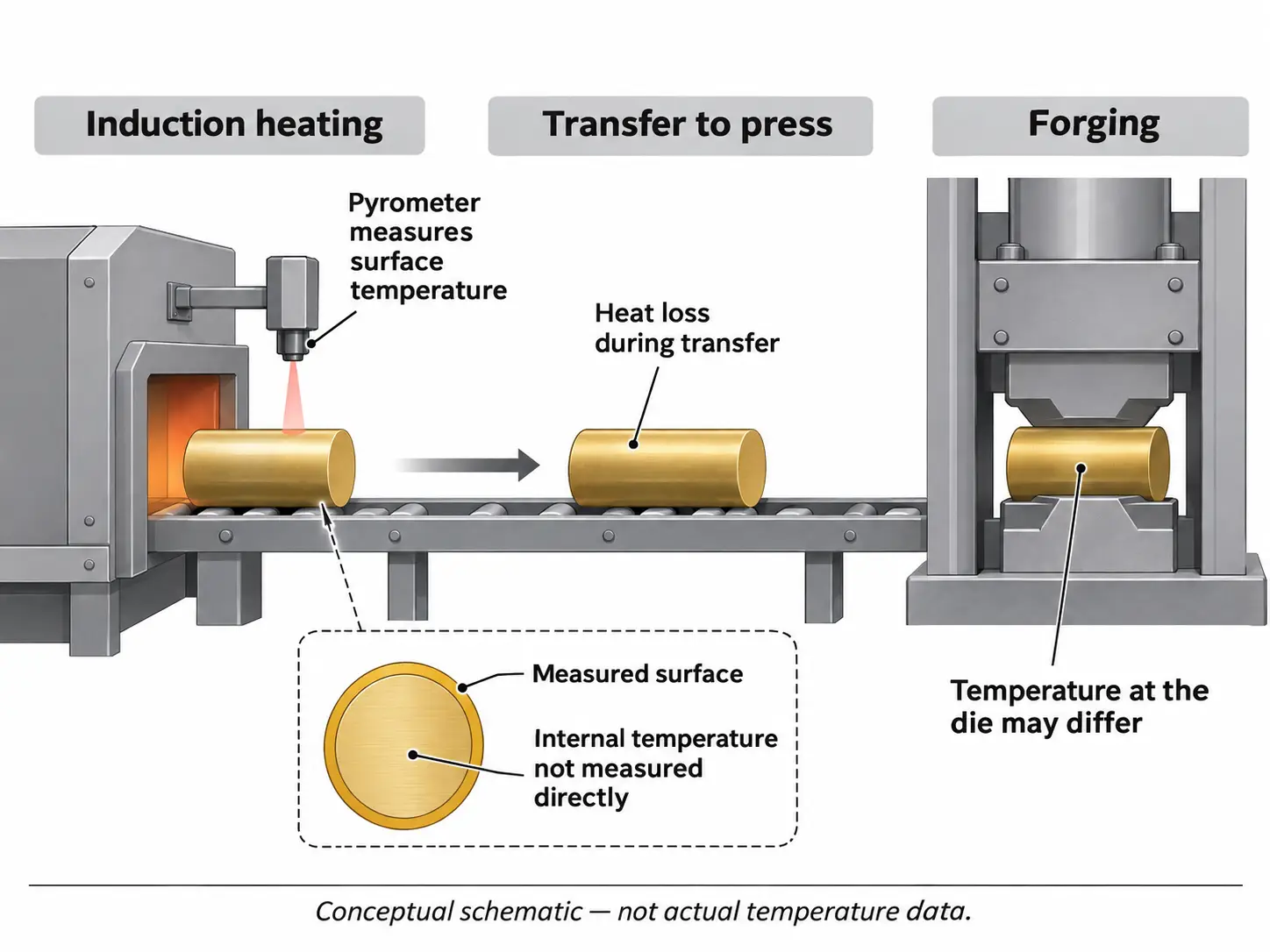
After discharge, the billet loses heat by radiation, convection and contact with the handling system.
The temperature loss depends on its size, surface condition and the time taken to reach the press.
This is why temperature control cannot be separated from billet handling. A reliable measurement at the heater outlet is valuable, but it must be interpreted in the context of the complete process.
5. Automated Heating Depends on More Than the Induction Power Supply
An automated brass billet heating line must move individual blanks through the heating section and deliver them to the press in the correct sequence.
The physical arrangement varies. Billets may be fed by mechanical systems designed for a particular diameter and length, and the heating equipment may be combined with non-contact temperature measurement and downstream handling.
SAET Induction’s brass heating applications describe temperature monitoring of individual billets in automated forging operations.
A more specific example is Induktio’s brass billet heating machine. The published description covers billets of different diameters and lengths, automatic handling through the inductor and transfer toward the forging press, with optical temperature monitoring.
These examples show how heating and material movement are linked in industrial equipment. For bar and billet heating built around forging press timing, vedere il nostro Macchina riscaldante per la forgiatura a barra a induzione.
For a new installation, several production situations deserve particular attention.
Changing billet dimensions.
A different diameter or length can affect heating behavior as well as the feeding mechanism. The heating recipe and mechanical setup may both require adjustment.
Brief press stoppages.
A billet held between the heater and press continues to cool. The control system needs an appropriate response when normal transfer timing is interrupted.
Temperature variation between billets.
Individual measurement can help identify unusual readings, but the acceptance limits must be established from the material and forging requirements.
Different material batches.
Changes in alloy specification or surface condition can affect heating or temperature measurement. The material actually supplied to the line should match the approved process.
A well-designed control sequence accounts for these situations without assuming that every billet experiences an identical cycle.
6. Is the Problem Caused by Heating or by Forging?
When defects appear in brass forgings, adjusting the heating temperature is an understandable first reaction. It is not always the right one.
The appearance of the forged part provides clues, but usually does not identify a single cause.
6.1 Incomplete Die Filling
Low billet temperature can make cavity filling more difficult by increasing deformation resistance.
Prima di aumentare la temperatura di riscaldamento, compare the affected parts with the actual billet volume, grado del materiale, press conditions and die geometry.
If the problem appears only after transfer delays, temperature loss deserves closer attention.
If it occurs consistently with billets already confirmed to be within the approved temperature range, tooling or forming conditions may be more relevant.
6.2 Cracks and Surface Damage
Crepe can develop from unsuitable hot-working conditions, but also from the starting material, local strain, die geometry or metallurgical inhomogeneity.
Research published in Materiali, Structural Factors Inducing Cracking of Brass Fittings, examined cracking in hot die-forged brass components.
The study connected the observed damage with local structural and compositional changes and the deformation conditions around the affected area.
It is an example of why a crack cannot automatically be classified as a heating defect. The investigation needs to consider how the material flowed through the die and what was present in the damaged region.
6.3 Folds, Laps and Irregular Flash
Folds and laps are closely associated with material flow. Temperature can influence that flow, but billet shape and die design are often essential to understanding how the defect formed.
Variation in flash can also arise from changes in billet volume or tooling, not just temperature.
A useful first comparison is whether the affected forgings share a common material batch, dal ciclo di riscaldamento, transfer delay or tooling condition.
That comparison helps narrow the investigation before machine settings are changed.
6.4 Surface Oxidation
Heavy oxidation can justify checking heating temperature and exposure time. It is also necessary to consider alloy composition and the surrounding atmosphere.
Discoloration alone is not a reliable measure of the billet’s internal temperature.
Surface examination and temperature records are more useful when considered together.
6.5 A Practical Troubleshooting Reference
| Observed problem | Heating-related check | Other important checks |
|---|---|---|
| Incomplete filling | Temperature at forging, perdita di calore durante il trasferimento | Billet volume, press force, geometria dello stampo |
| Cracking | Temperature range, possible local overheating | Stato materiale, alla deformazione, attrezzature |
| Folds or laps | Temperature effect on material flow | Billet geometry, progettazione dello stampo |
| Variable flash | Temperature variation between billets | Billet dimensions, condizione degli utensili |
| Heavy oxidation | Heating temperature and exposure time | Alloy and atmosphere |
The purpose of troubleshooting is to identify which process variable changed. Increasing power or extending heating time without that information can introduce a second problem while leaving the original one unresolved.
7. Establishing the Heating Process for a New Brass Forging
A heating trial is most useful when the material and forming requirements are defined before adjusting the induction equipment.
Start with the exact brass grade and its material specification. The published hot-working range provides a reference, while alloy-manufacturer recommendations and the forging operation help establish the temperature window to investigate.
Successivo, confirm the billet dimensions and the required production sequence. The heating arrangement must accommodate the real workpiece, including how it enters and leaves the inductor.
Temperature measurements should be checked under representative conditions. This includes assessing surface measurement accuracy and, where necessary, verifying the internal temperature distribution of trial billets.
The trial should also reproduce the intended transfer arrangement. A billet forged immediately after heating may behave differently from one held for longer before entering the die.
Infine, inspect the forgings. Die filling, flash, dimensions and surface condition provide evidence of whether the selected heating conditions are suitable.
If a different brass alloy is introduced later, its behavior needs to be checked against the established process. Similar billet dimensions and overlapping published temperature ranges do not guarantee equivalent results.
8. Domande frequenti
What temperature is normally used for induction heating before brass forging?
It depends on the alloy. The Copper Development Association lists approximately 650–815°C for C37700 forging brass. For C69300 ECO BRASS, Mitsubishi Materials identifies approximately 700–760°C as a suitable hot-forging interval in its technical guidance. The production target must be established for the actual forging operation.
Can the same induction heater process different brass alloys?
A heating system may be capable of processing more than one alloy, but the settings require evaluation. Differences in electrical properties, hot-working behavior and billet dimensions can affect the heating cycle.
Why can a billet show the correct temperature but still cause forging problems?
A pyrometer normally measures the observed surface. The billet may have a different internal temperature, the measurement may be affected by surface emissivity, or the billet may cool during transfer. Forging problems can also originate in tooling, billet volume or material condition.
Does induction heating eliminate defects in brass forging?
No heating method eliminates defects caused by unsuitable die design, material problems or forming conditions. Induction heating can provide controlled billet preparation, but its contribution to quality depends on the complete forging process.
9. Conclusione
Successful brass billet induction heating starts with the alloy and ends with the condition of the metal inside the forging die.
C37700 and C69300 illustrate why a published hot-working range is only a starting point. Their different compositions and electrical properties must be considered when developing the heating process.
For automated forging, particular attention belongs on surface temperature measurement, internal heating uniformity and the time between heater discharge and deformation.
When these factors are understood and controlled, induction heating can provide a consistent supply of billets for stampaggio a caldo. The finished forgings—not the temperature display alone—ultimately show whether the process is working.
Plan a Brass Billet Heating Process for Your Forging Line
Share your brass grade, billet dimensions and press timing. We can help you establish a heating cycle that delivers the right billet condition at the die.


