How to Choose an Induction Power Supply for Inclined Channel Quenching Machines
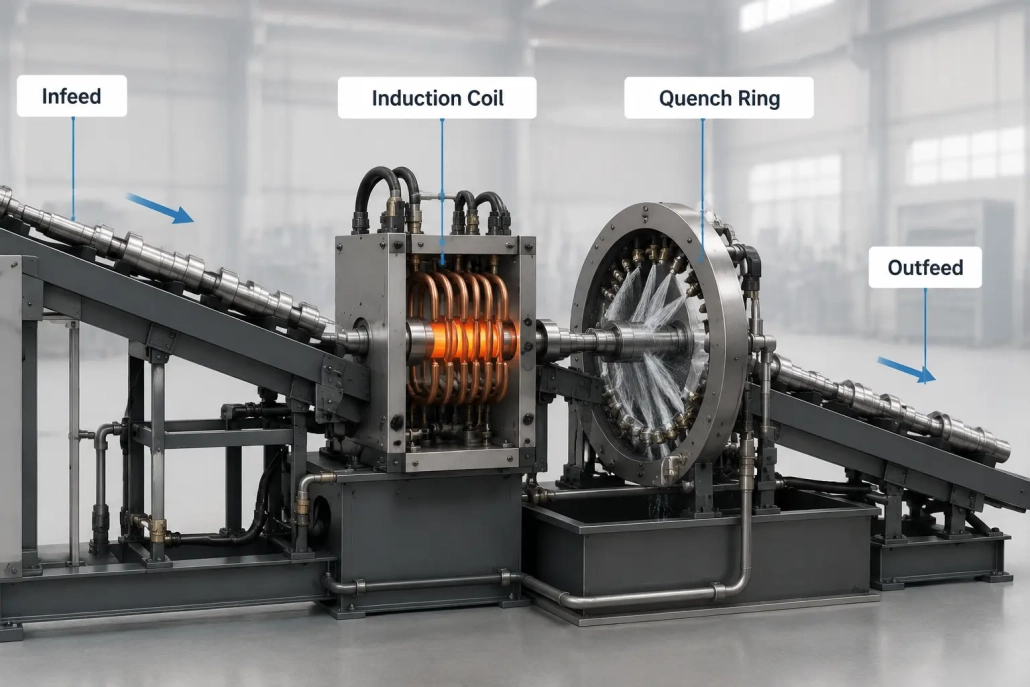
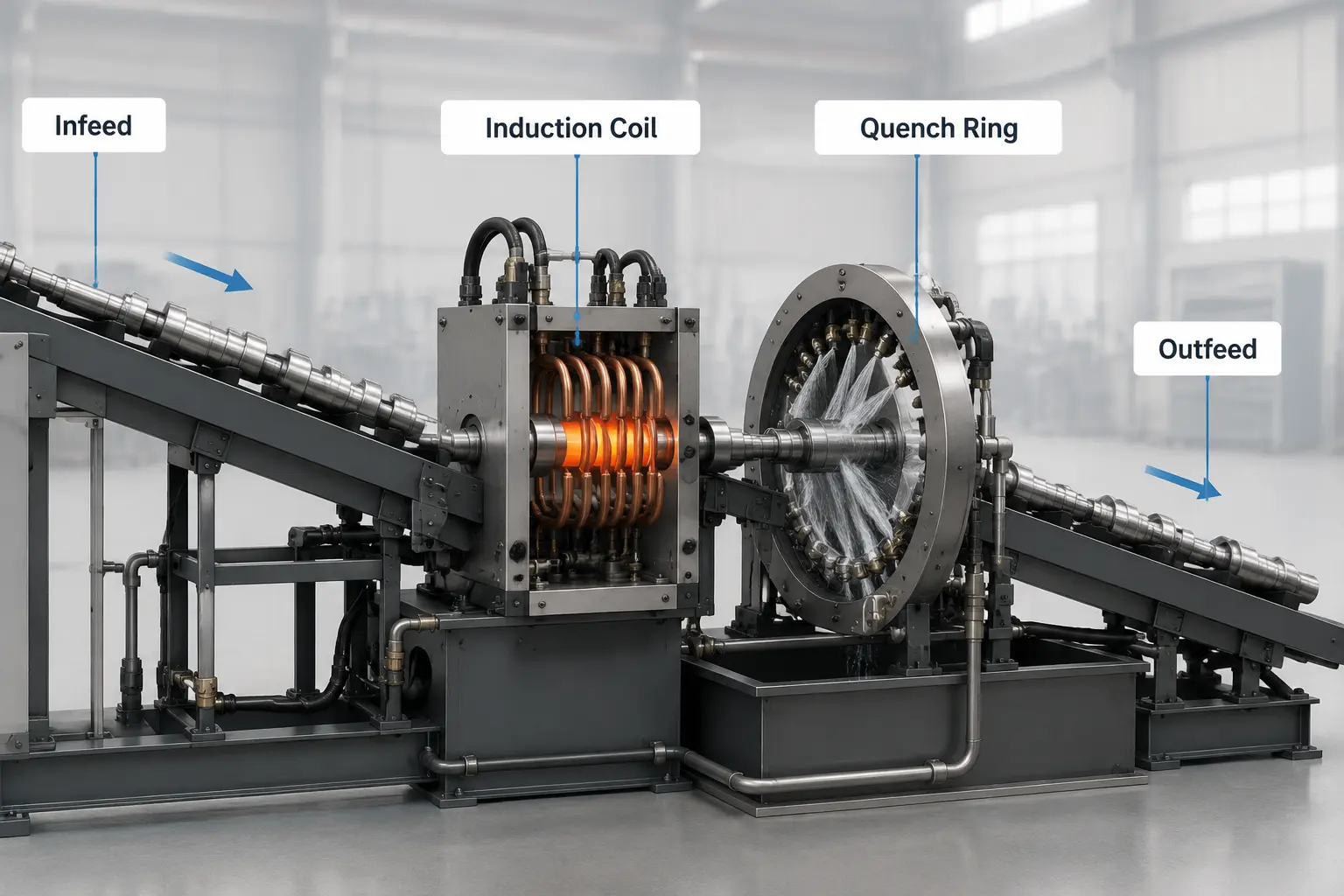
An inclined channel quenching machine is a continuous-flow system: shafts, rods, or rollers enter at one end, move through an induction coil inside a sloped channel, hit the quench ring, and exit as hardened parts—one after another, for hours at a time. The induction power supply for inclined channel quenching machine lines sits at the center of this process. Getting it wrong means inconsistent hardness, unplanned stoppages, or a line that never reaches its designed throughput.
| 1. What the machine does | 2. Why induction fits |
| 3. Power supply selection factors | 4. Typical applications |
| 5. Common selection mistakes | 6. Pre-selection checklist |
1. What Is an Inclined Channel Quenching Machine Used For?
An inclined channel quenching machine is used for continuous surface hardening of cylindrical metal parts—shafts, rods, rollers, and similar components. The key feature is continuous processing: workpieces move through the channel one by one while being heated and quenched. Gravity indexes each part through the coil and quench zone at a controlled rate, giving every workpiece the same thermal cycle. Typical parts include axle shafts, conveyor rollers, bearing races, transmission pins, and hydraulic rods.
2. Why Use Induction Heating in This System?
Most inclined channel quenching lines use induction heating because it fits the production style:
- Fast heating speed—power adjusts in milliseconds, matching the line’s continuous pace.
- Stable temperature control—once parameters are set, every part gets the same heat treatment.
- Suitable for continuous production—no contact, no consumables, no warm-up lag between parts.
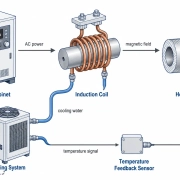
- No direct contact with the workpiece—the coil surrounds the channel without touching the part, so there is nothing to wear out. For more on how induction achieves this, see our induction heating fundamentals guide.
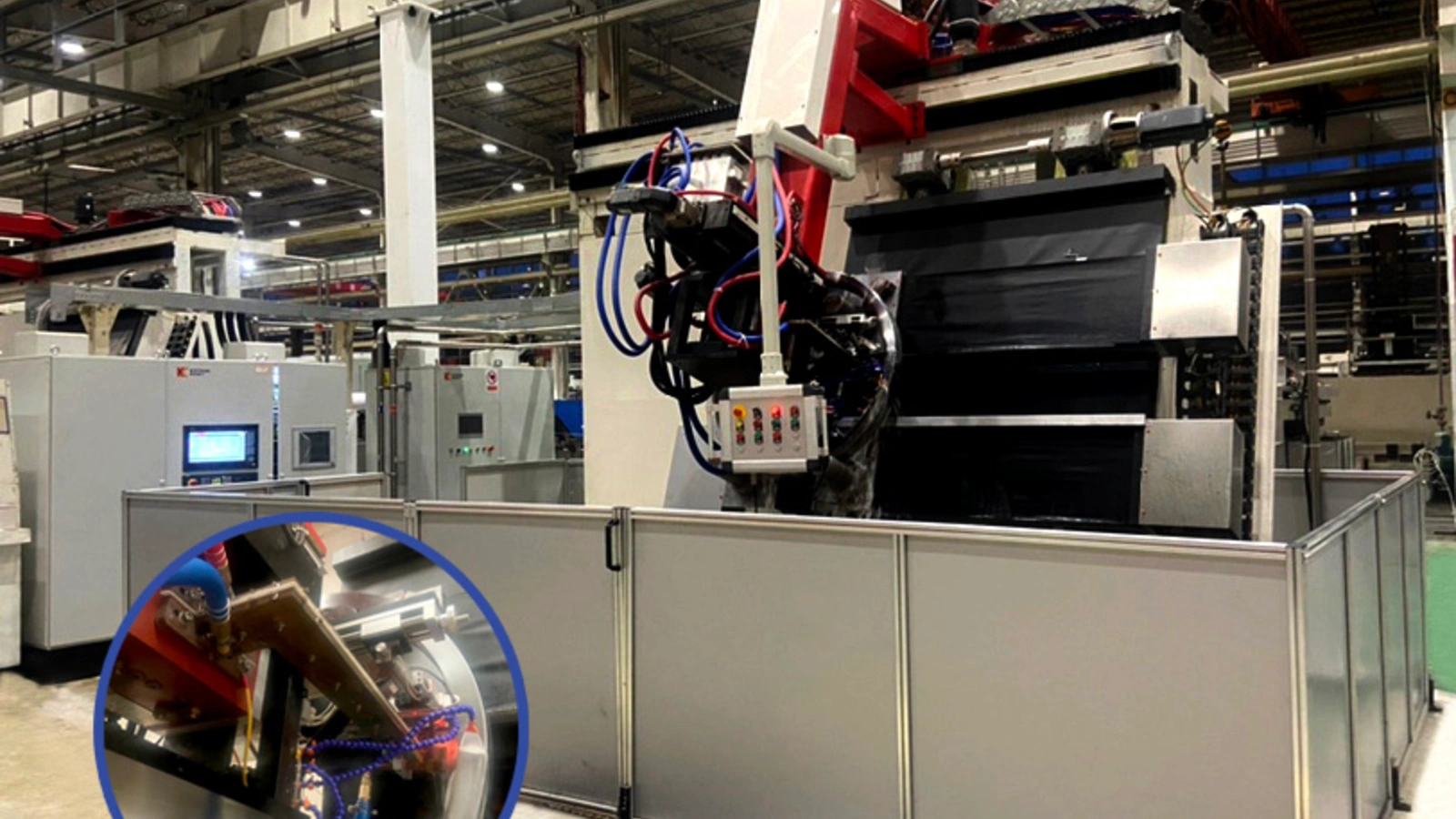
Continuous quenching line in operation
3. What Should You Consider When Choosing an Induction Power Supply?
Choosing the right power supply directly affects heating quality and production stability. Here are the key factors:
| Factor | What to Check |
|---|---|
| Power Level | Depends on workpiece size and cross-section. Larger-diameter parts need more power. Too low = incomplete heating. Too high = wasted energy, risk of overheating. |
| Frequency | Controls heating depth. Higher frequency = shallow heating (small parts, thin case). Lower frequency = deeper heating (large parts, deep case). Match frequency to the required case depth, not the part diameter. See our frequency classification guide. |
| Output Stability | Continuous operation demands stable output. Any fluctuation affects hardness consistency. Unlike batch processing, a continuous line may produce hundreds of bad parts before drift is detected. |
| Duty Cycle | This machine runs true continuous duty—no gaps between parts, no cooldown window. The duty cycle rating must hold at your shop’s actual summer ambient temperature, not just lab conditions. |
| Cooling System | Continuous operation = continuous heat. Most systems need water cooling to stay stable over long cycles. Size the chiller for sustained heat rejection, not peak rating. Our water cooling guide covers sizing. |
| Automation | Modern lines use PLC or CNC control. The power supply must support external control—remote start/stop, power adjustment, and interlock signals—to integrate smoothly with the production line. |
4. Typical Applications
Inclined channel quenching systems are used across many industries where cylindrical parts need consistent surface hardness:
| Industry | Typical Parts |
|---|---|
| Automotive | Axle shafts, input shafts, output shafts |
| Conveyor & Material Handling | High-wear rollers for mining and logistics |
| Agricultural Machinery | PTO shafts, tillage components, hydraulic rods |
| Bearing Manufacturing | Inner and outer races |
| Transmission & Powertrain | Gear shafts, layshafts, pinion shafts |
All of these applications demand repeatable hardness within a tight tolerance across thousands of parts. See our shaft hardening challenges article for more on this topic.
5. Common Selection Mistakes
| Mistake | Consequence |
|---|---|
| Choosing frequency by part diameter instead of case depth | Case too shallow = under-spec hardness. Case too deep = brittle surface, core property loss. |
| Using an intermittent-duty supply on a continuous line | Thermal trip mid-shift. Every part in the channel at that moment is scrap or needs rework. |
| Mismatching coil impedance to power supply output | Power reflected back to the supply, low efficiency, component overheating. |
| Treating the power supply as a standalone purchase | No PLC communication = manual power adjustments every time line speed changes. |
6. Simple Selection Checklist
Before choosing a power supply, confirm the following:
| Check | Why It Matters |
|---|---|
| Workpiece material | Steel grade affects power absorption and required heating rate. |
| Workpiece size | Diameter and cross-section determine power and frequency needs. |
| Required hardness depth | Drives frequency selection more than any other factor. |
| Production speed | Parts per hour determines dwell time and power per part. |
| Automation level | PLC/CNC interface requirements must be known before ordering. |
| Cooling conditions | Chiller capacity and ambient temperature affect usable duty cycle. |
Key Takeaway
An inclined channel quenching machine requires a stable, well-matched induction power supply. The three non-negotiables: output stability across a full shift, true continuous duty cycle at real factory temperatures, and automation compatibility with the line PLC. Match frequency to case depth, pair the coil with the supply, and size cooling for the long run. See our power selection guide for more on sizing.
Frequently Asked Questions
Can one power supply handle multiple part diameters on the same line?
Yes, if the supply’s power and frequency range covers all parts the line will run. Changeover is managed through stored recipe profiles. If the part range is extreme, two dedicated supplies may be more practical than a single compromised unit.
What happens if the power supply trips during continuous production?
Every workpiece in the heating zone at that moment is partially heated and unquenched—they must be segregated, inspected, and reworked or scrapped. The real cost is the production downtime: one mid-shift trip often costs more than the price difference between an adequate supply and a marginal one.
How do I synchronize power output with conveyor speed changes?
The line PLC sends an analog signal (0–10V or 4–20 mA) proportional to speed, and the power supply scales its output in real time. This is one of the strongest arguments for choosing a supply with industrial automation interfaces over a manual-control unit.
Need a Power Supply for Your Channel Quenching Line?
Share your part geometry, case depth requirements, and production rate—we’ll recommend an induction power supply and coil configuration matched to your line.