Chain Pin End Induction Hardening with Direct Water Spray Quenching
Ⅰ. Chain Pin End Induction Hardening in Operation
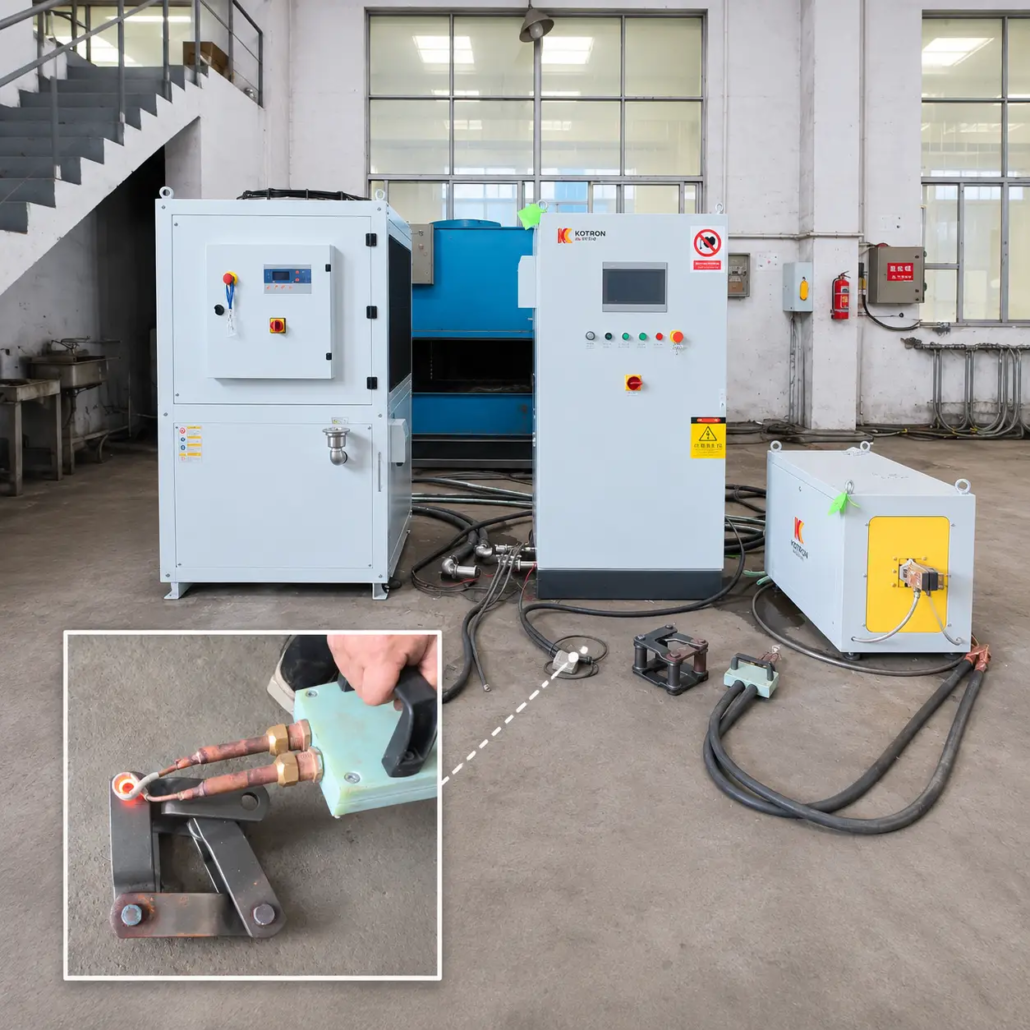
The application demonstrates localized induction hardening of a connecting pin within a steel chain link assembly.
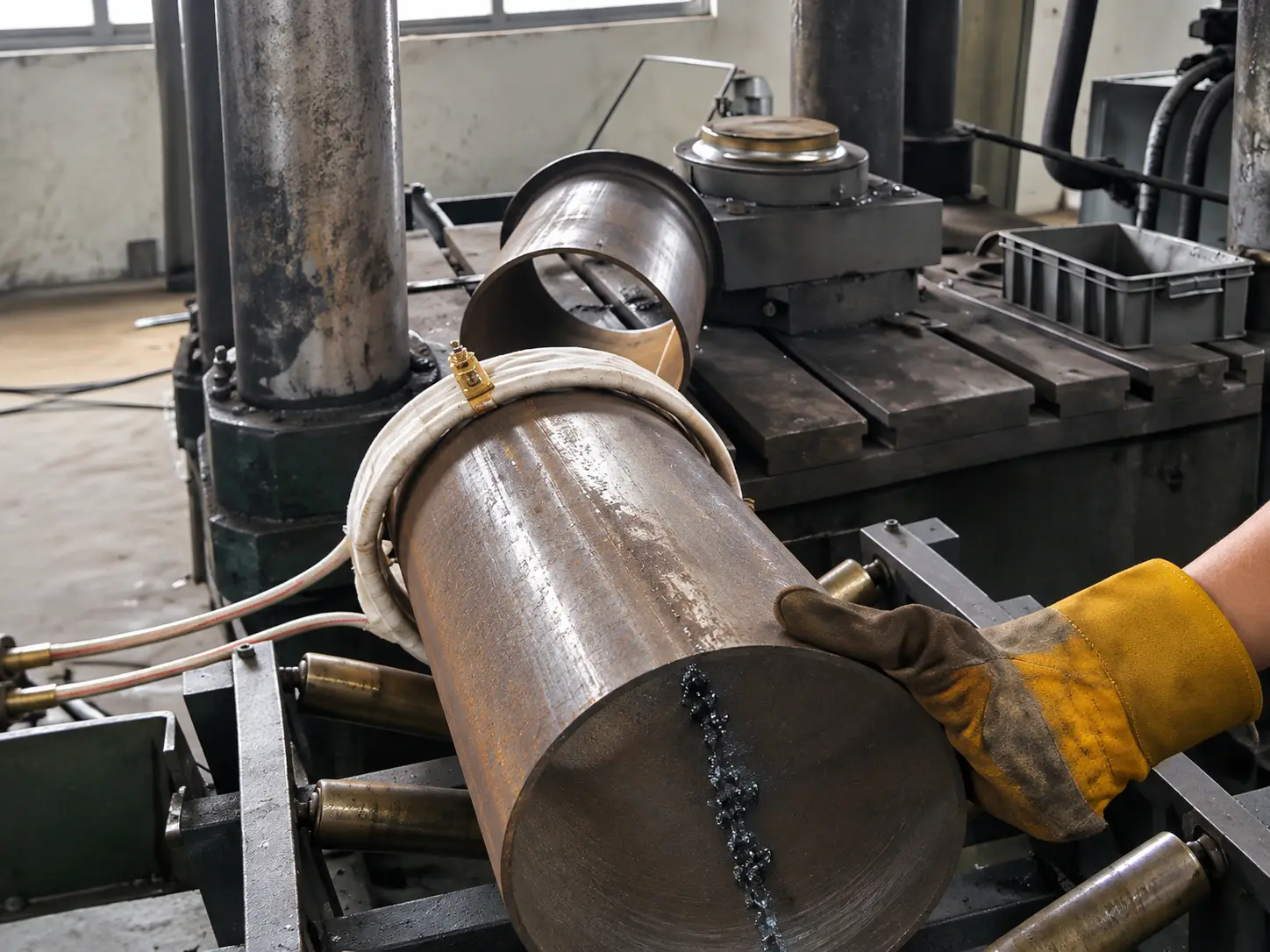
During operation, the operator holds the induction heating head and positions its coil around the exposed end of the installed chain pin.
The coil concentrates the heating process on the selected pin-end area rather than heating the entire chain link assembly.
Once the required heating condition is reached, water is applied directly to the heated area to complete the quenching stage.
The demonstrated process involves three main operations:
•Positioning the handheld induction coil around the exposed chain pin end
•Applying localized induction heating to the selected area
•Spraying water directly onto the heated region for quenching
This arrangement provides a practical method for localized heat treatment when the required hardening area is limited to a specific section of an assembled metal component.
Ⅱ. Localized Hardening of an Installed Chain Pin
The workpiece shown in this application consists of a steel chain link assembly with an inserted connecting pin.
The connecting pin is positioned within the joint structure, and its exposed end is the target area for induction heating.
This distinction is important because the process is not intended to heat the entire chain plate or the complete connecting pin uniformly.
Chain Pin Positioning
The pin is already inserted into the chain link assembly during the demonstrated operation.
The induction heating head is positioned around the exposed end, allowing the operator to concentrate the heating action on the required region.
The relationship between the pin and surrounding chain components must be considered when designing the induction coil.
Localized Treatment Area
The dimensions of the exposed pin end, the surrounding chain plate geometry and the required hardened area all influence the coil design and heating conditions.
The objective is to achieve the specified localized hardening result while limiting unnecessary heating of adjacent components.
For similar applications, the actual treatment area should be established according to the workpiece drawing and heat treatment requirements.
Ⅲ. Handheld Induction Heating and Direct Water Spray Quenching
The main feature of this application is the combination of localized induction heating and direct water spray quenching.
Both operations are important in determining the final heat treatment result.
Localized Induction Heating
The operator positions the handheld induction coil around the exposed end of the chain pin.
When the induction power supply is activated, electromagnetic induction generates heat within the electrically conductive workpiece.
Heating is concentrated around the selected pin-end region.
The required heating conditions depend on several factors, including:
— Chain pin material and initial condition
— Pin diameter and end geometry
— Required hardened area
— Target surface hardness
— Required effective hardening depth
Coil dimensions, power output and heating duration need to be matched to the specific workpiece and process requirements.
Direct Water Spray Quenching
After the heating stage, water is sprayed directly onto the heated pin-end area.
This cooling operation forms the quenching stage of the process.
The water spray arrangement and cooling conditions need to be suitable for the workpiece material and required hardening results.
For localized treatment, particular attention should be paid to the relationship between the heating area and the subsequent quenching area.
Heating and cooling conditions should be evaluated together during process development to achieve the specified surface hardness and hardened layer characteristics.
Process Inspection
For a production application, the resulting heat treatment should be evaluated against the customer’s requirements.
Relevant inspection items may include:
— Surface hardness at the specified location
— Effective hardened case depth
— Hardening area and coverage
— Condition of adjacent components
— Dimensional requirements after treatment
The actual inspection criteria depend on the chain pin design and application.
Ⅳ. Induction Heating Equipment and Handheld Coil Arrangement
The application uses a KECHUANG induction heating system configured for localized treatment of chain pins.
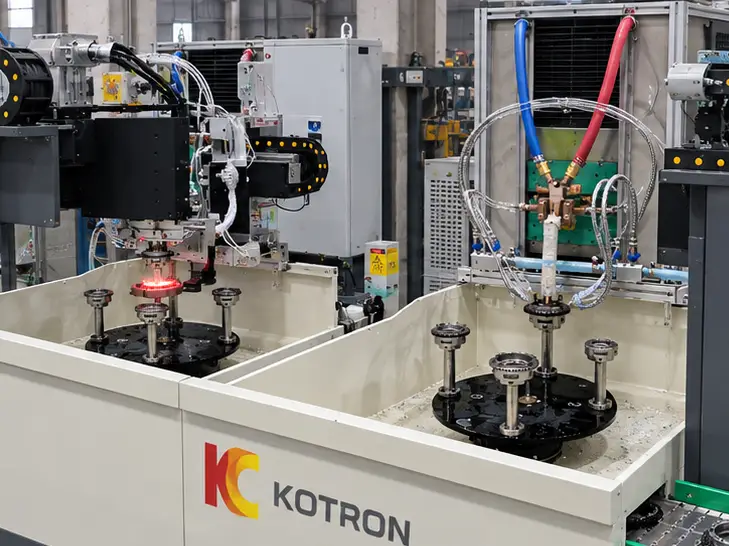
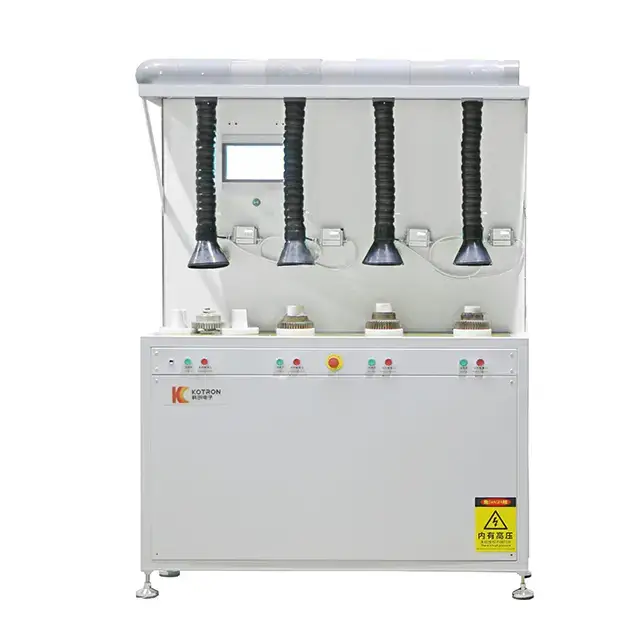
The complete equipment setup includes an induction heating power supply cabinet, supporting cooling equipment, an auxiliary equipment unit and a handheld induction heating assembly.
Induction Heating Power Supply
The central KOTRON cabinet serves as the induction heating power supply and control unit.
It provides the electrical power required by the induction heating assembly and allows the operator to control the heating operation.
Supporting Cooling Equipment
The equipment setup includes a separate cooling unit connected to the induction heating system.
Its function is to support the cooling requirements of the equipment during operation.
This equipment cooling circuit is distinct from the direct water spray applied to the chain pin during the quenching stage.
Handheld Induction Heating Head
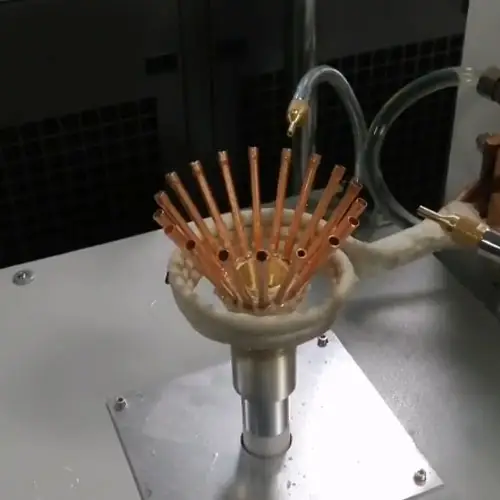
The handheld heating head is the main processing component used in this application.
It is connected to the power supply through the associated cables and water connections.
The operator can position the induction coil around the selected pin end without requiring the complete chain link assembly to be loaded into a large automated hardening machine.
The coil geometry is designed according to the pin dimensions and the required heating area.
Complete Equipment Configuration
The power supply, supporting cooling equipment, auxiliary unit and handheld heating assembly work together to provide the required heating setup.
This configuration is suitable for applications where localized treatment and flexible positioning of the induction coil are required.
Ⅴ. Customized Chain Pin End Induction Hardening Solutions
Different chain pin designs may require different localized hardening arrangements.
The appropriate induction heating system depends on the pin geometry, material, required treatment area and production conditions.
For a similar chain pin hardening application, KECHUANG evaluates the following information:
Workpiece Information
— Chain pin drawings or actual workpiece photos
— Pin diameter and exposed end dimensions
— Chain link assembly structure
— Workpiece material and initial heat treatment condition
Heat Treatment Requirements
— Required hardening location
— Target surface hardness
— Required effective hardening depth
— Specified hardening area
— Quenching requirements
Production Requirements
— Number of workpieces to be processed
— Expected production volume
— Manual or automated operation requirements
— Available installation space
Based on these details, the induction coil, power supply configuration and cooling arrangement can be evaluated for the intended application.
Frequently Asked Questions
Click a question to expand the answer.
Contact KECHUANG for a Customized Induction Heating Solution
If you need localized induction hardening for chain pins or similar assembled metal components, send us your workpiece drawings or photos together with the required heat treatment specifications. KECHUANG can evaluate the induction heating arrangement and develop a suitable solution based on your workpiece and production requirements.