
Common Heat Treatment Methods for Cast Alloys
Cast alloys respond differently to heat treatment because their microstructures and strengthening mechanisms are not the same. Cast steel, aluminum alloys, cast iron and copper alloys therefore require different treatment routes.
Ⅰ. Why Are Castings Heat Treated?
Ⅱ. Heat Treatment of Cast Steel
Ⅲ. Heat Treatment of Cast Aluminum Alloys
Ⅳ. Heat Treatment of Cast Iron
Ⅴ. Heat Treatment of Cast Copper Alloys
Ⅰ. Why Are Castings Heat Treated?
Heat treatment of cast alloys is commonly used to relieve residual stress, improve dimensional stability and machinability, refine the matrix structure, or increase strength, toughness and wear resistance.
The required treatment depends first on the alloy.
Steel castings can undergo phase transformations during heating and cooling, making annealing, normalizing and quenching and tempering practical. Heat-treatable aluminum castings rely mainly on solution treatment and precipitation hardening. Cast iron is strongly influenced by graphite morphology and matrix structure, while copper alloys vary considerably with composition.
A heat-treatment schedule should therefore be based on the actual material grade and required properties, not simply on the fact that the component is a casting.
Ⅱ. Heat Treatment of Cast Steel
Cast steel heat treatment is often used to refine the relatively coarse as-cast structure, reduce residual stress or obtain a better combination of strength and toughness.
-
Annealing
Commonly selected when lower hardness and improved machinability are required. The casting is heated into the appropriate temperature range and then cooled slowly, usually in the furnace. For many carbon and low-alloy cast steels, annealing temperatures are in the upper 800°C range, although the exact value depends on composition.
-
Normalizing
Also widely used for steel castings. The part is heated above its transformation range and then cooled in air. Compared with full annealing, normalizing generally produces a finer structure and somewhat higher strength.
-
Quenching and Tempering
For components exposed to heavier mechanical loading, quenching and tempering may be used. The casting is austenitized, quenched in a suitable medium and then tempered to obtain the required balance between strength and toughness.
The final process depends on more than material grade. Section thickness, quenching severity and the required mechanical properties also influence the treatment.
Ⅲ. Heat Treatment of Cast Aluminum Alloys
Aluminum casting heat treatment follows a different strengthening mechanism from steel. These alloys are not strengthened here by martensitic transformation; instead, heat-treatable grades gain strength mainly through precipitation hardening.
For many Al-Si-Mg casting alloys, the basic route is:
→
Quenching
→
Aging
During solution treatment, soluble alloying elements enter the aluminum matrix. Rapid cooling retains a supersaturated solid solution, while subsequent aging develops strengthening precipitates.
T4
Generally consists of solution heat treatment, quenching and natural aging. It is often used where relatively good ductility is required.
T5
Does not normally include a separate solution-treatment step. The casting is cooled from an elevated-temperature shaping or casting process and then artificially aged.
T6
Consists of solution heat treatment, quenching and artificial aging. For some Al-Si-Mg casting alloys, solution treatment may take place around the mid-500°C range, followed by quenching and artificial aging at a substantially lower temperature.
T6 is widely used where higher strength and hardness are required.
High-pressure die castings need additional caution. Gas trapped during casting may expand during high-temperature solution treatment and cause blistering or dimensional problems, so conventional T6 treatment is not suitable for every die-cast component.
Ⅳ. Heat Treatment of Cast Iron
Cast iron heat treatment varies significantly with graphite form and matrix structure.
Gray Cast Iron
Stress-relief annealing is common where dimensional stability is important. Treatment around 500–550°C is often used to reduce residual casting stress without substantially changing the basic structure.
Higher-temperature graphitizing treatment may be used where hard carbides or local white-iron structures need to be reduced to improve machinability.
Gray cast iron is not normally through-hardened in the same way as steel. Suitable grades, however, can receive localized surface hardening when greater wear resistance is required.
Ductile Iron
Offers a broader range of heat treatments, including ferritizing annealing, normalizing, stress relief, quenching and tempering, austempering and surface hardening.
Austempered ductile iron, or ADI, develops an ausferritic structure consisting mainly of acicular ferrite and carbon-enriched retained austenite. It should not simply be described as conventional lower bainite.
Compacted Graphite Iron
Commonly treated for stress relief or matrix control. More intensive strengthening treatments are generally less common than in ductile iron, although the final route still depends on the grade and component requirements.
For localized hardening specifically, see our separate guide to induction hardening of cast iron.
Ⅴ. Heat Treatment of Cast Copper Alloys
Cast copper alloys cannot be treated as one single heat-treatment family. Tin bronze, phosphor bronze, brass and aluminum bronze have different phase systems and therefore respond differently to heating.
For many cast bronzes, heat treatment is used mainly for stress relief or structural stabilization rather than steel-like quench hardening. This is common in bushings, bearing components, valves and other cast bronze parts.
Some brass components may also receive stress-relief treatment where residual stresses could contribute to dimensional changes or stress-corrosion cracking. The required treatment depends on alloy composition and service conditions rather than one universal temperature.
Aluminum Bronze
Aluminum bronze is different. Certain grades can respond to solution treatment followed by quenching and subsequent strengthening treatment. These alloys are often selected where strength, wear resistance and corrosion resistance are required.
Because copper-alloy families differ so widely, heat-treatment temperatures should always follow the specific alloy grade or process specification.
Ⅵ. Where Does Induction Heating Fit?
Most whole-part casting heat treatments remain furnace processes.
Full annealing, normalizing, aluminum solution treatment and long stress-relief cycles generally require the complete component to remain at a controlled temperature for a specified period. A furnace is usually better suited to this type of treatment.
Induction heating becomes more relevant when the required treatment is localized.
Typical examples include:
A cast steel roller, for example, may require higher hardness only on its working surface. A ductile-iron gear may require hardened teeth while retaining different properties in the core.
In these situations, induction heating can concentrate energy in the required region instead of heating the entire casting.
It is therefore better viewed as a complementary heat-treatment method rather than a general replacement for furnace treatment.
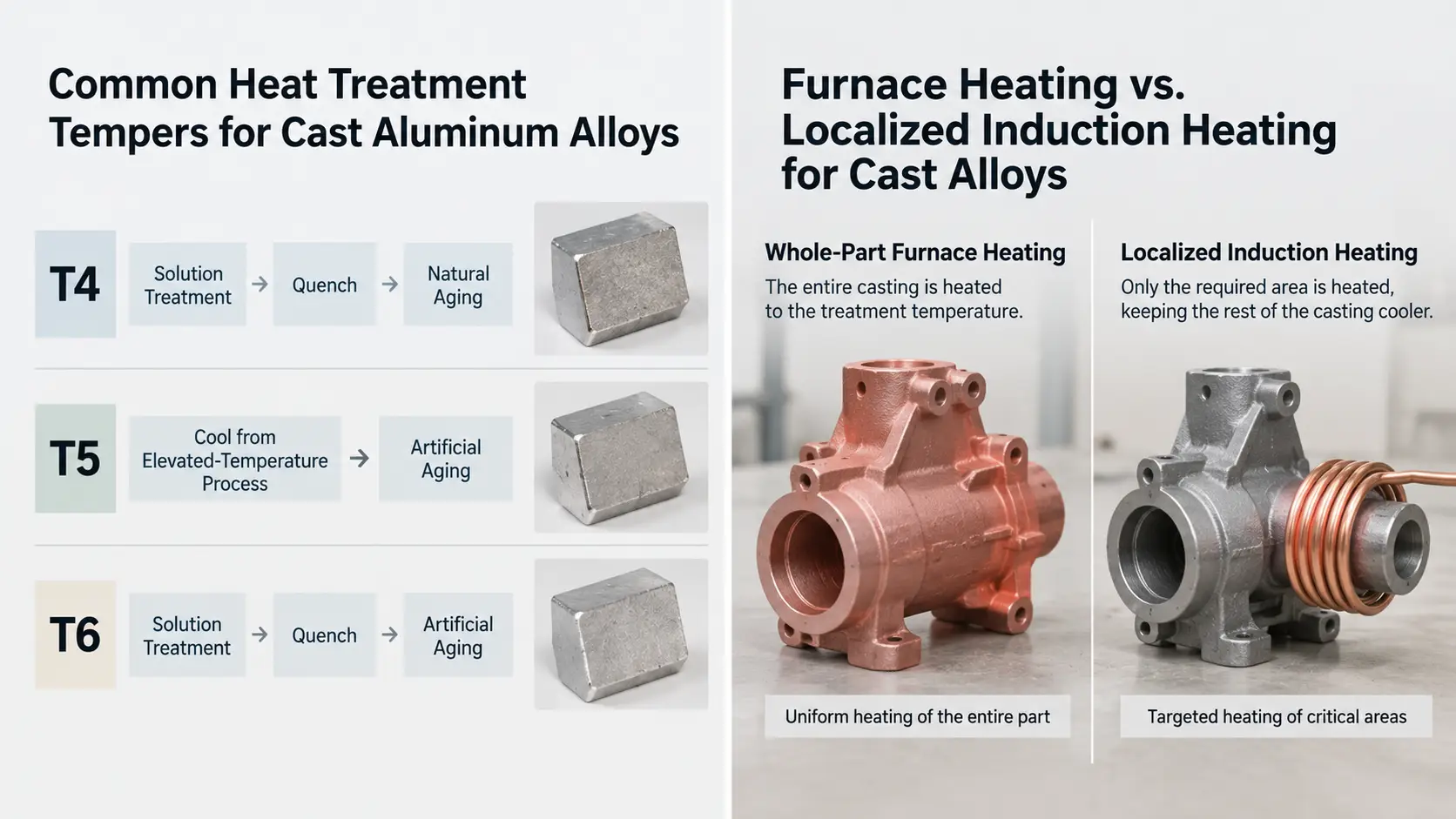
Furnace heating vs. localized induction heating for cast alloys.
Ⅶ. Typical Heat Treatment Routes for Different Cast Alloys
| Material | Main Purpose | Common Treatments |
|---|---|---|
| Cast steel | Structure refinement, machinability, strength and toughness | Annealing, normalizing, quenching and tempering |
| Cast aluminum | Precipitation strengthening | T4, T5, T6 |
| Gray cast iron | Stress relief, machinability, local wear resistance | Stress relief, graphitizing, selected surface hardening |
| Ductile iron | Matrix control, strength, toughness and wear resistance | Annealing, normalizing, austempering, Q&T, surface hardening |
| Cast copper alloys | Stress relief or alloy-specific strengthening | Stress relief and alloy-specific strengthening treatments |
The key point is that heat treatment should follow the alloy and the property that needs to change. Whole-part structural changes are usually handled by furnace treatment, while localized methods such as induction heating become more relevant when only a selected working surface or area needs to be modified.
Key Takeaway
Heat treatment of cast alloys is not a single process — the route follows the alloy and the property that needs to change. Whole-part structural changes such as annealing, normalizing and solution treatment are usually furnace work, while induction heating becomes the practical choice when only a selected surface or area needs treatment.
Frequently Asked Questions
Click a question to expand the answer.
Can induction heating replace furnace heat treatment for castings?
Not for most whole-part treatments. Annealing, normalizing, aluminum solution treatment and long stress-relief cycles need the entire casting held at a controlled temperature, which favors a furnace. Induction becomes relevant for localized work such as surface hardening, local tempering or selected-area heating.
Why is T6 treatment not suitable for every aluminum die casting?
Gas trapped during high-pressure die casting can expand during high-temperature solution treatment and cause blistering or dimensional problems. Conventional T6 is therefore not suitable for every die-cast component.
What heat treatment does gray cast iron typically need?
Stress-relief annealing around 500–550°C is common when dimensional stability matters, reducing residual casting stress without changing the basic structure. Higher-temperature graphitizing can improve machinability where hard carbides or white-iron structures are present.
Discuss Your Cast-Alloy Heat Treatment Application
Send us your material grade, part drawing and required properties. We can advise whether furnace or localized induction treatment fits your process.


