
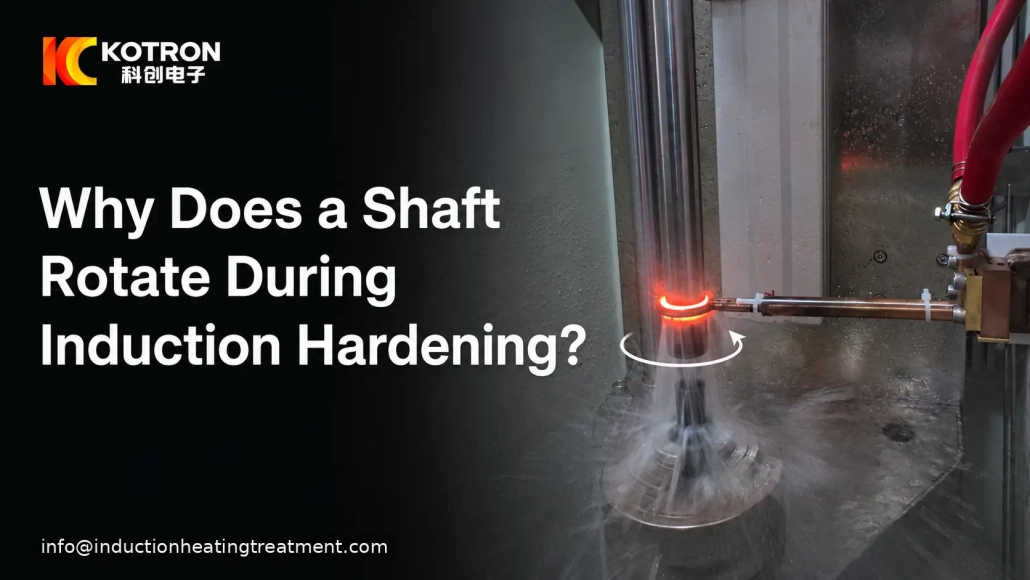
Why Does a Shaft Rotate During Induction Hardening?
During shaft scan hardening, the workpiece often rotates while moving through the induction coil. These two movements are not doing the same job.
Rotation mainly helps improve heating uniformity around the shaft circumference, while vertical travel moves the heating zone along the shaft length. The exact movement strategy still depends on the workpiece, inductor design and quenching process.
| Rotation Improves Circumferential Heating Uniformity | Rotation and Vertical Travel Do Different Jobs |
| Can a Shaft Rotate Too Slowly or Too Fast? | Does Every Shaft Need to Rotate? |
Ⅰ. Rotation Improves Circumferential Heating Uniformity
A ring-shaped induction coil surrounds the shaft, but this does not automatically mean that heating will be perfectly identical at every point around the circumference.
In practical induction hardening, the relationship between the workpiece and the inductor affects the heating pattern. Rotating the shaft allows different circumferential positions to repeatedly pass through the induction field.
For scan hardening, this helps average the heating around the shaft and produce a more uniform hardened case.
This is why shaft rotation is commonly combined with a ring-type inductor when a consistent circumferential hardening pattern is required. Radyne specifically describes shaft rotation as often necessary where a completely uniform case is required during progressive induction hardening.
Ⅱ. Rotation and Vertical Travel Do Different Jobs
On the vertical shaft-hardening process shown here, the workpiece rotates while moving upward through the induction coil.
The movements act in two different directions:
Rotation → around the circumference
Vertical travel → along the shaft length
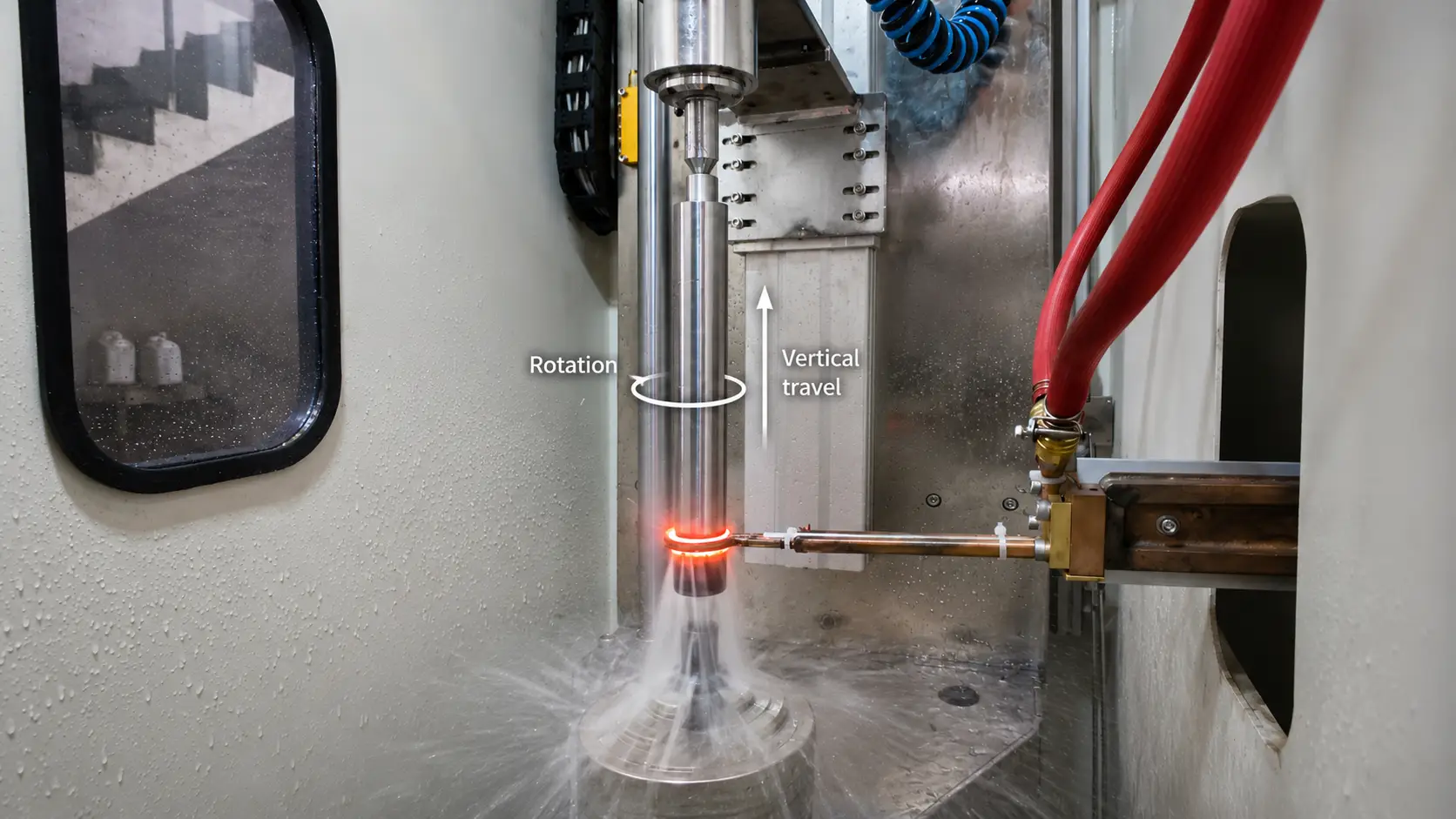
Rotation helps control circumferential uniformity, while vertical travel carries the heating zone along the shaft.
As the workpiece travels through the inductor, only a limited section is being actively heated at one time. The scan movement therefore determines how the hardened zone progresses along the shaft.
Your final hardened pattern is not determined by either movement alone. Power, frequency, scan speed, rotation, inductor design and quenching work together.
The vertical CNC machine used in our shaft-hardening application is a workpiece-moving design with a spindle rotation system and controlled vertical feed, which matches this type of process arrangement.
Ⅲ. Can a Shaft Rotate Too Slowly or Too Fast?
More rotational speed is not automatically better.
If a process relies on rotation for circumferential uniformity, insufficient rotation may not provide the averaging effect required during the heating cycle.
At the other extreme, high rotational speed can create a different problem: the moving workpiece can affect how the quenching liquid reaches the surface.
Inductoheat notes that higher rotational speed can improve circumferential heating uniformity, but excessive speed may deflect the quenchant and reduce cooling effectiveness in some areas, particularly around changes in shaft diameter. This can contribute to locally reduced hardness.
This is why there is no single RPM that is correct for every shaft.
Rotation speed has to be established together with the workpiece geometry, scan speed, inductor design and quenching arrangement.
Ⅳ. Does Every Shaft Need to Rotate?
No.
Rotation is common in conventional shaft scan hardening, but it is not a universal requirement of induction hardening.
Some processes achieve the required heating pattern through a different inductor design instead of rotating the workpiece.
A clear example is Inductoheat’s CamPro system for camshaft hardening. Its stationary SHarP-C process is specifically designed to eliminate workpiece rotation during induction heat treatment.
This is an important distinction.
The correct question is not:
“Should every shaft rotate?”
It is:
“What combination of workpiece movement and inductor design produces the required hardening pattern?”
For conventional cylindrical shaft scan hardening, rotation is often used to improve circumferential uniformity, while scanning controls the hardened zone along the shaft length.
Other workpieces may require a different approach.
Related equipment: CNC Shaft Induction Hardening Machine
Key Takeaway
During induction hardening, shaft rotation averages heating around the circumference, while vertical travel carries the hardened zone along the shaft. The two movements do different jobs. Speed must be set together with scan speed, inductor design and quenching — and not every shaft needs to rotate at all.
Frequently Asked Questions
Click a question to expand the answer.
Does every shaft need to rotate during induction hardening?
No. Rotation is common in conventional shaft scan hardening but is not a universal requirement. Some processes, like Inductoheat’s CamPro camshaft system, are designed to eliminate workpiece rotation through a different inductor design.
What happens if a shaft rotates too slowly?
If the process relies on rotation for circumferential uniformity, insufficient rotation may not provide the averaging effect required during the heating cycle, leaving an uneven hardened case.
Can rotation speed be too high?
Yes. Excessive speed can deflect the quenchant and reduce cooling effectiveness in some areas, particularly around changes in shaft diameter, contributing to locally reduced hardness.
What determines the final hardened pattern?
Power, frequency, scan speed, rotation, inductor design and quenching all work together. Neither rotation nor vertical travel alone determines the final hardened pattern.
Select the Right Movement Strategy for Your Shaft
Send your shaft drawing and hardening requirements. We will match rotation, scan movement, inductor design and quenching to your part.


