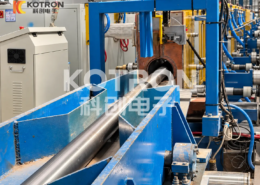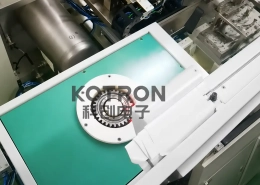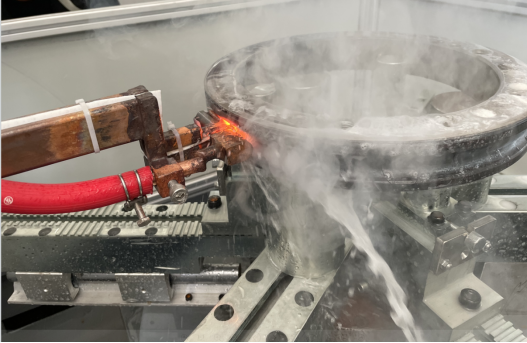
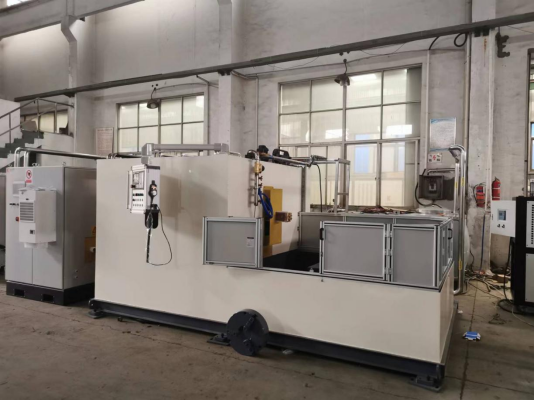
Gantry Dual-Station Slewing Bearing Internal Gear Induction Hardening Machine
I.Two Hardening Requirements for Slewing Bearings
Gear Tooth Scan Hardening
Gear teeth are subjected to continuous meshing and heavy loads, making surface hardness and dimensional accuracy critical.
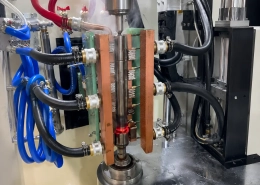
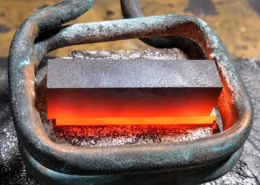
This machine supports scan hardening of both internal and external gears through precise CNC positioning and customized induction coils. The scanning process provides consistent case depth while minimizing thermal distortion, making it suitable for demanding applications in wind power, construction machinery, and heavy equipment.
Key Benefits
-
Suitable for internal and external gears – The same machine handles both gear types with minimal adjustment, so you don’t need separate equipment for ring gears versus pinions or sun gears.
-
Precise tooth profile scan hardening – The induction head follows the actual tooth contour, heating the root, flank, and tip exactly where needed, without oversoaking adjacent areas.
-
Uniform case depth – Consistent heating and quenching produce a hardened layer that stays even across the entire gear, eliminating shallow spots that could become early failure points.
-
High wear resistance – The resulting metallurgical structure gives the teeth a tough, durable surface that withstands abrasive wear and rolling contact fatigue over millions of cycles.
-
Minimal distortion – Because the process is tightly controlled, thermal expansion and contraction are kept within narrow limits, often reducing the need for post‑heat straightening or grinding.
-
Stable production quality – With repeatable positioning and real‑time feedback, you get the same results from the first part to the thousandth, making quality control straightforward and predictable.
Raceway Scan Hardening
Raceways require a continuous hardened track to withstand rolling contact fatigue generated by rolling elements.
The machine performs continuous circumferential induction scan hardening to achieve uniform hardness distribution and excellent metallurgical consistency across the raceway surface.
Key Benefits
-
Suitable for inner and outer raceways – The same setup works for both ring types without reconfiguring the coil or fixturing, simplifying your changeover between different bearing designs.
-
Continuous scan hardening – The induction head moves steadily along the raceway surface, producing a smooth, uninterrupted hardened band with no start‑stop marks or uneven transitions.
-
Uniform hardness distribution – The scan speed and power are tightly regulated, so the hardness level stays consistent across the entire circumference, avoiding soft zones that could shorten bearing life.
-
Improved rolling fatigue resistance – The controlled case structure resists spalling and pitting under repeated rolling contact, giving the raceway a longer service life even in high‑load applications.
-
Stable heat treatment quality – Process parameters are automatically held within tight tolerances, so every raceway comes out with the same metallurgical properties, batch after batch.
-
Excellent process repeatability – Once a recipe is established, the machine reproduces it with minimal variation, making it easy to maintain quality standards across multiple production runs.
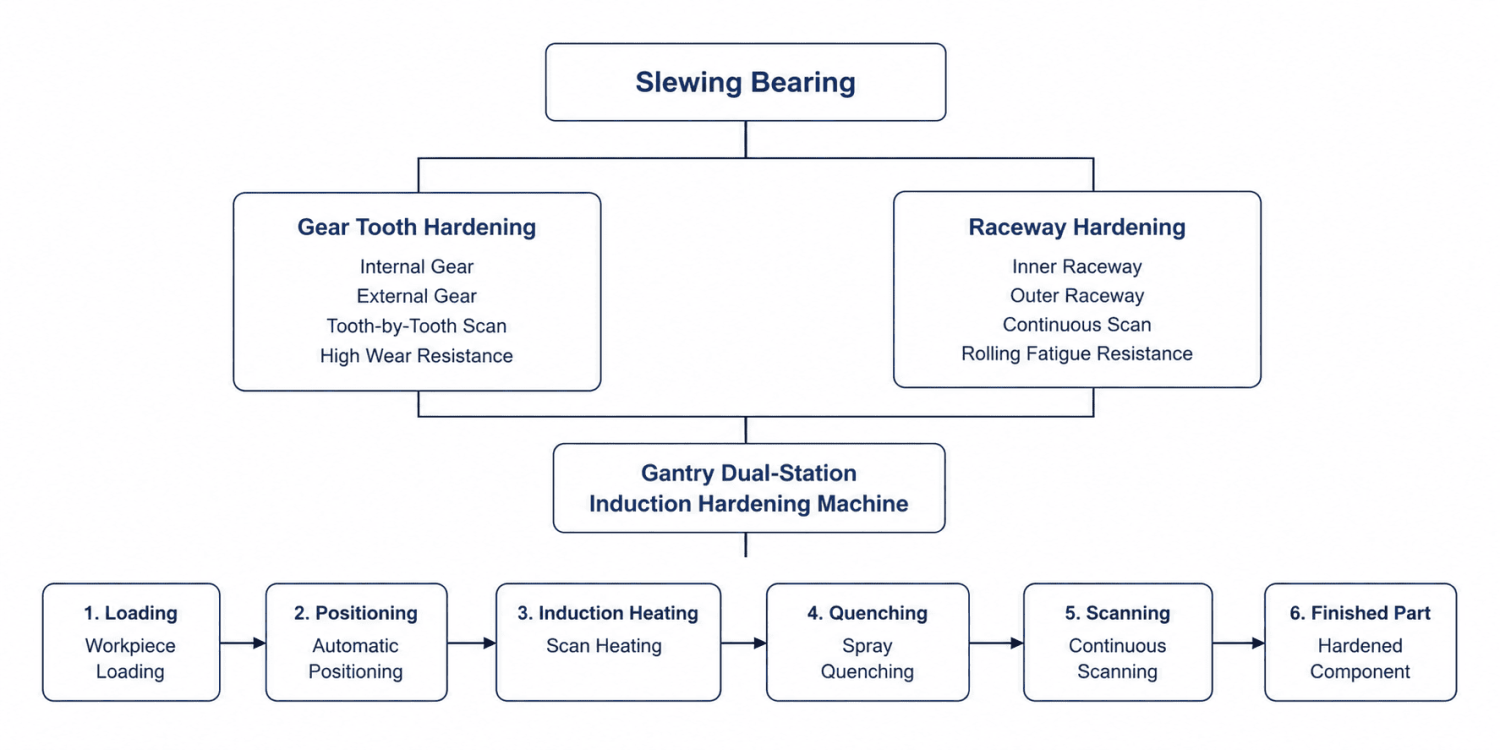
II. Process
III.Intelligent Quality Monitoring
To ensure consistent hardening quality, the machine integrates an intelligent process monitoring system capable of recording and analyzing the complete heat treatment cycle.
Real-time process data, including power, frequency, current, temperature, cooling water parameters, and quenching conditions, can be continuously monitored and stored for quality control and traceability.
Monitoring Functions
-
Real‑time process monitoring – Key parameters such as power, frequency, scan speed, and coolant flow are tracked live on screen. Operators can see exactly what’s happening during every cycle, so they can spot deviations as they occur.
-
Standard process curve comparison – Each run is overlaid against a reference curve stored in the system. Any mismatch in heating or cooling profiles is highlighted immediately, making it easy to verify that the hardening pattern stays within spec.
-
Overheating and underheating alarms – The system triggers clear visual and audible alerts if temperatures drift outside the set window. This protects both the workpiece and the induction coil, preventing scrap before it happens.
-
Historical data storage – All process data for every part is automatically saved to the onboard memory. You can retrieve past cycles for review or analysis without manual record‑keeping.
-
Process traceability – Every workpiece is linked to its own process log, complete with timestamps and parameter sets. This gives you a clear chain of evidence for quality audits or customer inquiries.
-
Database management for production records – The built‑in database organises all your batches and makes searching easy. You can export reports, archive old jobs, or compare performance across different production periods with just a few clicks.
IV.Detailed Specifications
- Machine Parameters
- Structure: Gantry Type
- Control: Siemens 840DSL
- Power Supply: Digital DSP IGBT
- Working Station: Dual Station
- Heat Treatment Performance
- Surface Hardness: 50–60 HRC
- Case Depth: ≥2.2 mm
- Tooth Root Depth: ≥1.2 mm
- Applicable Module: 3–14
V.Typical Applications
The machine is widely used for induction hardening of large slewing bearings and ring components in industries including:
-
Wind turbine manufacturing – Main shaft bearings, yaw rings, and pitch bearings all demand deep, uniform hardening to cope with fluctuating wind loads and corrosive offshore environments. Our process ensures the raceways and gear teeth hold their hardness profile for decades of service, reducing the risk of premature failure in the field.
-
Construction machinery – Excavators, bulldozers, and wheel loaders depend on large slewing rings that take constant beating from digging, pushing, and lifting. The machine delivers a consistent case depth that resists pitting and wear, giving these rings the longevity needed for harsh job sites and tight maintenance schedules.
-
Mining equipment – Crushers, grinding mills, and heavy conveyor systems run around the clock under heavy shock loading and abrasive dust. Hardening these components properly means fewer unexpected breakdowns. Our system provides the penetration and uniformity that keep bearing surfaces intact even when the going gets rough.
-
Cranes and lifting equipment – Tower cranes, mobile cranes, and port‐side gantries all require smooth, reliable slewing motion. The gear teeth and raceways are hardened to maintain tight clearances and minimise wear over millions of rotation cycles. That translates into safer lifting, less downtime, and lower replacement costs over the crane’s lifetime.
-
Machine tools – Large rotary tables, indexing heads, and positioning rings need precise, stable gear hardening to preserve accuracy over years of high‐precision machining. Our machine’s fine positioning control and repeatability ensure that every tooth gets the same heat pattern, so the table indexes consistently, part after part.
-
Heavy industrial equipment – From steel mill roll necks to marine propulsion shaft bearings and paper machine drying cylinders, specialised ring components come in all shapes and sizes. The machine’s flexible inductor tooling and generous diameter capacity make it an ideal fit for these custom, high‐value workpieces, where hardening quality can make or break the entire assembly.
VI.Why Choose This Machine
-
Two hardening processes in one platform – gear tooth and raceway
Instead of buying separate machines for tooth flank hardening and raceway hardening, this single unit does both. You can switch between processes without unclamping the workpiece, which cuts down on material handling and eliminates the errors that come with repositioning. -
Handles large slewing bearings up to Ø6000 mm
Whether you’re working on wind turbine main bearings, heavy-duty rotary rings for excavators, or port machinery slewing bearings, this machine has the capacity to cover them. It accepts both thin-walled rings and thick cross‑section workpieces as long as they fall within the maximum diameter, so you’re not limited to a narrow product range. -
High positioning accuracy for consistent case depth and hardness
The slide ways are rigid, and the closed‑loop feedback system keeps the induction head repeatable to within ±0.1 mm. That translates into uniform hardening patterns from the first part to the hundredth, batch after batch. Scrap rates stay low even when you’re running high volumes. -
Flexible induction tooling for quick changeovers
We offer a range of interchangeable inductors and flux concentrators that suit different bore sizes, tooth profiles, and hardening zones. Changing over to a new workpiece takes only about ten minutes—just swap the tooling, call up the stored recipe, and you’re ready for the next job. This makes short runs and mixed production much more practical. -
Full digital monitoring with complete traceability
Every cycle is tracked in real time—power, frequency, coolant flow, heating duration, and more. The system logs all process data automatically and stores it in a searchable database. Later on, you can pull up reports for any production batch, which is invaluable for quality audits, process troubleshooting, or answering customer queries with hard evidence. -
Built for stable, efficient, around‑the‑clock production
The machine frame and moving components are designed with heavy‑duty margins, validated by FEA and fatigue testing. It holds up through double shifts—or even triple shifts—without frequent service interruptions. Add optional automation interfaces and built‑in self‑diagnostics, and you get a machine that keeps running reliably while delivering a strong return on investment over its lifetime.