
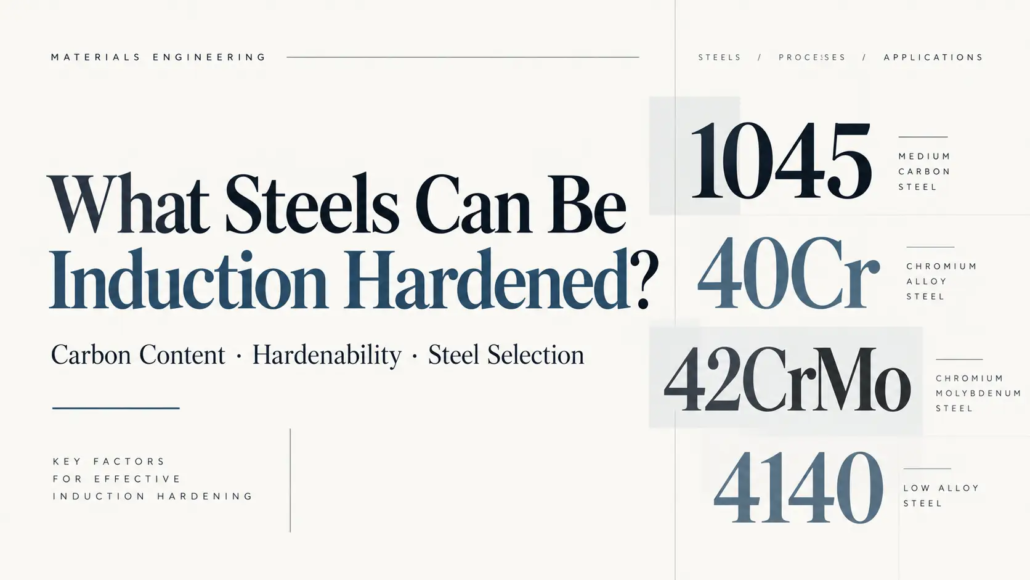
유도 경화가 가능한 강철? 탄소, 경화성 & 등급 안내
How Carbon Content, Hardenability and Steel Grade Affect Induction Hardening Suitability
Medium-carbon steels such as AISI 1045 and alloy steels such as AISI 4140 are common candidates for 인덕션 경화. 그러나, the ability to heat steel by induction does not mean it can achieve the required surface hardness and effective case depth after quenching.
Suitability depends on the steel’s carbon content, hardenability and initial microstructure, together with the heating and quenching conditions. The selected grade must meet the specified hardened-layer requirements while retaining the necessary core properties.
2. Why Carbon Content and Hardenability Are Different
3. How to Evaluate 1045, 40Cr, 42CrMo 및 4140
4. How to Confirm Whether a Steel Meets the Hardening Requirement
1. Which Steel Grades Are Commonly Induction Hardened?
유도 경화 is commonly used for medium-carbon and alloy steels that can form a sufficiently hard martensitic structure after localized austenitization and quenching.
Unlike carburizing, conventional induction hardening does not add carbon to the steel surface. The material must already have the carbon content needed to develop the specified hardness.
Medium-carbon steels
AISI 1045 is widely used for induction-hardened shafts, 핀, rollers and other mechanical components requiring a hard working surface.
C45 and Chinese 45 steel are closely related medium-carbon grades used for similar purposes. AISI 1050 and resulfurized grades such as 1144 are also found in induction-hardening applications, although their material characteristics and manufacturing tradeoffs differ.
These steels are often suitable for localized hardening, but the achievable hardness profile depends on more than the steel designation.
Alloy steels
Alloy steels such as AISI 4140, 4150, 40Cr and 42CrMo are also used for induction hardening.
Chromium, molybdenum and other alloying elements can increase hardenability, helping the steel develop martensitic hardening at greater depths under suitable heating and cooling conditions.
That advantage becomes relevant when the required hardness profile or component geometry makes the cooling response particularly important. It does not mean that an alloy steel is always preferable to a plain-carbon grade.
Low-carbon and high-carbon steels
Ordinary low-carbon steels generally have limited potential for high as-quenched martensitic hardness. They may respond to induction hardening but fail to meet a demanding surface-hardness requirement.
High-carbon steels offer greater hardness potential, although their processing can involve additional concerns related to toughness, retained austenite and quench cracking. Certain high-carbon and tool steels also require grade-specific austenitizing conditions.
The material choice should reflect the properties required of the finished component, rather than carbon content alone.
2. Why Carbon Content and Hardenability Are Different
Carbon content and hardenability are central to steel selection, but they describe different aspects of the hardening response.
Carbon content determines hardness potential
The carbon content of steel strongly influences the hardness of martensite formed during quenching. Within the relevant composition range, more carbon generally increases the potential as-quenched hardness.
This explains why AISI 1045 can develop considerably higher martensitic hardness than an ordinary low-carbon steel when both are properly austenitized and quenched.
Increasing induction power cannot make up for insufficient carbon in the material. If a steel lacks the composition needed for the specified hardness, a more aggressive heating cycle will not solve that limitation.
The actual measured hardness still depends on the microstructure produced during quenching and any subsequent tempering.
Hardenability influences how deeply the steel hardens
Hardenability describes a steel’s ability to form martensite under given cooling conditions. It is not a measure of maximum hardness.
Two grades with similar carbon contents may reach comparable surface hardness while developing different hardness profiles beneath the surface.
AISI 1045 and AISI 4140 illustrate this distinction. Their nominal carbon contents are broadly similar, but the chromium and molybdenum in 4140 generally provide greater hardenability.
Under appropriate conditions, this can help 4140 develop martensitic hardening farther below the surface.
유도 경화에서, 하지만, the steel must first be adequately austenitized at the depth where hardening is required. Greater hardenability cannot compensate for a heating cycle that never brings that region into the necessary austenitizing condition.
The final effective case depth depends on both the heated region and its transformation during quenching.
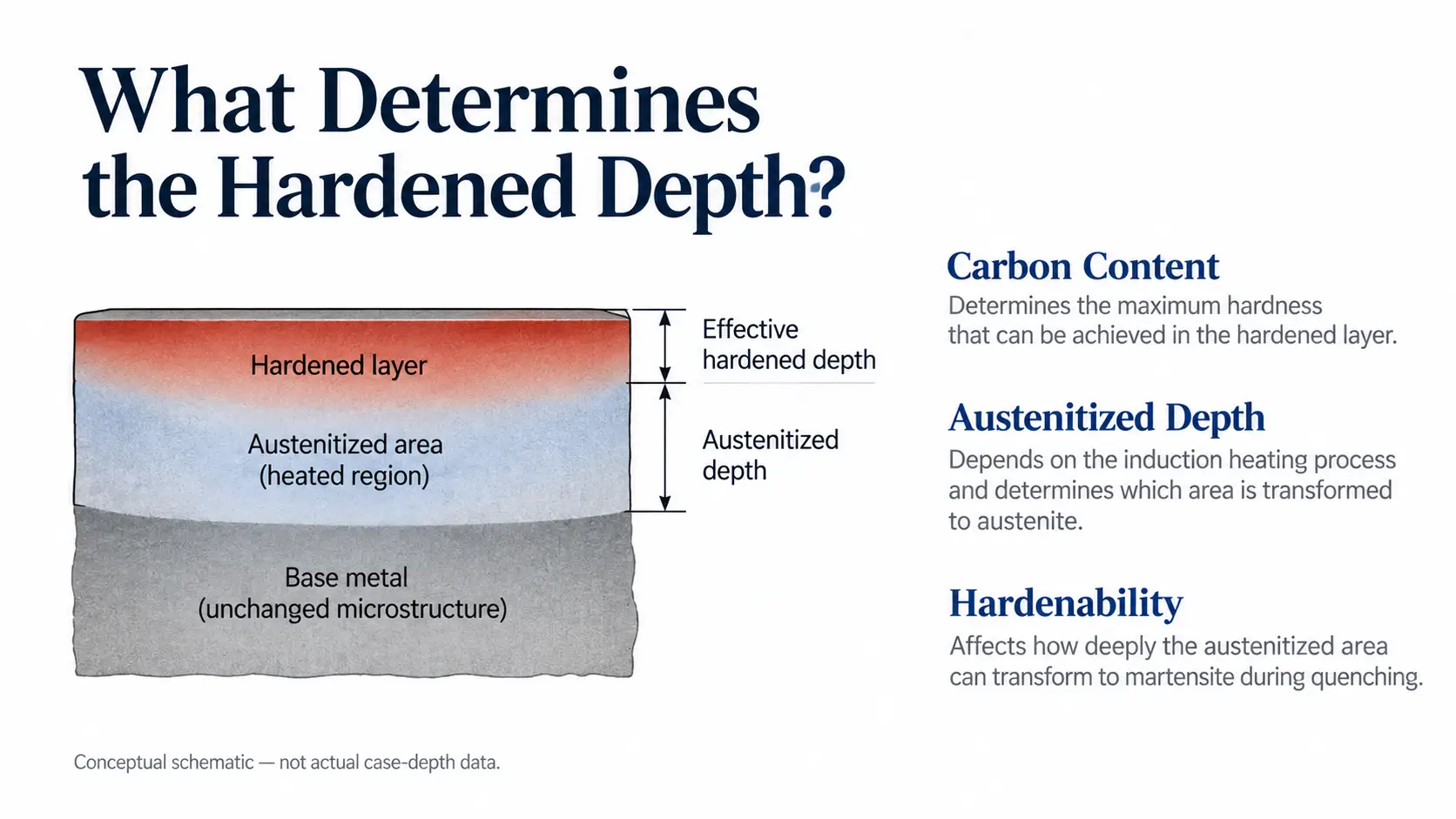
Factors that determine the effective case depth in induction hardening.
| 특성 | Main Influence | Practical Significance |
|---|---|---|
| Carbon content | Potential as-quenched martensitic hardness | Can the steel develop the required hardness? |
| 경화성 | Martensite formation under specified cooling conditions | Can the required hardness be maintained through the intended depth? |
| Austenitized depth | Region heated sufficiently for the necessary transformation | Has the intended region been prepared for hardening? |
| Quenching response | Microstructure formed during cooling | Does the heated region develop the required hardness profile? |
This distinction matters because a material change and a process adjustment solve different problems.
If surface hardness is limited by the steel’s carbon content, changing the heating pattern will not necessarily help. If the material has adequate hardness potential but the hardened layer is too shallow, the heating depth and quenching response need to be evaluated before selecting another grade.
3. How to Evaluate 1045, 40Cr, 42CrMo 및 4140
AISI 1045, 40Cr, 42CrMo and AISI 4140 are all established candidates for induction hardening. Choosing among them requires comparing their hardenability and mechanical properties against the actual part requirements.
Practical steel-grade comparison
| Steel Grade | When to Consider It | Main Selection Consideration |
|---|---|---|
| AISI 1045 / C45 / 45 강철 | A practical starting point for shafts, pins and other components requiring localized surface hardening | Adequate carbon for many surface-hardening applications, but relatively limited hardenability compared with many alloy steels |
| 40Cr | When chromium-alloy steel properties and increased hardenability are relevant to the component | Required hardness profile, core properties and incoming heat-treated condition |
| 42CrMo | When chromium-molybdenum steel is specified or greater hardenability is needed | 효과적인 케이스 깊이, core mechanical properties and the applicable material standard |
| AISI 4140 | When a chromium-molybdenum steel offers a suitable combination of hardenability and mechanical properties | Required hardness distribution, initial material condition and compatibility with the component specification |
The table is an initial selection guide. It does not establish guaranteed hardness values or case depths.
When is 1045 충분함, and when might 4140 help?
Consider a shaft requiring a hardened bearing surface.
If AISI 1045 achieves the specified surface hardness and effective case depth while meeting the required core properties, using a higher-alloy grade may offer no necessary advantage.
Suppose instead that the shaft reaches its target surface hardness but the hardened layer is too shallow.
There are two different possibilities.
The induction heating cycle may not have austenitized the steel deeply enough. 그 경우, changing to a higher-hardenability grade will not necessarily correct the problem.
Alternatively, the required depth may have been adequately austenitized, but the cooling conditions and material hardenability may be insufficient to produce the specified hardness at that depth.
Under those circumstances, a grade with greater hardenability, 예를 들어 4140, may be worth evaluating.
The distinction is important: insufficient austenitized depth and insufficient hardenability are not the same problem.
How do 40Cr and 42CrMo compare?
40Cr is a chromium-alloy steel, while 42CrMo contains chromium and molybdenum. The additional alloying characteristics of 42CrMo can provide greater hardenability, depending on the applicable composition and material condition.
For a component requiring a particular core strength and hardened-depth profile, that difference may influence the material choice.
It would be misleading, 하지만, to rank 42CrMo as universally better for induction hardening. Where 40Cr already meets the drawing requirements, the additional hardenability may provide little benefit.
Are 42CrMo and AISI 4140 equivalent?
42CrMo and AISI 4140 belong to closely related chromium-molybdenum steel families. They are frequently compared in international material selection, but their governing standards and permitted composition ranges are not necessarily identical.
The same caution applies when comparing Chinese 45 강철, C45 and AISI 1045.
Cross-reference tables can identify possible corresponding grades. They do not replace checking the actual material specification, chemical composition and delivery condition before substitution.
The incoming condition also matters
A steel grade describes a chemical composition range, not a complete metallurgical condition.
Normalized, annealed and quenched-and-tempered material can respond differently during rapid induction austenitization. 차이점 starting microstructure can influence austenite formation and the subsequent hardness profile.
This becomes especially relevant when a previously successful process begins producing different results after a change in material supply.
Rather than assuming the steel grade is unsuitable, the incoming material condition should be examined alongside the process.
For further material-selection background, Materials Selection for Induction Hardening Processes discusses commonly treated grades and the tradeoffs between carbon content, hardenability, machinability and mechanical requirements.
4. How to Confirm Whether a Steel Meets the Hardening Requirement
A steel-grade comparison helps narrow the choices, but approval for a particular component must be based on its specified properties.
Before selecting or substituting a grade, establish four things:
①Material specification: Confirm the exact steel designation, chemical composition and applicable standard.
②Incoming condition: Check the supplied heat-treatment condition and relevant material history.
③필수 속성: Identify the specified surface hardness, 유효 케이스 깊이, hardened pattern and core-property requirements.
④Hardening response: Determine whether the material can meet those requirements under representative heating and quenching conditions.
The order matters. Without defined acceptance requirements, it is difficult to judge whether greater hardenability or higher carbon content is actually beneficial.
Confirm the result on the workpiece
A successful induction-hardening trial should produce the required hardness distribution, not merely an acceptable surface reading.
A material may achieve the specified surface hardness while failing the effective case-depth requirement. 반대로, a steel may have sufficient hardenability but require a different heating cycle to produce the intended hardened region.
The applicable hardness and case-depth measurements should be selected according to the component specification. Detailed methods are covered in 유도 경화 부품을 검사하는 방법, while the broader qualification process is addressed in 유도 경화 공정 검증.
If a steel cannot achieve the specified combination of surface hardness, hardened depth and core properties, a different grade or treatment route may be necessary. For low-carbon components designed around a carbon-enriched surface, that may involve reconsidering the choice between induction hardening and carburizing.
핵심 내용: AISI 1045, 40Cr, 42CrMo 및 4140 can all be suitable for induction hardening, but their advantages depend on the application. The useful selection criterion is whether the steel can produce the required hardness profile while meeting the component’s other mechanical and manufacturing requirements.
자주 묻는 질문
답변을 펼치려면 질문을 클릭하세요..
Can low-carbon steel be induction hardened?
Ordinary low-carbon steels have limited potential for high as-quenched martensitic hardness because they lack sufficient carbon. They may respond to induction heating but often fail a demanding surface-hardness requirement. If a carbon-enriched surface is needed, carburizing is usually a more suitable route.
~이다 4140 always better than 1045 for induction hardening?
반드시 그런 것은 아닙니다. 만약 1045 already reaches the specified surface hardness and effective case depth while meeting core properties, a higher-alloy grade offers no advantage. 4140 becomes relevant when greater hardenability is needed to reach the required depth, not when surface hardness alone is the issue.
What is the difference between carbon content and hardenability?
Carbon content mainly determines the potential as-quenched martensitic hardness, while hardenability describes how deeply the steel forms martensite under given cooling conditions. Two grades with similar carbon can reach similar surface hardness yet develop different depth profiles.
How do I confirm a steel is suitable for my component?
Confirm the material specification and incoming condition, identify the required surface hardness, case depth and pattern, and verify the hardening response on the actual workpiece through appropriate inspection and trials.
Need a Steel-Specific Induction Hardening Evaluation?
Send us your material and part requirements and we will review their suitability for induction hardening.


