Automatic Ball Stud Induction Hardening Machine for Automotive Steering and Suspension Components
Ⅰ. See the Ball Stud Hardening Process
Automatic Induction Hardening for Ball Studs
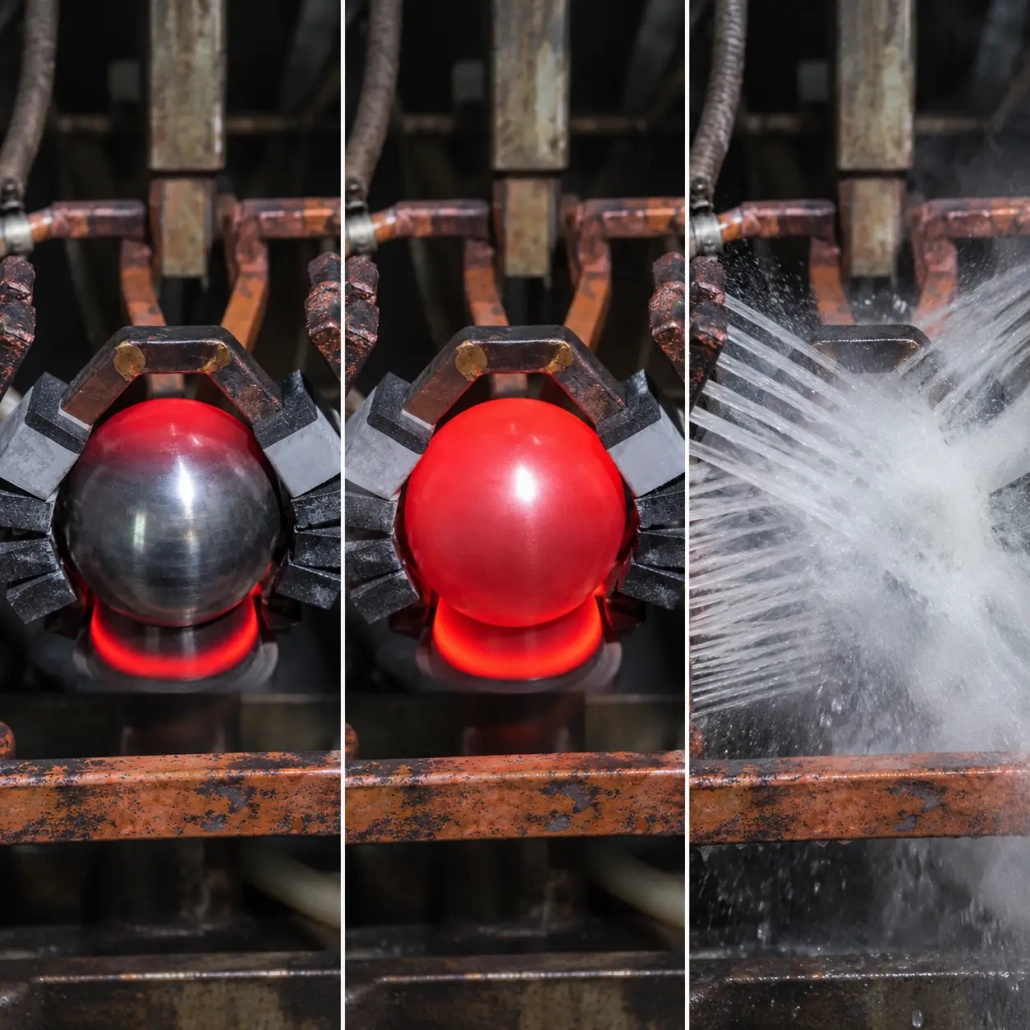
Contoured Coil · Constant-Speed Rotation · Surface Hardening
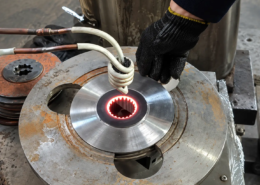
The video shows the spherical head rotating during induction heating. The inductor follows the required heating area rather than using a general-purpose circular coil.
Controlled rotation allows different areas of the ball surface to pass repeatedly through the effective heating zone, helping reduce circumferential differences before quenching.
Ⅱ. Why Ball Studs Need a Dedicated Hardening Setup
A ball stud combines a spherical working surface, a transition area and a shank. This geometry creates a different induction-heating condition from a straight cylindrical shaft.
If the inductor does not match the ball profile, some areas may couple more strongly with the electromagnetic field than others. Uneven heating, local overheating or an irregular hardening pattern may result.
The hardening process therefore needs to consider the workpiece geometry together with:
•Induction coil shape
•Coil-to-workpiece clearance
•Workpiece rotation
•Heating power and time
•Required hardening area
•Quenching condition
The machine and process are developed from the actual drawing and heat-treatment requirement rather than from ball diameter alone.
Ⅲ. Custom Contoured Induction Coil
The induction coil is designed around the spherical area that needs to be hardened.
Its geometry can be matched to the ball diameter, transition profile and required hardening zone so that the electromagnetic coupling is better suited to the workpiece.
Depending on the component, coil design may need to account for:
•Ball diameter
•Ball-to-shank transition
•Required case pattern
•Available coil clearance
•Quenching arrangement
For significantly different ball stud sizes, changing only the machine settings may not be sufficient. A different induction coil or fixture may also be required.
Ⅳ. Controlled Rotation for More Uniform Heating
The ball stud rotates at a controlled speed during heating.
For a spherical surface, this allows different circumferential areas to pass repeatedly through the effective heating zone instead of remaining in one fixed relationship with the induction coil.
The heating result depends on the combination of:
Custom Coil + Controlled Rotation + Heating Parameters
Rotation speed is therefore part of the hardening process rather than only a mechanical machine setting.
The required speed is determined together with the coil design, heating time, power and workpiece geometry.
Ⅴ. Localized Surface Hardening with Attention to Distortion
The process is intended to harden the specified surface region without unnecessarily heating the entire ball stud.
Localized induction heating concentrates the thermal cycle around the required area. The hardened layer provides the surface properties specified for the part, while thermal influence on the core and shank can be limited through the selected process.
Final hardness and effective case depth depend on the material, previous condition of the workpiece and the heat-treatment specification.
Dimensional control is also important because the spherical surface is a functional geometry. Excessive distortion may affect subsequent machining, assembly or contact with the mating socket.
Process development therefore needs to consider:
•Heating symmetry
•Ball-to-shank transition
•Rotation during heating
•Quenching distribution
•Required case pattern
•Post-hardening roundness or dimensional tolerance
Induction heating can help limit unnecessary thermal exposure, but final distortion and roundness depend on the actual component and process. They should be evaluated against the drawing rather than treated as fixed machine specifications.
Ⅵ. Automatic Processing for Batch Production
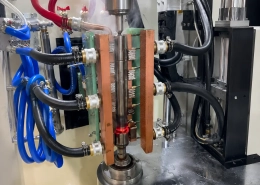
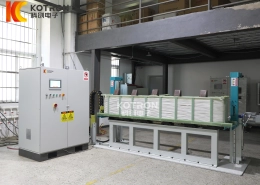
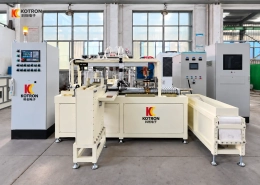
The machine can combine part handling, positioning, rotation, induction heating and quenching in an automatic cycle.
A typical sequence is:
→
→
→
→
→
The exact loading arrangement and machine layout are selected according to the workpiece and production requirement.
CNC control coordinates the machine movement and hardening cycle. An IGBT induction power supply provides the heating energy required by the process.
Automatic loading and unloading can reduce repeated manual handling and is suitable for production where ball studs are processed continuously in batches.
Ⅶ. Steering, Tie-Rod-End and Suspension Ball Studs
The machine can be developed for different automotive ball stud applications, including:
•Steering ball studs
•Tie-rod-end ball studs
•Suspension ball studs
These components may differ in ball diameter, shank geometry, overall length and required hardening area.
A machine intended for several product variants can use adjustable process settings and interchangeable tooling. Depending on the difference between parts, product changeover may involve:
•Selecting the corresponding CNC settings
•Adjusting the workpiece position
•Changing the fixture
•Changing the induction coil
•Adjusting the heating cycle
The practical product range should be defined during machine design. Multiple-size capability does not mean that one coil or one fixture is suitable for every ball stud.
Ⅷ. What Determines the Machine Configuration?
The correct configuration starts with the actual ball stud and its hardening specification.
| Information | Why It Matters |
|---|---|
| Ball diameter and geometry | Affects coil design and electromagnetic coupling |
| Shank dimensions | Affects fixture design and positioning |
| Material | Affects hardening response |
| Required hardening area | Defines the target heating zone |
| Surface hardness requirement | Defines the heat-treatment target |
| Effective case depth | Influences frequency and heating conditions |
| Roundness or distortion requirement | Affects process development and inspection |
| Product variants | Determines tooling and changeover requirements |
| Required production rate | Influences automation and machine configuration |
No universal power, frequency, rotation speed or cycle time is stated because these values depend on the actual workpiece and production target.
Ⅸ. Frequently Asked Questions
Click a question to expand the answer.
Why does the ball stud rotate during induction heating?
The spherical surface does not interact with the induction field in the same way as a straight cylindrical surface. Controlled rotation helps different areas of the ball pass through the heating zone and can improve circumferential heating uniformity.
Does every ball stud require a different induction coil?
Not necessarily. Parts with similar geometry may use the same machine configuration, but significant changes in ball diameter, transition shape or hardening area may require a different coil or fixture.
Does the whole ball stud become hardened?
The process is intended for localized surface hardening according to the drawing. The required case pattern, hardness and depth should be specified for the actual component.
Can one machine process several ball stud sizes?
It can be configured for a defined range of products. Changeover may involve CNC settings together with fixture or coil replacement, depending on the difference between parts.
How is the required induction power selected?
Power cannot be selected from ball diameter alone. Material, geometry, required case depth, heating time, coil design and production requirement all affect the final selection.
Ⅹ. Send Us Your Ball Stud Drawing
For an initial technical evaluation, the most useful information is:
•Ball stud drawing or clear dimensions
•Material
•Area to be hardened
•Required hardness and case depth, if specified
•Required production rate
From these details, the induction coil, machine arrangement, heating process, tooling and automation configuration can be evaluated for the application.