
احتفظ بالأوستينيت بعد تصلب الحث: لماذا تتشكل ولماذا هي مهمة
تشكيل, تأثيرات الأداء, and Measurement in Induction-Hardened Steel
Why does retained austenite remain after induction hardening, and is it harmful? The answer depends on the steel, the microstructure produced during heating and quenching, and the requirements of the finished component.
Retained austenite is a portion of the austenite formed during heating that remains untransformed after quenching. It is not automatically a defect, but its amount and distribution can influence hardness, wear resistance and dimensional stability. Understanding how it forms and how it can be measured helps engineers determine whether it represents an acceptable microstructural condition or requires further investigation.
2. Why Does Retained Austenite Remain After Quenching?
3. How Can Retained Austenite Affect Hardened Steel?
4. How Is Retained Austenite Measured?
5. What Should Be Checked When Retained Austenite Is Higher Than Expected?
1. What Is Retained Austenite After Induction Hardening?
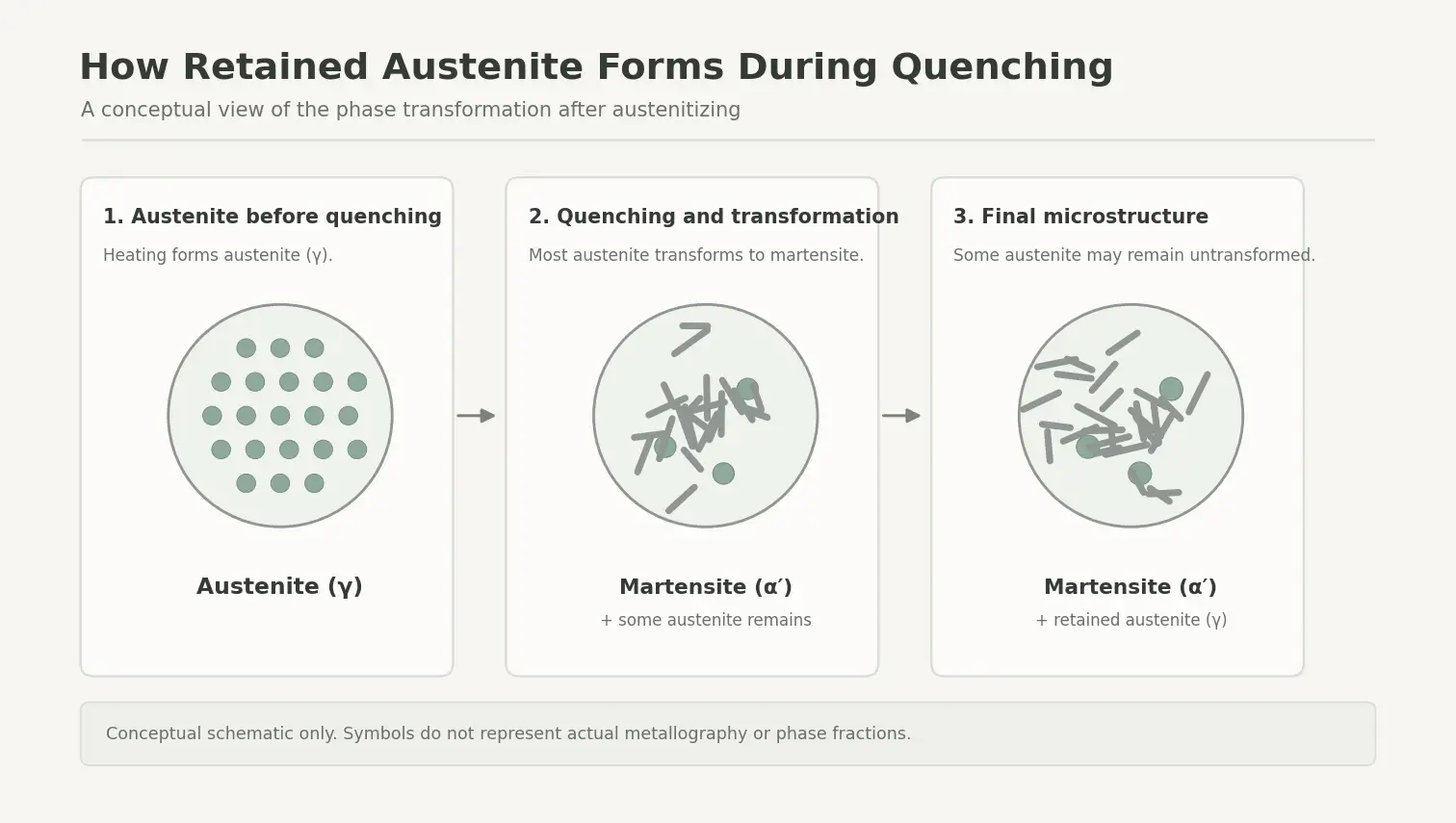
أثناء التقسية بالتحريض, the workpiece surface is heated to form austenite. Rapid cooling then transforms much of that austenite into martensite, producing a hardened surface layer. The transformation may remain incomplete, leaving some austenite in the final microstructure.
The hardened region can contain martensite, retained austenite and, depending on the steel and heating conditions, undissolved carbides or other constituents. Their proportions may vary through the hardened layer because the local thermal history, starting microstructure and carbon distribution are not necessarily uniform.
Retained austenite and undissolved carbides are different constituents. Carbides that dissolve during heating can release carbon into the austenite, changing its composition and subsequent transformation behavior. The amount of carbide dissolution therefore can influence the retained-austenite content after quenching.
For an induction-hardened component, identifying retained austenite is only the first step. Its amount, location and effect on the required component properties determine whether it needs further evaluation.
2. Why Does Retained Austenite Remain After Quenching?
Retained austenite forms when the martensitic transformation does not consume all the austenite produced during heating. The result depends on the austenite composition, its condition before quenching and the temperature reached during cooling.
Austenite composition and transformation temperature
The martensite-start temperature (Ms) is the temperature at which martensitic transformation begins during cooling. Carbon dissolved in austenite, along with certain alloying elements, can lower Ms.
As the steel cools below Ms, martensite forms. If cooling stops before the transformation has progressed sufficiently, some austenite remains untransformed. In steels with a relatively low transformation temperature, retained austenite may remain even after substantial cooling.
This helps explain why two steels subjected to similar induction-hardening cycles can develop different microstructures. Their compositions and the resulting austenite characteristics may differ, so the same nominal process conditions do not necessarily produce the same retained-austenite content.
Austenitizing temperature and carbide dissolution
أثناء التسخين, carbides may dissolve into the austenite. The extent of dissolution depends on the material, temperature and time at temperature.
Additional carbon dissolved into austenite can change its transformation behavior and, in some steels, increase the amount of retained austenite after quenching.
This relationship has been investigated in induction-heated bearing steel. في Influence of Induction Heating Conditions on Quenched Structure of SUJ2 Steel, researchers examined the effects of austenitizing temperature and undissolved carbide content on retained austenite and hardness. Under the conditions studied, higher austenitizing temperatures and lower undissolved carbide content were associated with increased retained austenite.
These findings apply to the investigated SUJ2 steel and experimental conditions. They should not be treated as a universal relationship for every induction-hardened steel.
Why induction heating conditions matter
Induction hardening commonly uses rapid heating and relatively short heating cycles. The resulting austenite depends on how the material responds during that particular thermal cycle, including how quickly austenite forms and how much carbon dissolves before quenching.
The initial microstructure is therefore relevant. Carbide distribution and prior heat treatment can affect the austenitization process and the composition of the resulting austenite.
A nominal power setting or heating time alone does not establish the actual austenitizing condition throughout the workpiece. The thermal history of the hardened region must be considered when investigating an unexpected microstructure.
For a broader explanation of the starting material’s influence, انظر كيف تؤثر البنية المجهرية السابقة على نتائج تصلب الحث.
Quenching conditions and the final transformation
Quenching determines the cooling path after austenitization, but retained austenite is not simply evidence of an insufficiently severe quench. Some austenite may remain because its composition and transformation characteristics prevent the martensitic transformation from proceeding to completion at the final temperature.
Cooling conditions still matter, but they should be evaluated alongside the steel composition and the austenite produced during heating. Changing إخماد شدة alone may not resolve the underlying cause.
3. How Can Retained Austenite Affect Hardened Steel?
Retained austenite can affect component performance, but its presence does not automatically indicate a problem. The consequences depend on its amount and distribution, the surrounding microstructure and the conditions under which the component operates.
الصلابة
Martensite is generally the principal hard phase produced by conventional steel hardening. Because retained austenite and martensite have different mechanical properties, their proportions can influence measured hardness.
Hardness also depends on factors such as the carbon content of martensite and the distribution of other microstructural constituents. A hardness reading therefore cannot reliably establish the retained-austenite fraction. Two components with similar hardness readings may have different phase compositions.
If hardness changes after a process adjustment, that result alone does not establish whether retained austenite increased or decreased.
Wear and contact fatigue
In gears, bearings and other components subjected to repeated contact loading, retained austenite may influence wear and fatigue behavior.
Under some loading conditions, retained austenite can transform and contribute to changes in local hardness and stress. In other circumstances, its presence may be associated with reduced performance. The outcome depends on the steel, the surrounding microstructure and the service conditions, so retained-austenite content alone is not sufficient to predict wear resistance or fatigue life.
Dimensional stability and residual stress
Retained austenite can be important when استقرار الأبعاد is critical. If it transforms during subsequent processing or service, the associated volume change can affect component dimensions and redistribute residual stresses.
This matters for precision components whose fit, clearance or geometry must remain within specified tolerances. The risk depends on the stability of the retained austenite and the conditions to which the component is exposed; its presence does not mean that dimensional changes will necessarily occur.
The relevant engineering question is whether the resulting microstructure meets the component’s requirements, rather than whether retained austenite can be eliminated entirely.
4. How Is Retained Austenite Measured?
When retained austenite may affect component performance, its content should be measured with a suitable method rather than inferred from hardness alone.
X-ray diffraction
X-ray diffraction (XRD) is widely used to quantify retained austenite in steel. It identifies crystalline phases through their diffraction patterns and can estimate the retained-austenite fraction when an appropriate measurement procedure is used.
The SAE technical paper Retained Austenite and Its Measurement by X-Ray Diffraction discusses XRD measurement in hardened steels and other engineering materials.
For induction-hardened components, the measurement location matters. An XRD result characterizes the sampled near-surface measurement volume; it should not automatically be treated as representative of the entire hardened case. If retained-austenite content varies with depth, the inspection plan must account for that variation.
The result also needs to be interpreted in context. حالة السطح, material texture, measurement procedure and other microstructural constituents can affect the measurement or its interpretation.
Other measurement methods
Magnetic methods and electron backscatter diffraction (EBSD) may be suitable for particular applications. Magnetic methods can require application-specific calibration, while EBSD can provide localized phase information but involves more demanding sample preparation and analysis.
Visual examination of an etched microstructure alone is not a dependable substitute for quantitative phase measurement when an accurate retained-austenite fraction is required. The ASM proceedings paper Retained Austenite Benefits or Avoidance Requires Dependable Determination discusses the importance of reliable determination and the limitations of different measurement approaches.
The method should match the engineering question. Routine hardness testing, على سبيل المثال, does not provide the same information as quantitative retained-austenite measurement. For a broader overview of verification, انظر كيفية فحص الأجزاء المقواة بالتحريض.
5. What Should Be Checked When Retained Austenite Is Higher Than Expected?
A higher-than-expected retained-austenite result does not automatically mean the component is out of specification. There is no single acceptable percentage for all induction-hardened steels. The result must be assessed against the relevant material requirements and component performance criteria.
Confirm the measurement first
Check that the measurement method is suitable, the result is reliable and the measurement location represents the region of interest. If the result is unexpected, verify it before changing the process.
Review the material and process history
Confirm the درجة الصلب and starting material condition, then review the actual heating cycle and quenching records. Particular attention should be given to the austenitizing condition and whether the process followed the intended procedure.
These records help determine whether the result is consistent with the material’s transformation behavior or may indicate a process deviation.
Decide whether a process change is justified
Compare the measured result with the applicable specification and functional requirements. If retained austenite is associated with a demonstrated performance concern, investigate the likely cause before adjusting the process.
Increasing the austenitizing temperature or changing quench severity without understanding the cause may not produce the intended result. Such changes can also affect martensite formation, carbide dissolution and hardness.
Where an adjustment is necessary, verify its effect through suitable microstructural measurement and the relevant component-quality tests.
الوجبات الجاهزة الرئيسية
Retained austenite after induction hardening is the fraction of austenite that remains untransformed after quenching, and its presence is not automatically a defect.
Its amount depends on steel composition, austenitizing conditions, carbide dissolution and the cooling path, and its consequences for hardness, يرتدي, contact fatigue and dimensional stability depend on the component and service conditions.
The practical question is whether the measured content meets the component’s requirements, not whether retained austenite can be eliminated entirely.
الأسئلة المتداولة
Is retained austenite always a defect?
لا.
Retained austenite is not automatically harmful. Its significance depends on its amount and distribution, the surrounding microstructure and the component’s service requirements. Some retained austenite is acceptable in many induction-hardened parts.
Can I determine the retained-austenite content from a hardness reading?
لا.
Hardness depends on several factors, including the carbon content of the martensite and the distribution of other constituents. Two components with similar hardness can have different phase compositions, so hardness alone cannot reliably establish the retained-austenite fraction. Use a quantitative method such as X-ray diffraction when the content matters.
Does a higher-than-expected retained-austenite result mean the part is out of specification?
ليس بالضرورة.
There is no single acceptable percentage for all steels. The result must be assessed against the applicable material and component requirements. First confirm the measurement is reliable, then review the material and process history before changing the process.
What conditions increase retained austenite?
Carbon dissolved in austenite and certain alloying elements lower the martensite-start temperature, so higher austenitizing temperatures and greater carbide dissolution can increase retained austenite in some steels. The effect is material-specific and should be confirmed for each steel rather than assumed.
Need to Evaluate Retained Austenite in Your Hardened Parts?
إرسال الصف الصلب الخاص بك, heat-treatment requirements and any retained-austenite measurement results — we can help you assess whether the resulting microstructure meets your component’s requirements.


