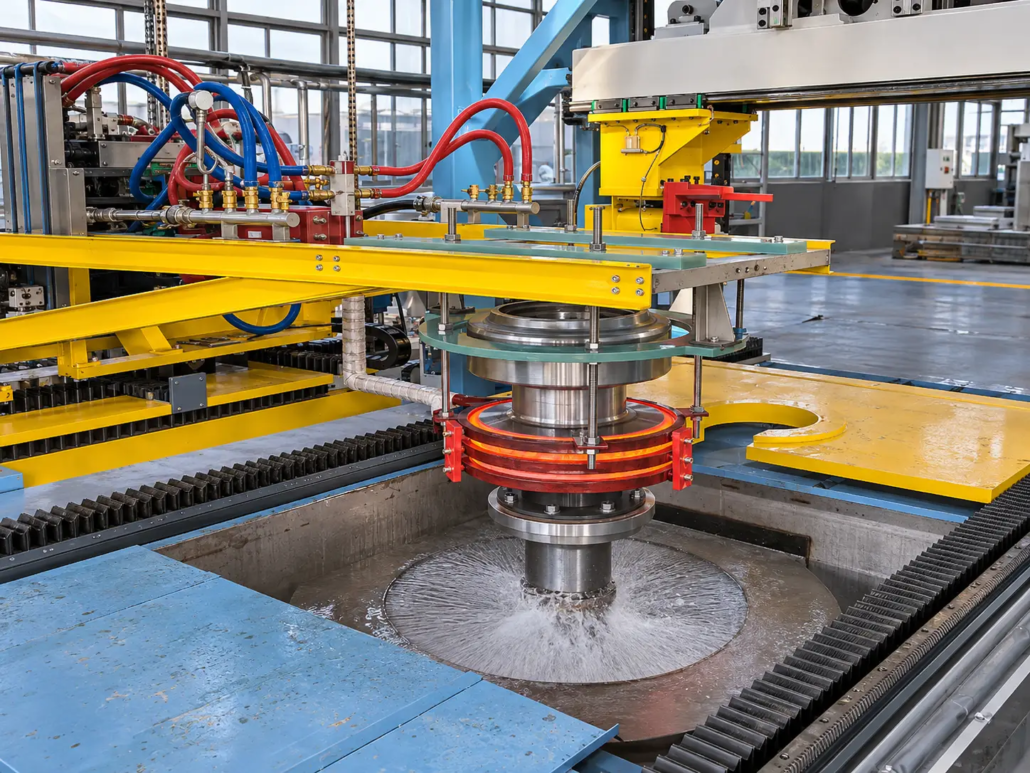
Track Idler Outer Rim Induction Hardening Machine with Rotary Scanning
Ⅰ. Track Idler Induction Hardening in Operation
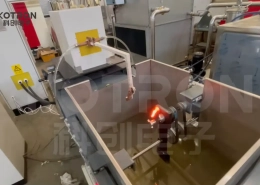
The video shows a vertical induction hardening machine processing the outer rim of a track idler.
The workpiece is mounted on a rotary fixture and rotates during processing. A stationary induction coil heats the outer rim, producing the visible red-hot area. The spray quenching arrangement below the heating position cools the heated surface as the workpiece rotates through the processing sequence.
The equipment is designed specifically for the circumferential hardening of the idler’s outer working surface.
Ⅱ. Rotary Scanning Induction Hardening Process
This machine uses workpiece rotation rather than induction coil movement to achieve circumferential scanning.
The processing principle is straightforward:
Workpiece Positioning and Rotation
The track idler is secured on the rotary fixture and positioned relative to the fixed induction coil.
Rotary Induction Heating
As the workpiece rotates, successive sections of the outer rim pass through the induction heating zone. The coil heats the specified surface to the required hardening temperature.
Progressive Quenching
The heated sections are brought to the spray quenching position during rotation, where cooling liquid is applied to the surface.
By keeping the induction coil stationary and rotating the workpiece, the machine can progressively process the outer circumference without requiring the heating assembly to travel around the component.
Ⅲ. Induction Heating and Spray Quenching
The outer rim forms the circumferential working surface of the track idler and is the target area for this induction hardening application.
During processing, the induction coil generates localized heating on the outer rim. The heated region appears red-hot before reaching the lower spray quenching position.
The heating and cooling arrangements must be coordinated to achieve the specified surface hardness and hardened case depth.
Important process considerations include:
— Induction coil geometry and heating clearance
— Workpiece rotation speed
— Heating power and processing time
— Circumferential treatment coverage
— Spray quenching position and cooling conditions
The specific parameters are determined by the workpiece material, dimensions and heat-treatment requirements.
Ⅳ. Track Idler Outer Rim Hardening Requirements
Different track idlers can have different outer diameters, rim widths, material specifications and surface hardening requirements.
These differences affect the induction heating arrangement and machine configuration.
For example, the induction coil must match the outer rim geometry and maintain suitable clearance during rotation. The rotary fixture must also hold the workpiece securely and maintain stable positioning throughout the process.
The main technical requirements generally include:
— Workpiece outside diameter and rim width
— Required hardened area
— Surface hardness specification
— Effective hardened case depth
— Circumferential hardening coverage
These requirements should be established from the workpiece drawing and heat-treatment specification before the final machine configuration and process parameters are determined.
Ⅴ. Customized Induction Hardening Machines for Different Track Idlers
Kechuang develops track idler induction hardening machines according to the dimensions and processing requirements of each workpiece.
Depending on the application, the following parts can be customized:
— Rotary fixtures and workpiece clamping structures
— Induction coil diameter and geometry
— Heating position and treatment coverage
— Rotation mechanism and speed control
— Spray quenching arrangement
— Machine dimensions and supporting structure
For track idlers with different outside diameters or rim widths, the fixture, coil and quenching positions can be adjusted accordingly.
The objective is to provide a complete machine that matches the actual workpiece and required hardening process rather than relying on one standard configuration.
Ⅵ. Frequently Asked Questions
Click a question to expand the answer.
Does the track idler rotate during induction hardening?
Yes. The workpiece rotates while the induction coil remains stationary. This allows successive sections of the outer rim to pass through the heating zone.
Does the induction coil move around the track idler?
No. In this configuration, the induction coil remains fixed during processing. Circumferential scanning is achieved through workpiece rotation.
How is the heated outer rim quenched?
A spray quenching arrangement is positioned below the heating area. Cooling liquid is applied to the heated surface during the rotary processing sequence.
Can the machine accommodate different track idler sizes?
Yes. The rotary fixture, induction coil, supporting structure and spray quenching arrangement can be customized according to the workpiece dimensions and hardening requirements.
Ⅶ. Request a Customized Track Idler Hardening Solution
Looking for induction hardening equipment for excavator or bulldozer track idlers?
Send Kechuang a workpiece drawing or a few photos of your track idler, together with a brief description of the required hardening area.
We can evaluate the application and discuss a suitable rotary induction hardening machine for your production requirements.
Request a Customized Track Idler Hardening Solution
Send us your workpiece drawing or photos and we will discuss the appropriate rotary induction hardening machine for your track idler application.