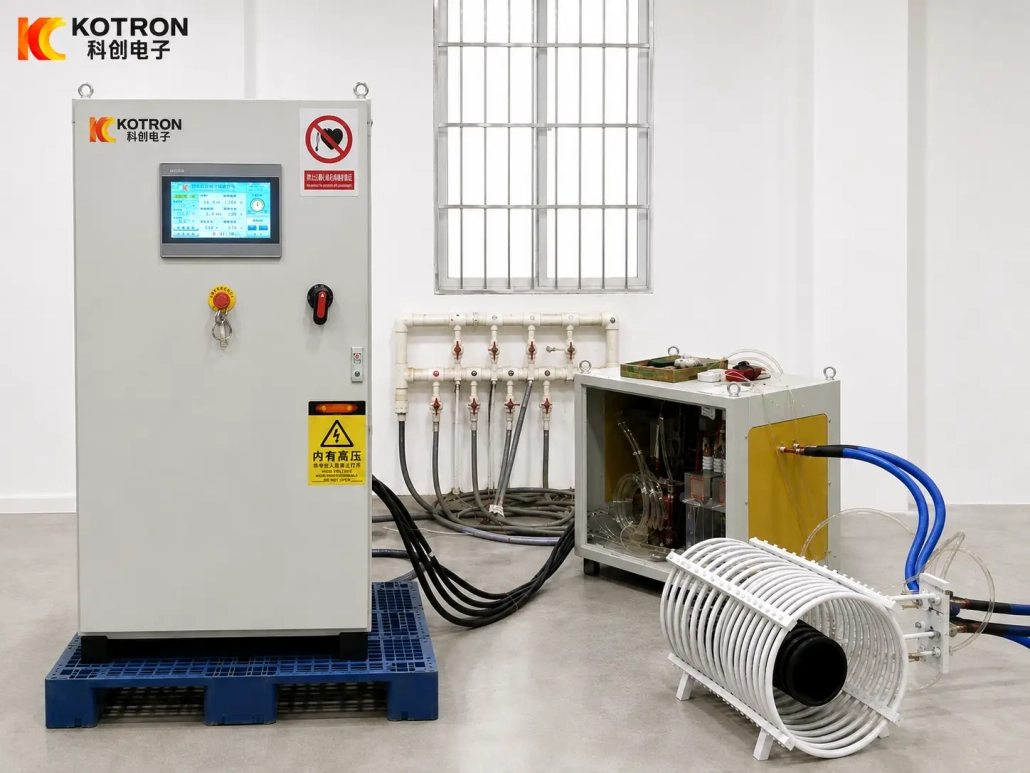
Large Cylinder Induction Heating System for Forging
Ⅰ. See the Induction Heating System in Operation
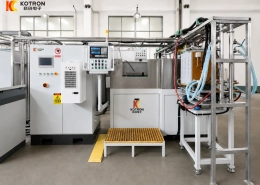
Video 1 — Complete System View: Shows the induction power supply, transformer, output connection, multi-turn inductor and cylindrical workpiece before visible red heating develops.
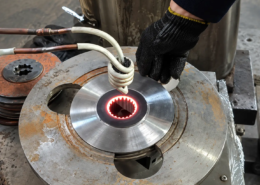
Video 2 — Cylinder Heating Close-Up: Shows the selected cylindrical section gradually becoming red-hot inside the multi-turn induction coil.
The second video provides a direct view of the heating process, but visible surface color alone should not be treated as a measurement of the temperature through the full wall thickness.
Ⅱ. What Is Being Heated?
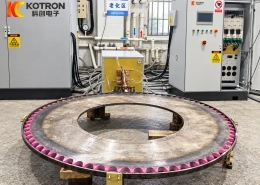
The workpiece shown in this system is a large hollow cylindrical workpiece.
Only the required cylindrical section is surrounded by the effective heating area of the inductor. During operation, this section is heated before the workpiece moves to the subsequent forging process.
This type of induction heating system can be evaluated for large hollow or cylindrical workpieces where:
— A defined length needs to be heated before forging
— The workpiece has a relatively large diameter
— Heating through the cylindrical section is required
— A standard small billet-heating arrangement is not suitable for the workpiece geometry
The final forged component may differ from project to project. The heating system is therefore configured from the actual workpiece rather than from the name of the finished part.
Ⅲ. How Is a Large Cylinder Heated?
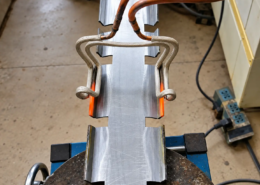
The cylindrical workpiece is positioned inside a long multi-turn induction coil.
Alternating current in the coil creates an electromagnetic field around the workpiece. Electrical currents are induced in the conductive metal, generating heat in the cylindrical section surrounded by the inductor.
For this application, the long coil is especially important.
A short induction coil would concentrate heating over a much narrower axial area. Here, multiple turns are distributed along the workpiece so that a relatively long section can be heated during the same process.
The heating result depends on several factors together:
Workpiece Material + Outside Diameter + Inside Diameter + Wall Thickness + Heated Length + Power + Frequency + Heating Time + Coil Design
This is why a large-cylinder inductor cannot simply be treated as an enlarged version of a small induction coil.
Ⅳ. Why Heat Penetration Matters Before Forging
The objective of induction heating for forging is different from induction surface hardening. Surface hardening concentrates on creating a controlled hardened layer. Before forging, the required section of the workpiece needs sufficient heating for the following deformation process.
For a hollow cylindrical workpiece, the outside surface can become visibly hot before the full wall thickness reaches the required thermal condition.
Wall thickness therefore matters.
Two cylinders with the same outside diameter can behave very differently if one has a thin wall and the other has a much heavier section.
Power, frequency and heating time have to be considered together so that the required cylindrical section receives sufficient heat penetration for the downstream forging operation.
The actual target temperature and acceptable temperature distribution depend on the workpiece material and forging process.
Ⅴ. Main Components of the Heating System
The complete equipment shown in the video includes the main electrical and heating sections required for induction forging heating.
| Component | What It Does |
|---|---|
| Induction Power Supply | The power cabinet supplies and controls the electrical energy used for heating. The required power is selected according to the workpiece size, material, heated section and production requirement. |
| Transformer / Matching Section | The transformer and matching section connects the induction power system with the heating load. Its configuration is matched to the inductor and workpiece rather than being treated as a fixed component for every project. |
| Power Output Connection | Heavy-duty output connections transfer power from the electrical section to the inductor. Relevant electrical and induction components require cooling during operation according to the equipment configuration. |
| Multi-Turn Induction Coil | The cylindrical induction coil forms the main heating zone around the workpiece. Its inside diameter, effective length, number of turns and electrical configuration are selected for the actual cylinder. |
Ⅵ. Power, Frequency and Coil Design Depend on the Workpiece
There is no single power rating, frequency or coil size that is suitable for every large cylinder. For equipment selection, several dimensions need to be considered together.
| Workpiece Information | Why It Matters |
|---|---|
| Outside diameter | Determines the basic coil size and heating load |
| Inside diameter | Defines the hollow section of the workpiece |
| Wall thickness | Strongly affects the heating requirement through the section |
| Heated length | Influences effective coil length and total heating load |
| Material | Affects the required forging condition and heating response |
| Workpiece weight | Influences total energy required |
| Required heating time | Affects power selection |
| Forging requirement | Determines the target heating condition |
For this reason, specifying only an outside diameter such as “a 500 mm cylinder” is not enough to select an induction heating system. The same outside diameter may correspond to very different workpiece masses and wall thicknesses.
Ⅶ. Customized Induction Heating for Large Cylinders
Customization in this type of system is mainly related to the heating process. Depending on the workpiece, the project may require changes to:
①Inductor inside diameter
②Effective heating length
③Number and spacing of coil turns
④Induction power
⑤Operating frequency
⑥Transformer and electrical matching
⑦Heating sequence
⑧Workpiece loading arrangement
The required heated section is especially important. If only one part of a long cylindrical workpiece needs to reach the forging condition, the effective heating area should be designed around that section rather than unnecessarily heating the complete workpiece. This is why the workpiece drawing and marked heating area are useful at the beginning of equipment selection.
Ⅷ. Temperature and Process Monitoring
Heating control can be configured according to the production requirement. Depending on the selected system, available functions can include:
①Temperature measurement
②Heating time control
③Power monitoring
④Voltage and current monitoring
⑤Process parameter recording
⑥Heating curve display
⑦Upper and lower parameter alarms
⑧Historical production records
Temperature feedback and process monitoring should be treated as project-specific configurations rather than assumed standard functions on every machine. For forging applications, monitoring is particularly useful when the same workpiece needs to be heated repeatedly under a defined process.
Ⅸ. What Kind of Workpiece Is This System Suitable For?
This heating arrangement is mainly intended for large cylindrical or hollow workpieces requiring a relatively long section to be heated before forging. Possible workpiece forms can include:
①Hollow cylindrical preforms
②Thick-wall cylinders
③Large sleeves
④Cylindrical forging blanks
⑤Other large hollow or cylindrical workpieces
The final use of the forged component does not determine the induction system by itself. A cylinder intended for heavy machinery and another used in energy equipment may require completely different heating systems if their dimensions, wall thicknesses or forging requirements are different. The workpiece itself remains the starting point for system design.
Ⅹ. What Information Do We Need?
For a large-cylinder induction heating project, please send the workpiece drawing together with the material, outside and inside diameter, wall thickness, overall length, required heating length, workpiece weight and target forging temperature if known. Information about the required heating time, production rate and downstream forging process is also useful. If the final forging application is not yet confirmed, we can still evaluate the system from the known workpiece dimensions and required heating section.
Frequently Asked Questions
Click a question to expand the answer.
What diameter range can this system handle?
There is no single diameter range. The inductor inside diameter, power and frequency are matched to the actual workpiece, so the outside diameter, inside diameter and wall thickness are evaluated together.
How is the required heating time determined?
Heating time depends on wall thickness, material, power and frequency. For a hollow cylinder, the full wall thickness must reach the required condition — visible surface color alone does not confirm temperature through the section.
Can this system heat solid bars or small billets?
This arrangement is designed for large hollow or cylindrical workpieces with a relatively long heated section. A solid bar or standard billet is usually better handled by a standard billet-heating setup, so the system should be matched to the actual geometry.
Ready to Configure Your Large-Cylinder Heating System?
Send your workpiece drawing and key dimensions — outside and inside diameter, wall thickness, heated length and material — and we will match the power, frequency and coil design to your cylinder.