
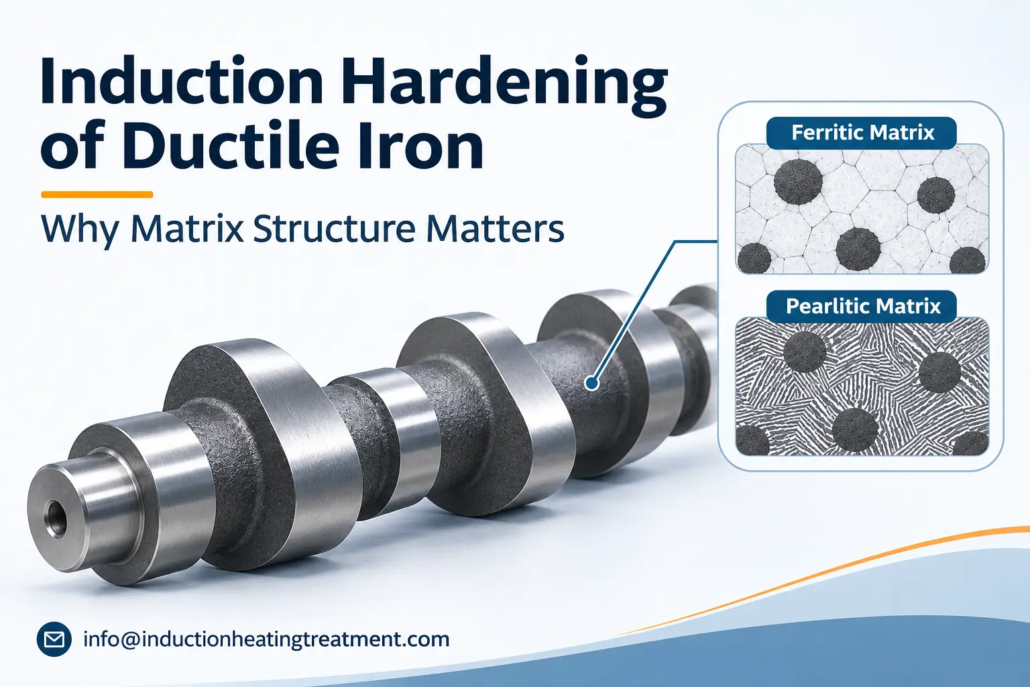
Żeliwo sferoidalne utwardzane indukcyjnie: Dlaczego struktura macierzy ma znaczenie
How Ferrite, Pearlite and Graphite Influence Austenitization and Surface Hardness
Induction hardening of ductile iron can produce a hard, wear-resistant surface on components such as camshafts and other loaded castings. Jednak, ductile iron does not always respond to rapid heating and quenching in the same way. The starting matrix structure has a major influence on the result.
Quick Answer: Ductile iron can be induction hardened, especially when its matrix is predominantly pearlitic. Pearlite provides a more readily available source of carbon during rapid austenitization, while a ferritic matrix generally makes it harder to achieve high, uniform surface hardness. Graphite nodules can supply additional carbon, but how much enters the surrounding austenite depends on the heating conditions and diffusion time.
2. Why Does the Starting Matrix Structure Matter?
3. How Do Graphite Nodules Affect Austenitization?
4. How Do Heating and Quenching Conditions Affect the Result?
5. How Can the Hardening Response Be Evaluated?
1. Can Ductile Iron Be Induction Hardened?
Tak. Żeliwo ciągliwe, also known as nodular cast iron or spheroidal graphite iron, can be induction surface hardened when its composition, starting microstructure and processing conditions are suitable.
The main difference between ductile iron and gray żeliwa is the form of graphite. Ductile iron contains graphite in approximately spherical particles, called graphite nodules, rather than the flake-like graphite found in gray iron.
These nodules are surrounded by a metallic matrix that may be ferritic, pearlitic or a mixture of both.
Podczas hartowania indukcyjnego, the selected surface region is heated into the austenitizing range and then quenched. Where suitable austenite has formed, quenching can produce a martensitic matrix with increased hardness.
The graphite nodules do not transform into martensite. The hardening response comes from changes in the metallic matrix around them.
Where is induction-hardened ductile iron used?
One documented application is the ductile iron camshaft.
Dokument techniczny SAE Induction Hardened Ductile Iron Camshafts describes the development of an induction-hardened ductile iron camshaft for an automotive engine.
The project involved evaluation of hardness, mikrostruktura, chemical composition, residual stress and cracking resistance. It illustrates the need to develop the material and hardening process together rather than treating ductile iron as directly interchangeable with steel.
Why the material grade alone is not enough
Two ductile iron castings may have similar nominal chemical compositions but different matrix structures.
One may contain mostly pearlite, while another contains a substantial amount of ferrite. Differences in alloying, casting conditions and previous heat treatment can also affect the structure entering induction hardening.
These differences matter because the rapid heating cycle must produce a suitable austenitized matrix before quenching.
A material designation or total carbon percentage does not establish how readily that transformation will occur.
2. Why Does the Starting Matrix Structure Matter?
Dla starting matrix affects how quickly austenite forms and how carbon becomes available during heating.
This is particularly important in induction hardening because the time available for transformation and carbon redistribution is often much shorter than in conventional furnace heat treatment.
Pearlitic ductile iron
Pearlite is a structure consisting of alternating ferrite and cementite, an iron carbide containing carbon.
During austenitization, pearlite transforms as cementite dissolves and carbon redistributes into the developing austenite.
Because the carbon-containing cementite is distributed throughout the pearlitic structure, the distances involved in carbon redistribution can be relatively short.
Predominantly pearlitic ductile iron is therefore generally well suited to rapid induction hardening, provided the heating cycle produces sufficient austenitization and the subsequent quench is appropriate.
This is one reason pearlitic ductile iron is commonly preferred for applications requiring a high surface hardness after induction hardening.
The fineness and distribution of pearlite also matter. Describing the matrix simply as pearlitic does not completely define its response to a short heating cycle.
Ferritic ductile iron
Ferritic ductile iron behaves differently.
Ferrite contains very little dissolved carbon and lacks the distributed cementite found in pearlite. During austenitization, carbon must become available from other sources, particularly the graphite nodules.
Carbon can diffuse from graphite into the developing austenite, but the process requires suitable temperature and time.
Under a short induction-heating cycle, carbon enrichment may be concentrated near the graphite nodules rather than extending sufficiently throughout the matrix.
This makes predominantly ferritic ductile iron less suitable for conventional rapid induction hardening when high, relatively uniform surface hardness is required.
Ferritic ductile iron is not impossible to induction harden. Specialized rapid-heating treatments have produced localized martensitic structures and improved fatigue properties in ferritic specimens, but these results should not be confused with obtaining a uniformly hardened martensitic matrix.
Ferritic-pearlitic ductile iron
Many commercial ductile irons contain both ferrite and pearlite.
Their response depends on the amount and distribution of each constituent.
The pearlitic regions provide carbon through cementite dissolution, while ferritic regions may depend more strongly on carbon redistribution from nearby phases and graphite.
In some castings, ferrite forms a thin region around graphite nodules, sometimes described as a bull’s-eye structure. If these ferritic regions are sufficiently narrow, carbon diffusion during a suitable heating cycle may allow them to austenitize.
Larger ferritic regions can be more difficult to transform adequately within the same heating time.
W rezultacie, two ferritic-pearlitic castings with similar overall pearlite content may still show different hardening responses because their matrix structures are arranged differently.
Evidence from controlled austenitization research
The study Effect of Intercritical Austenitization and Starting Matrix on Martensite Start Temperature and Austenite Carbon Concentration in Ductile Iron, published in International Journal of Metalcasting, compared ductile iron specimens prepared with fully ferritic and fully pearlitic starting matrices.
Under the investigated continuous-heating and intercritical austenitization conditions, the pearlitic starting matrix produced a greater austenite fraction and higher estimated austenite carbon concentration than the ferritic matrix at the same austenitization temperature. The resulting martensite start temperatures also differed.
These were controlled metallurgical experiments, not a comparison of production induction-hardening recipes.
The findings help explain why starting matrix structure matters, without establishing a universal heating cycle or hardness result for ductile iron castings.
3. How Do Graphite Nodules Affect Austenitization?
Ductile iron contains considerably more total carbon than most steels used for induction hardening. Jednak, much of that carbon exists as graphite.
This distinction is important because total carbon content is not the same as the carbon concentration in the austenite formed during heating.
Graphite as a source of carbon
During austenitization, carbon can dissolve from graphite nodules and diffuse into the surrounding metallic matrix.
Material close to a graphite nodule may become enriched before material farther away reaches a similar carbon concentration.
The extent of this enrichment depends on the temperature, heating time and local diffusion conditions, as well as the size and distribution of the graphite nodules.
These differences can affect the austenite condition and the microstructure produced after quenching.
Na przykład, regions with different austenite carbon concentrations may have different martensite start temperatures and different amounts of trwałą austenitę after cooling.
The resulting hardness response is therefore influenced by where the carbon is available during the heating cycle, not simply by how much carbon the casting contains overall.
Local martensite formation around graphite nodules
A specific example comes from the 2004 study Fatigue Strength of Ferritic Ductile Cast Iron Hardened by Super Rapid Induction Heating and Quenching.
The researchers treated ferritic ductile iron using several super-rapid induction-heating and quenching cycles.
Under the investigated conditions, martensite formed in ring-shaped regions around graphite nodules. The researchers referred to this structure as ringed martensite.
The treated specimens also showed improved fatigue strength compared with the untreated material, with the researchers relating the improvement to compressive residual stresses associated with the treatment.
This is an example of a specialized treatment producing a useful local microstructural change. It does not mean that the entire ferritic matrix became uniformly hardened or that the same result can be expected from conventional induction-hardening cycles.
Why excessive carbon dissolution is not the answer
When ferritic ductile iron responds poorly to induction hardening, it may seem reasonable to increase the heating temperature or extend the heating time to dissolve more carbon from the graphite.
The approach has limitations.
Greater carbon dissolution may change the austenite composition and subsequent transformation behavior. Excessive thermal exposure can also contribute to grain coarsening, increased retained austenite, irregular hardness and greater susceptibility to cracking.
Cast iron has additional overheating concerns because of its composition and comparatively low melting range relative to many common steels.
These issues are discussed in Valery Rudnev’s technical article Induction Hardening of Cast Irons.
For a predominantly ferritic casting, changing the starting matrix may be a more suitable route to achieving conventional surface-hardening requirements than attempting to compensate entirely through longer or more intense induction heating.
4. How Do Heating and Quenching Conditions Affect the Result?
The heating cycle must produce the intended austenitized condition before quenching. For ductile iron, this depends strongly on the starting matrix and the availability of carbon.
Heating temperature and time
Reaching an austenitizing temperature does not necessarily mean that a suitable austenite structure has formed throughout the intended hardened region.
Podczas szybkiego nagrzewania indukcyjnego, austenite formation, cementite dissolution where pearlite is present, and carbon diffusion occur within a limited time.
A predominantly pearlitic matrix may respond satisfactorily to a cycle that leaves a more ferritic matrix only partly transformed.
If austenitization is insufficient, the quenched region may contain unwanted ferritic or other non-martensitic constituents, resulting in lower or uneven hardness.
Increasing thermal exposure can promote further transformation, but excessive heating may produce an unfavorable microstructure or increase the risk of damage.
Z tego powodu, the heating cycle should be developed for the actual ductile iron material and its required hardened condition rather than selected solely from nominal machine settings.
Warunki hartowania
Once suitable austenite has formed, the cooling conditions must support the intended martensitic transformation.
The final hardness depends on both the austenite condition before hartowanie and the cooling history.
If the heating stage has not produced suitable austenite, a more severe quench will not necessarily correct the resulting hardness problem.
podobnie, adequate austenitization does not guarantee the required hardened structure if the cooling conditions are unsuitable.
Thermal stresses during heating and quenching also need consideration, particularly for castings with complex geometry or local stress concentrations.
Why identical machine settings may give different results
Consider two batches of ductile iron castings processed with the same induction-hardening program.
The first batch has a predominantly pearlitic matrix. The second contains considerably more ferrite.
Even if the programmed heating and quenching conditions remain unchanged, the batches may reach different austenitized states and develop different hardness profiles after quenching.
This does not prove that matrix structure caused every difference between the batches. Variations in composition, casting condition, geometry or local heating and cooling may also contribute.
Jednak, a change in the incoming material structure is an important possibility to investigate before changing the induction-hardening settings.
5. How Can the Hardening Response Be Evaluated?
For ductile iron, useful hardening evaluation begins with the starting matrix and continues through the finished hardened structure.
A single surface-hardness reading cannot explain why a casting responded well or poorly to induction hardening.
Examine the starting material
Metallographic examination can establish whether the incoming matrix is predominantly ferritic, pearlitic or mixed.
For ferritic-pearlitic material, the location and distribution of ferrite are worth noting, particularly around graphite nodules.
The graphite morphology and distribution should also be considered where they may influence carbon availability or indicate differences in casting quality.
When investigating a change between production batches, comparing the incoming microstructures of acceptable and problematic castings is more informative than examining one sample without a reference.
Check hardness and the quenched matrix
Po utwardzeniu, surface hardness and hardness-depth measurements can help establish whether the required hardened condition has been achieved.
A prepared metallographic cross-section can provide additional information about the microstructure of the hardened region.
Na przykład, it can help determine whether the intended martensitic matrix formed or whether substantial non-martensitic regions remain.
Hardness measurements in ductile iron need careful interpretation because graphite nodules have a very different mechanical response from the metallic matrix. In localized microhardness testing, an indentation affected by a graphite nodule may not represent the hardness of the surrounding matrix.
The test method, load and measurement location should therefore be appropriate to the feature being evaluated.
For general hardness and case-depth measurement methods, zobacz Jak sprawdzać części hartowane indukcyjnie.
Distinguish insufficient austenitization from inadequate quenching
When hardness is lower than expected, metallography can help identify whether the problem may be associated with incomplete austenitization or the structure produced during cooling.
These causes should not be treated as interchangeable.
A substantial amount of retained ferrite after treatment may indicate that the intended matrix transformation was not achieved, although the interpretation depends on the starting material and target structure.
Other unexpected transformation products may point toward unsuitable cooling conditions, an unfavorable austenite condition or both.
The investigation should compare microstructural evidence with the known material condition and actual process history rather than assign a cause from hardness alone.
What matters when qualifying the process
The starting matrix, wymagana twardość powierzchni, hardened depth and final microstructure should be evaluated as related parts of the same process.
Predominantly pearlitic ductile iron is generally a more suitable starting material for conventional rapid induction hardening when a high, relatively uniform surface hardness is required.
Ferritic and ferritic-pearlitic materials need closer consideration of carbon availability and austenitization behavior, especially when the heating cycle is short.
The central question is not whether ductile iron contains enough carbon overall. It is whether the selected heating cycle allows the metallic matrix to form austenite with suitable carbon content and distribution before quenching.
That is why the starting matrix structure matters so much in induction hardening of ductile iron.
Kluczowe dania na wynos
•Ductile iron can be induction hardened, but the starting matrix structure strongly influences the result.
•Predominantly pearlitic ductile iron is generally the most suitable starting material for rapid induction hardening.
•Ferritic matrices rely on carbon diffusion from graphite nodules, which is limited under short heating cycles.
•Heating and quenching must be developed for the actual material, not transferred from steel or nominal settings.
•Evaluate the starting microstructure, quenched matrix and hardness together — a single hardness reading is not enough.
Często zadawane pytania
Kliknij pytanie, aby rozwinąć odpowiedź.
+Can ductile iron be induction hardened?
Tak. Ductile iron can be induction surface hardened, especially when the matrix is predominantly pearlitic. Pearlite supplies carbon more readily during rapid austenitization than a ferritic matrix.
+Why does a ferritic matrix harden poorly?
Ferrite contains little dissolved carbon and lacks the distributed cementite found in pearlite. Carbon must diffuse from graphite nodules, and under a short induction-heating cycle this enrichment is often concentrated near the nodules rather than spread through the matrix.
+Do graphite nodules harden during induction hardening?
Nie. The graphite nodules do not transform into martensite. The hardening response comes from the metallic matrix around them, and carbon dissolved from the nodules can enrich the surrounding austenite.
+What happens if I just increase the heating temperature for ferritic iron?
Longer or more intense heating may dissolve more carbon, but it can also cause grain coarsening, increased retained austenite, irregular hardness and a higher risk of cracking. Changing the starting matrix is often a better route.
+How should I evaluate the hardening response of ductile iron?
Examine the starting matrix metallographically, measure surface hardness and case depth, and check the quenched microstructure. Distinguish insufficient austenitization from inadequate quenching, and compare acceptable versus problematic batches.
Need Help Developing an Induction Hardening Process for Cast Iron?
KECHUANG provides induction heating systems and process support for hardening cast iron and steel components. Send your material specifications for an evaluation.


