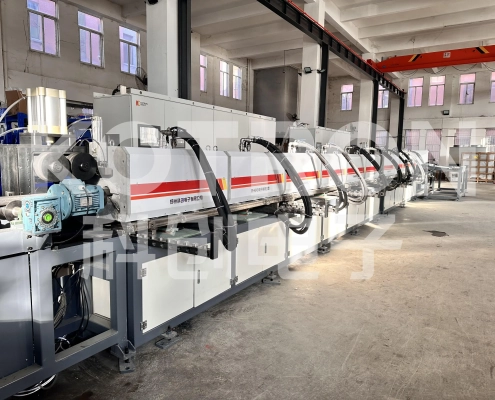
Induction Forging

Induction forging is a precision metal forming process that uses electromagnetic induction heating to rapidly and uniformly heat metal workpieces to their forging temperature, followed by shaping via forging presses or hammers. It is widely used in the production of automotive parts, hardware tools, and mechanical components.

Core Working Principle

  1. Electromagnetic Induction Heating
    The workpiece is placed inside an induction coil connected to a high-frequency power supply. When alternating current flows through the coil, it generates a rapidly changing magnetic field. This field induces eddy currents within the workpiece, and the electrical resistance of the metal converts these currents into heat, rapidly raising the workpiece’s temperature—typically to 1,100–1,250 °C for steel materials.
    Heating is localized: it can target the entire workpiece or specific sections (e.g., the end of a shaft) based on coil design, minimizing heat loss to the surroundings.
  2. Forging Forming
    Once the workpiece reaches the optimal forging temperature (a state of high plasticity and low deformation resistance), it is immediately transferred to a forging die. External force from forging equipment reshapes the workpiece into the desired size and geometry—common processes include upsetting, extruding, and piercing.
  3. Post-forging Treatment
    After forging, workpieces may undergo cooling, heat treatment (e.g., quenching and tempering), or machining to meet final mechanical property and dimensional accuracy requirements.

Key Advantages

  1. High Heating Efficiency & Speed

    Heat is generated directly inside the workpiece, with minimal heat dissipation to the environment. Heating cycles are short (often completed in seconds to minutes), significantly boosting production efficiency.

  2. Uniform Temperature Distribution

    Precise control of the induction coil’s frequency and power ensures uniform heating of the target area, avoiding overheating or underheating. This reduces forging defects like cracks and uneven deformation.

  3. Energy Conservation & Environmental Friendliness

    Compared to traditional fuel-fired furnaces, induction forging consumes less energy and produces no smoke, dust, or harmful emissions, aligning with green manufacturing standards.

  4. Precision & Flexibility

    It can heat specific regions of a workpiece (localized heating), making it ideal for parts requiring partial forging (e.g., automotive axle shafts, connecting rod ends). The process is easily automated for integration into production lines.

  5. Improved Workpiece Quality

    Rapid heating reduces the oxidation and decarburization of the workpiece surface, preserving the metal’s original properties and reducing post-forging machining costs.

Typical Applications

  • Automotive Industry: Manufacturing crankshafts, camshafts, axle shafts, and steering components.
  • Hardware Tools: Producing wrenches, pliers, and drill bits.
  • Mechanical Engineering: Fabricating gears, bolts, and hydraulic cylinder components.
Induction Forging Traditional Forging (Coal/Gas Furnace Heating)
Heat is generated directly inside the workpiece with no environmental heat loss; heating cycle is measured in seconds/minutes, and production can start immediately after startup The furnace is heated first, then heat is transferred to the workpiece, resulting in high heat loss; preheating the furnace in advance is required, and heating time is long
Power and frequency are adjustable, with temperature control error within ±5℃; precise local heating of workpieces is achievable, ensuring uniform temperature Temperature is greatly affected by manual operation and environment, prone to local overheating/underheating; mostly overall heating with rough temperature control
Optimized workpiece grain structure, fewer defects such as cracks and deformation, scrap rate reduced by about 30%; minimal surface oxidation and decarburization, high material utilization rate Prone to forging defects due to uneven heating, with relatively high scrap rate; severe surface oxidation of workpieces requires large subsequent machining allowance
Energy consumption reduced by about 25%; no open flame, smoke, or harmful gas emissions, complying with environmental protection standards High energy consumption, emitting large amounts of smoke and waste gas; additional investment in environmental protection equipment is required
Heating parameters can be precisely set and recalled repeatedly; easy integration with automated forging and conveying lines, reducing manual intervention Relies on manual temperature judgment and operation; high difficulty in automation integration, and production stability is affected by human factors
Heat is concentrated on the workpiece, resulting in less heat exposure to equipment and forging dies, extending die service life Residual heat and smoke from the furnace corrode forging dies, causing rapid die wear and frequent replacement
Customized induction coils can be made for different workpieces, suitable for diverse needs such as rod-end heating and special-shaped part forging Fixed furnace heating method, difficult to achieve local heating, and weak adaptability to complex workpieces
Steel Bar Hot Rolling3