
Induction Heating Power Selection: How to Choose the Right Power
Choosing the right induction heating power selection is one of the most critical decisions in thermal processing. Whether you are hardening automotive components or forging industrial parts, the power rating of your equipment directly affects heating quality, cycle time, and operating cost. This guide walks you through the 7 key factors that determine optimal induction heating power selection, from understanding input versus coil power to managing edge effects on complex geometries.
📋 Table of Contents
- Input Power vs. Coil Power: What’s the Difference?
- How Power Is Calculated by Application
- Surface Power Density: The Key Selection Metric
- Design Principle: Concentrate Power, Heat Faster
- Managing the Edge Effect: When Less Power Is Better
- FAQ: 4 Common Questions About Induction Heating Power Selection
- Free Application Consultation
1. Input Power vs. Coil Power: What’s the Difference?
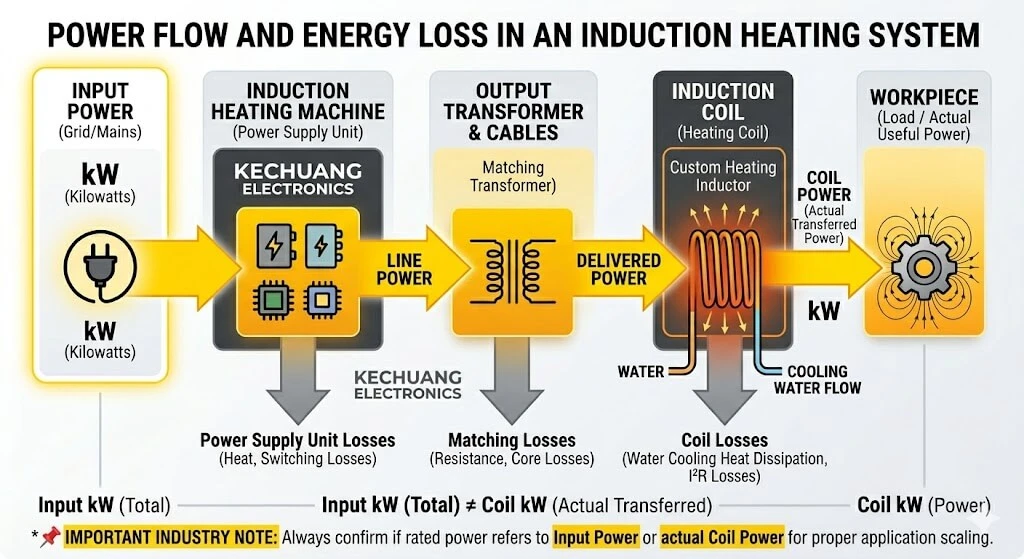
The power rating of an induction heating machine, measured in kilowatts (kW), typically refers to the input power of the equipment rather than the power actually delivered inside the coil. Understanding this distinction is fundamental to correct induction heating power selection.
A small number of manufacturers calculate and quote coil power instead, which represents the energy that reaches your workpiece after system losses. The gap between these two values stems from efficiency losses in cables, capacitors, and the coil itself. Always clarify which figure a manufacturer is quoting when comparing equipment to ensure accurate induction heating power selection.
2. How Power Is Calculated by Application
Power requirements vary significantly depending on the industry and process. Understanding how your specific application determines power needs is essential for proper induction heating power selection.
For through-heating applications such as induction forging and forming, manufacturers calculate power based on material throughput (kg/h) and target temperature. For induction hardening processes, calculations are based on the heated surface area covered by the coil, expressed in square centimeters (cm²). The resulting metric is known as surface power density, forming the backbone of any reliable induction heating power selection framework.
3. Surface Power Density: The Key Selection Metric
Surface power density serves as the practical benchmark most engineers rely on when performing induction heating power selection for hardening applications. In induction hardening, it can reach up to 25 W/mm², depending on the required case depth and operating frequency.
Shallow hardening demands higher power density (15–25 W/mm²) with shorter heating times.
Deep hardening requires lower power density (5–10 W/mm²) and longer heating to allow thermal conduction toward the core.
Using surface power density as your selection baseline simplifies induction heating power selection — you match equipment output to process requirements without getting lost in coil efficiency variables. For more details, refer to ScienceDirect’s comprehensive overview of induction heating principles.
4. Design Principle: Concentrate Power, Heat Faster
When designing induction coils, the core goal is to minimize the heated surface area while maintaining effective coverage across the workpiece. This principle directly impacts induction heating power selection and coil design strategy.
A smaller heating footprint concentrates available power, raising surface power density for faster and more controlled heating. This principle applies equally to single-shot coils and scanning coils used in automotive manufacturing and other high-volume industries.
For scanning applications, traversal speed also matters — slower scanning increases energy input per unit area, while faster scanning reduces it. Proper induction heating power selection accounts for both coil geometry and scanning parameters.
5. Managing the Edge Effect: When Less Power Is Better
High power density is not always the optimal choice for induction heating power selection. Research shows that sharp edges and insufficient chamfering on workpieces can cause localized overheating, leading to excessive thermal stress, grain growth, and grain boundary liquefaction that ultimately results in cracking.
According to induction heating research on ScienceDirect, uneven current density distribution caused by electromagnetic end effects and edge effects is a major contributor to coil failure and workpiece cracking, a finding also confirmed by Inductoheat in their technical documentation.
To compensate, experienced engineers use larger coil geometries that envelop the entire workpiece. This approach distributes power over a greater area, reducing peak density at vulnerable edges. Effective induction heating power selection thus involves knowing when to dial power density back, not just when to maximize it.
6. FAQ: 4 Common Questions About Induction Heating Power Selection
Q1: What is the difference between input power and coil power?
Input power is the total electrical power drawn from the grid, measured at the machine input terminals. Coil power is the actual energy delivered inside the induction coil to the workpiece. The gap reflects efficiency losses in cables, capacitors, and the coil itself. Accurate induction heating power selection requires knowing which value a manufacturer is quoting.
Q2: Do I need high or low surface power density?
The rule of thumb is straightforward: shallow case depths (under 2 mm) need high power density (up to 25 W/mm²) with fast heating cycles. Deeper cases (over 4 mm) require lower density (5–10 W/mm²) with longer soak times. Your optimal induction heating power selection depends on material grade, hardness requirements, and part geometry.
Q3: Can one power supply handle different workpieces?
Yes. Modern induction power supplies with flexible frequency and power output ranges can accommodate diverse workpieces across industries from Oil & Gas to Lithium Battery Manufacturing. However, each new application requires re-evaluating the coil design, power level, and frequency parameters as part of thorough induction heating power selection.
Q4: What happens if I choose the wrong power level?
Under-powering causes insufficient heating, non-uniform hardness, and extended cycle times that hurt productivity. Over-powering risks surface melting, grain growth, cracking at sharp edges, and unnecessary capital and electricity expenditure. Both outcomes underscore why proper induction heating power selection before purchase is essential.
7. Get a Free Induction Heating Power Selection Consultation
To help our engineering team provide accurate induction heating power selection recommendations in your first communication, prepare the following information:
- Workpiece material — steel, copper, aluminum, brass, or alloy grade
- Heating objective — surface hardening, through-heating, induction melting, brazing, or annealing
- Target temperature or hardness — specify HRC range or °C
- Production rate — pieces per hour or kg/h throughput
- Workpiece geometry — note any sharp edges, thin walls, or irregular cross-sections
- Production mode — single-piece batch or continuous production line
With this information ready, our team can proceed directly to solution evaluation — no back-and-forth delays. Whether your application involves HVAC components or solar panel manufacturing parts, proper induction heating power selection starts with clear application data.


Leave a Reply
Want to join the discussion?Feel free to contribute!