
Choose induction heating treatment machine requires a preliminary understanding of the induction heating equipment market. The following sections will provide a basic overview of the market from multiple perspectives.
1.Choose Between Analog Control Machines and Digital Control Machines
2.Advantages and disadvantages of analog control and digital control
3.Advantages of Optical Fiber Transmission in Induction Heating treatment machine
4.Structural type selection
5.Protection performance and reliability
Choose Between Analog Control Machines and Digital Control Machines
- The 1st generation, built on an analog circuit architecture, offers basic functionality with a 1% control accuracy and manual power adjustment. While it is a reliable entry-level option for simple applications, it is limited by its low efficiency, narrow load compatibility, and lack of intelligence, making it unsuitable for modern industrial demands.
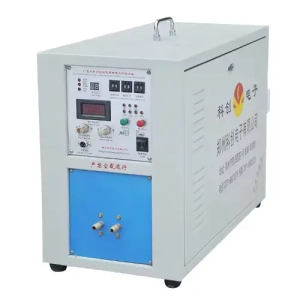
1st generation induction heating system
- The 2nd generation, powered by a general CPU, represents a notable upgrade with digital power adjustment, an LCD screen interface, and multiple protection systems. With a 0.5% control accuracy and faster startup speed, it handles more complex tasks better than its predecessor, but still falls short in terms of efficiency and load flexibility.
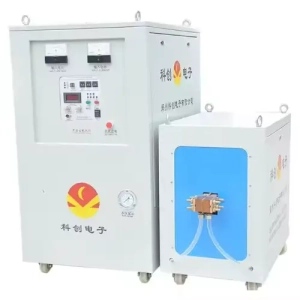
2nd generation induction heating system
- The 3rd generation, based on a DSP architecture, is the most advanced solution available. It delivers 0.1% ultra-high control accuracy, optical fiber signal transmission, and intelligent rapid protection. Its high efficiency, wide load compatibility, and smart features such as fault location alerts and hybrid resonance modes make it ideal for high-precision, high-throughput industrial environments.
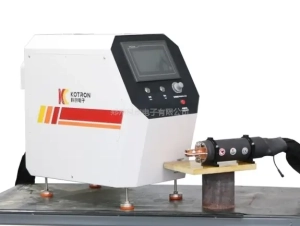
The 3rd generation induction heating system
| Item | 1st Generation | 2nd Generation | 3rd Generation |
|---|---|---|---|
| Control Method | Analog Chip | General CPU | Digital Signal Processing |
| Control Accuracy | 1% | 0.5% | 0.1% |
| Reliability | Medium | Medium | High |
| Human-Machine Interface | Mechanical Meter & Digital Display | LCD Screen | Touch Screen |
| Power Adjustment | Manual | Digital | Digital / Network / Intelligent |
| Signal Transmission | Electrical Signal | Electrical Signal | Optical Fiber Transmission |
| Efficiency | Medium | Medium-High | High |
| Load Application Range | Medium | Medium | Wide |
| Intelligence | None | None | High |
| Startup Speed | Load-dependent, max 0.2s | Max 0.1s | 0.05s (both no-load and full-load) |
| Process Repeatability | Medium Repeatability | High Repeatability | High Repeatability |
| Protection System | Few | Multiple Protection | Intelligent Rapid Protection |
| Fault Diagnosis | Only Prompt | Fault Display | Alerts Fault Location and Solutions |
| Power Regulation Mode | Frequency & Chopper Regulation | Chopper Regulation | Pre-stage Voltage Regulation & Soft Switching PWM |
| Resonance Mode | Series Resonance | Series Resonance | Series Resonance / Parallel Resonance / Hybrid Resonance |
| Cooling Method | Water Cooling | Air Cooling | Water Cooling / Air Cooling |
| Load Type | Standard Transformer | Variable Transformer | Standard Transformer / Variable Transformer / Coaxial Transformer |
With three generations of technological refinement, we have evolved from analog-signal controlled induction heating systems to fully digital-controlled ones. We have accumulated rich experience in the independent manufacturing of induction heating power supplies—the core components of induction heating systems. Leveraging a premium supply chain, coupled with our extensive manufacturing expertise and comprehensive after-sales service, we provide reliable guarantees for induction heating solutions in the manufacturing industry.
Core Mainboard
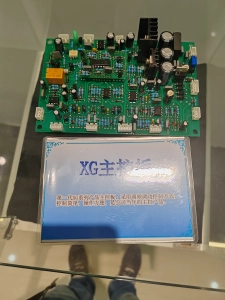
The 1st generation induction heating treatment machine mainboard
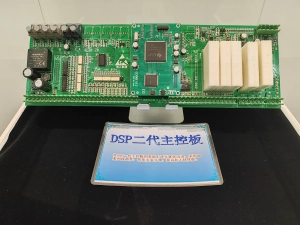
dsp induction heating treatment machine mainboard
The core mainboard represents our core technology, developed independently, manufactured in-house, and refined through iterative hardware and software optimizations. We guarantee a 10-year warranty core mainboards. (Damage not caused by human factors)
The control process, data processing, and parameter storage of the DSP intelligent induction heating power supply are all performed digitally. Environmental changes do not affect the calculation and output process. Compared with analog control systems, the all-digital power supply offers higher stability across varying environments.
The core mainboard controls IGBTs to operate in an optimal soft-switching state, minimizing switching losses, voltage/current surges, and local temperature rise. This not only prevents the reduction of inversion efficiency caused by deviations from the optimal inversion state, but also resolves issues such as accelerated IGBT aging (e.g., unexpected failure after one year of use) and high long-term maintenance costs.
Our DSP intelligent Induction Heating Treatment Machine employs DSP+CPLD all-digital power and frequency control technology, and the technology has evolved to the second-generation high-performance precise control algorithm. All control processes, data processing, and parameter calculations are executed at high speed within the intelligent chip, ensuring frequency tracking without loss of lock or drift, and achieving nanosecond-level control accuracy.
Optical fiber
Optical fiber communication is adopted to prevent electromagnetic interference, enhance transmission response speed, and boost overall efficiency.


