
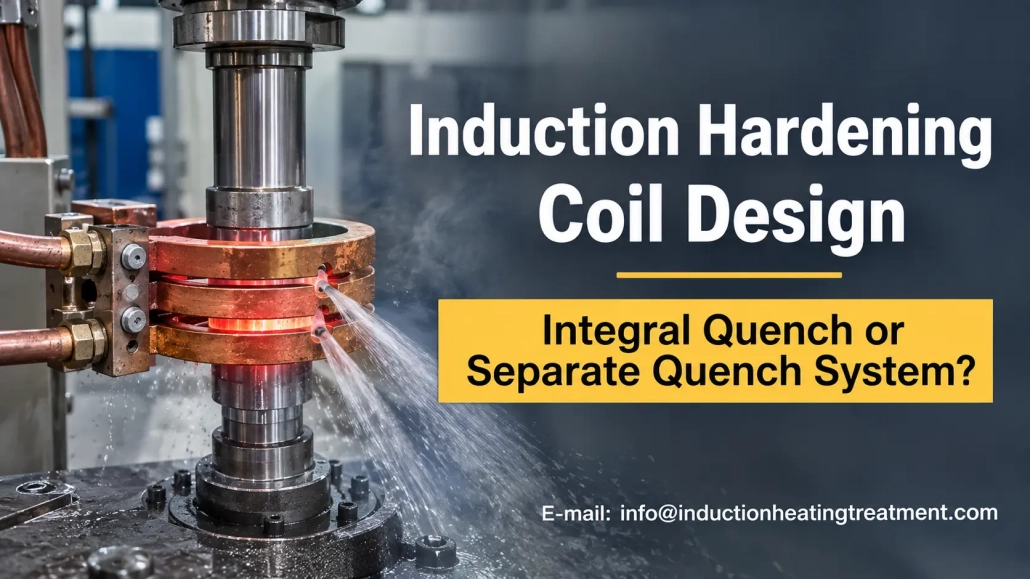
Induction Hardening Coil Design: Integral Quench or Separate Quench System?
In induction hardening, the coil and quench arrangement has a direct effect on service life, maintenance and production rhythm.
In practice, two common designs are used. One is an integral quench inductor, where heating and spray quenching are combined in the same assembly. The other uses a water-cooled heating coil with a separate quench system.
Both designs are used in production. The better choice depends less on theory and more on how the part is hardened, how often the system runs, and how important coil life and production efficiency are in the actual process.
1.Integral Quench Inductor
An integral quench inductor combines heating and quenching in one assembly, so its main advantage is simple structure.
In this arrangement, the inductor usually needs a certain thermal capacity. It is therefore often made from relatively thick copper, commonly with a wall thickness of about 6–12 mm. This increases copper consumption and also makes machining and drilling the spray holes more labor-intensive.
There are also some operating drawbacks. During quenching, the workpiece remains in the inductor position, which means the heating position is occupied during the cooling stage. In repetitive production, this can reduce equipment utilization.
Another issue is maintenance of the spray holes. The inductor already carries heat when quenching begins. If the quenching liquid contains salts, calcium impurities or additives, deposits may gradually narrow the spray-hole cross-section. If the holes are not cleaned regularly, quench flow can decrease over time.
This matters most in processes where self-tempering after quenching is part of the hardening result. When quench flow drops, the self-tempering temperature may rise, and the final hardness can shift gradually without an obvious machine failure.
So the advantage of the integral quench inductor is clear: it is structurally straightforward. But in continuous production, simplicity may come with trade-offs in maintenance stability and cycle efficiency.
2.Separate Quench System
The second arrangement separates the two functions. The induction coil is used only for heating, while quenching is carried out by a separate spray unit or quench ring.
Because the heating coil is continuously water-cooled, it does not experience the same temperature rise as an integral quench inductor. This usually improves coil service life. A production example from a camshaft application showed that when a separate quench system was adopted, inductor life increased from about 15,000 cycles to 90,000 cycles. That figure should be treated as one application example, not a universal rule, but it does show the possible benefit of keeping the heating coil thermally protected.
This arrangement can also improve the production sequence. Since the workpiece is cooled in a separate quench position, it does not continue to occupy the heating position. For parts with multiple hardened sections, one section can be cooling while another is being heated. In that case, the system makes better use of the induction power source and can improve production rate.
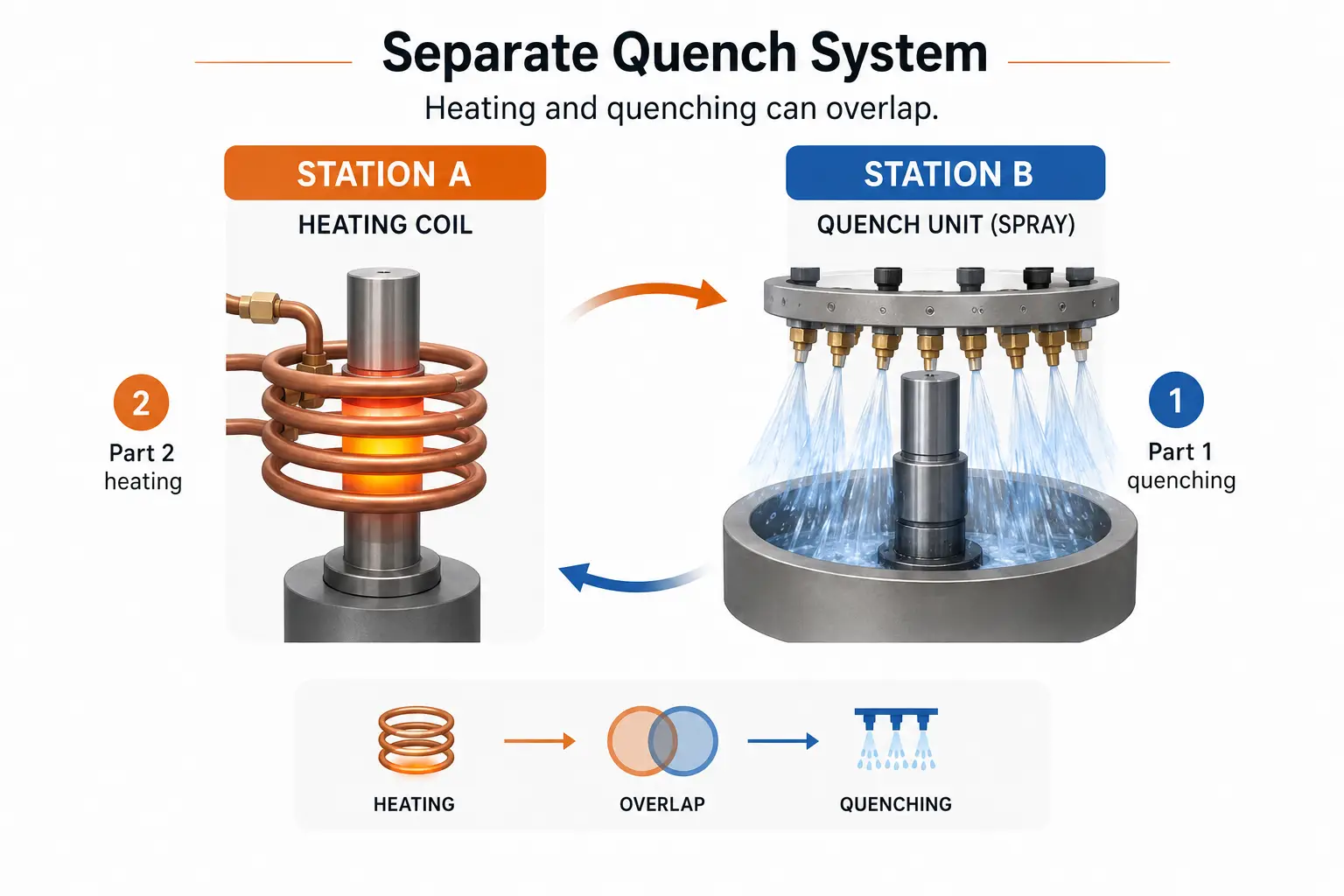
This is one of the most practical advantages of a separate quench system. It does not only extend coil life; it also gives more flexibility in organizing the hardening cycle.
Of course, separating heating and quenching also means the system structure is less compact than the integral design. The layout, timing and alignment between heating and quenching positions need to be considered carefully.
3.Which One Is Better?
There is no single answer for every induction hardening application.
An integral quench inductor is suitable when compact structure and straightforward mechanical arrangement are the main priorities. It can still be a practical solution for many parts, especially where production rhythm is not heavily limited by the heating position being occupied during quenching.
A separate quench system is often the better choice when longer coil life, more stable spray conditions and better production utilization are important. This is especially true in repetitive or high-volume production, where heating and cooling can be arranged as overlapping steps.
In other words, the decision should not be made by coil style alone. It should be based on the workpiece, the quenching medium, maintenance requirements, cycle expectations and how the hardening process is organized in production.
For some jobs, the simpler integral design is enough. For others, separating the heating coil from the quench system can bring clear long-term advantages.
Not Sure Which Quench Arrangement Fits Your Part?
Send us your workpiece drawing, hardened area and production requirement. We can evaluate both coil designs against your process and recommend the better fit.


