
Automotive of Induction heating
Induction heating technology is a cornerstone of automotive manufacturing, underpinning performance and efficiency across both fuel-powered and new energy vehicles (EV CAR). It is now evolving toward precision, intelligence, and sustainability to meet the industry’s evolving demands.
Applications
Core Powertrain Strengthening: Induction hardening boosts wear resistance and fatigue strength of engine crankshafts, camshafts, and transmission gears while preserving core toughness, ensuring long-term reliability.
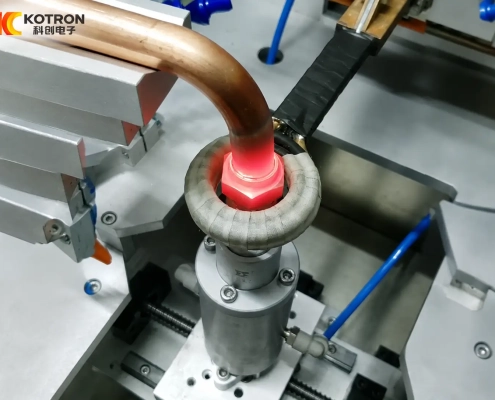
Body & Pipeline Precision Joining: Induction heating cures structural adhesives for door/hood hemming (minimizing thin-plate deformation) and enables leak-free brazing of fuel/brake pipelines, enhancing driving safety.
Motor System Manufacturing: Dual-coil induction heating ensures uniform temperature control for motor housing-stator shrink fitting, reducing thermal deformation. It also enables fast curing of rotor/stator impregnation and consistent brazing of copper bar joints.
Body Production: Medium-frequency induction melting guarantees stable material quality for battery pack frames; induction bonding/welding realizes reliable connection of steel-aluminum hybrid bodies and battery cooling plates, avoiding electrochemical corrosion.
- Battery & Automatic
Induction heating technology, with its advantages of non-contact operation, precise temperature control and high energy efficiency, runs through the entire manufacturing process of new energy batteries: it not only facilitates material melting and electrode drying to ensure the high purity and uniformity of cell raw materials; but also realizes tab welding and edge sealing to improve cell consistency and reliability; it can also complete module brazing and preheating before laser welding to enhance the structural stability and electrical conductivity of battery packs. Meanwhile, it supports low-temperature cell preheating and non-destructive pole piece recycling to drive cost reduction and efficiency improvement throughout the battery life cycle. In the future, it will further expand into new scenarios such as solid-state battery sintering to boost the technological upgrading of the battery industry.
Future Development Trends
Intelligent & Automated Integration: Full integration with Industry 4.0 lines, AI-driven parameter optimization, real-time temperature monitoring, and digital twin predictive maintenance will enable unmanned, traceable production.
Precision & Customization: Custom induction coils and multi-frequency heating technology will optimize temperature control for complex components like integrated motor housings, with third-gen semiconductor (GaN/SiC) power supplies cutting energy consumption by 12–15%.
Green & Global Adaptation: High-efficiency solid-state power supplies will meet EU IE4 energy efficiency standards, while modular equipment designs will suit multi-variety, small-batch production in emerging markets.
Scenario Expansion: New applications will include battery thermal management for NEVs, precision welding of hydrogen fuel cell bipolar plates, and stress relief for integrated die-cast bodies.
 https://www.inductionheatingtreatment.com/wp-content/uploads/2026/09/bent-copper-tube-induction-brazing.webp
1086
1448
cui yanan
https://www.inductionheatingtreatment.com/wp-content/uploads/2025/12/kclogo2.webp
cui yanan2026-09-04 03:43:192026-09-08 03:49:35Induction Brazing for HVAC & Refrigeration Copper Components
 https://www.inductionheatingtreatment.com/wp-content/uploads/2025/12/Copper-Tube-Manifold-Welding-1.webp
500
500
inductionheatingtreatment
https://www.inductionheatingtreatment.com/wp-content/uploads/2025/12/kclogo2.webp
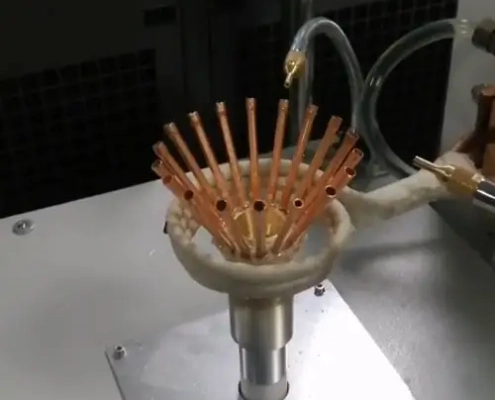
inductionheatingtreatment2025-12-18 01:53:592026-08-05 07:23:24Copper Tube Manifold Welding


