
Industry of Induction
In the development process of the induction industry centered on the principle of electromagnetic induction, induction heating technology has emerged as a core supporting technology that runs through the entire industrial chain of R&D, production and application, by virtue of its remarkable characteristics of high efficiency, precision, controllability and environmental friendliness. It drives efficiency improvement and quality innovation in such sub-sectors as induction equipment manufacturing, induction heat treatment and induction melting.
As a core technical branch of the induction industry, induction heating relies on the unique mechanism of eddy current heat generation via electromagnetic induction. Different from the inefficient conduction mode of traditional open-flame and resistance heating, it can act directly on target metal workpieces to achieve endogenous heat conversion. This characteristic not only increases heating efficiency by more than 40% and significantly reduces energy consumption, but also enables refined control over heating zones and temperature profiles through the precise regulation of current frequency and power parameters. It minimizes the heat-affected zone to the millimeter level, effectively avoiding issues such as workpiece deformation and performance degradation, and thus meets the stringent requirements for high-precision processing in the induction industry.
| Induction Heating | Fire Heating | Resistance Heating |
|---|---|---|
| Electromagnetic induction eddy current endogenous heating, non-contact | Fuel combustion heat conduction/radiation, contact-based | Resistance element heating followed by conduction, contact-based |
| 60%–90%, energy saving ≥ 40% | 30%–60%, high heat loss | 50%–80%, high conduction loss |
| ±1℃–±5℃, programmable temperature curve control | ≥±30℃, large temperature fluctuation | ±10℃–±15℃, high thermal inertia |
| Millimeter-level, localized targeted heating | Large, overall workpiece heating | Relatively large, heat diffusion via conduction |
| Low, minimal stress from rapid heating/cooling | High, severe thermal deformation and oxidation | Medium, deformation prone due to prolonged conduction heating |
| Flame-free, smoke-free, low noise | High waste gas emission, open-flame hazard, heavy pollution | Risk of element aging and short circuit |
| High, digital programming and remote control enabled | Low, heavily dependent on manual operation | Medium, requires temperature control module retrofitting |
| Precision heat treatment, melting, solar panel/automotive manufacturing | Rough machining, preheating of large forgings | Small-batch heating, laboratory applications |
 https://www.inductionheatingtreatment.com/wp-content/uploads/2026/09/bent-copper-tube-induction-brazing.webp
1086
1448
cui yanan
https://www.inductionheatingtreatment.com/wp-content/uploads/2025/12/kclogo2.webp
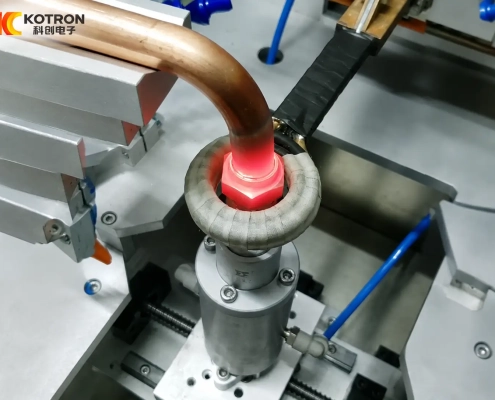
cui yanan2026-09-04 03:43:192026-09-08 03:49:35Induction Brazing for HVAC & Refrigeration Copper Components
 https://www.inductionheatingtreatment.com/wp-content/uploads/2025/12/Copper-Tube-Manifold-Welding-1.webp
500
500
inductionheatingtreatment
https://www.inductionheatingtreatment.com/wp-content/uploads/2025/12/kclogo2.webp
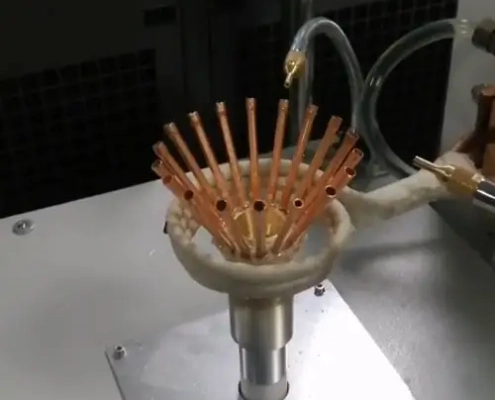
inductionheatingtreatment2025-12-18 01:53:592026-08-05 07:23:24Copper Tube Manifold Welding


