Induction Heating vs. Gas Furnace: 8 Factors to Choose the Right Heating System
Choosing between induction heating vs gas furnace technology is not about which system gets hotter. It is about control, speed, efficiency, and total cost over the life of your process. Both can reach forging and heat-treating temperatures. They just get there in fundamentally different ways — and the gap between them grows wider as energy costs rise and quality requirements tighten.
This guide walks through the eight factors that matter most when comparing the two technologies, so you can make a decision grounded in your application — not in a spec-sheet showdown.
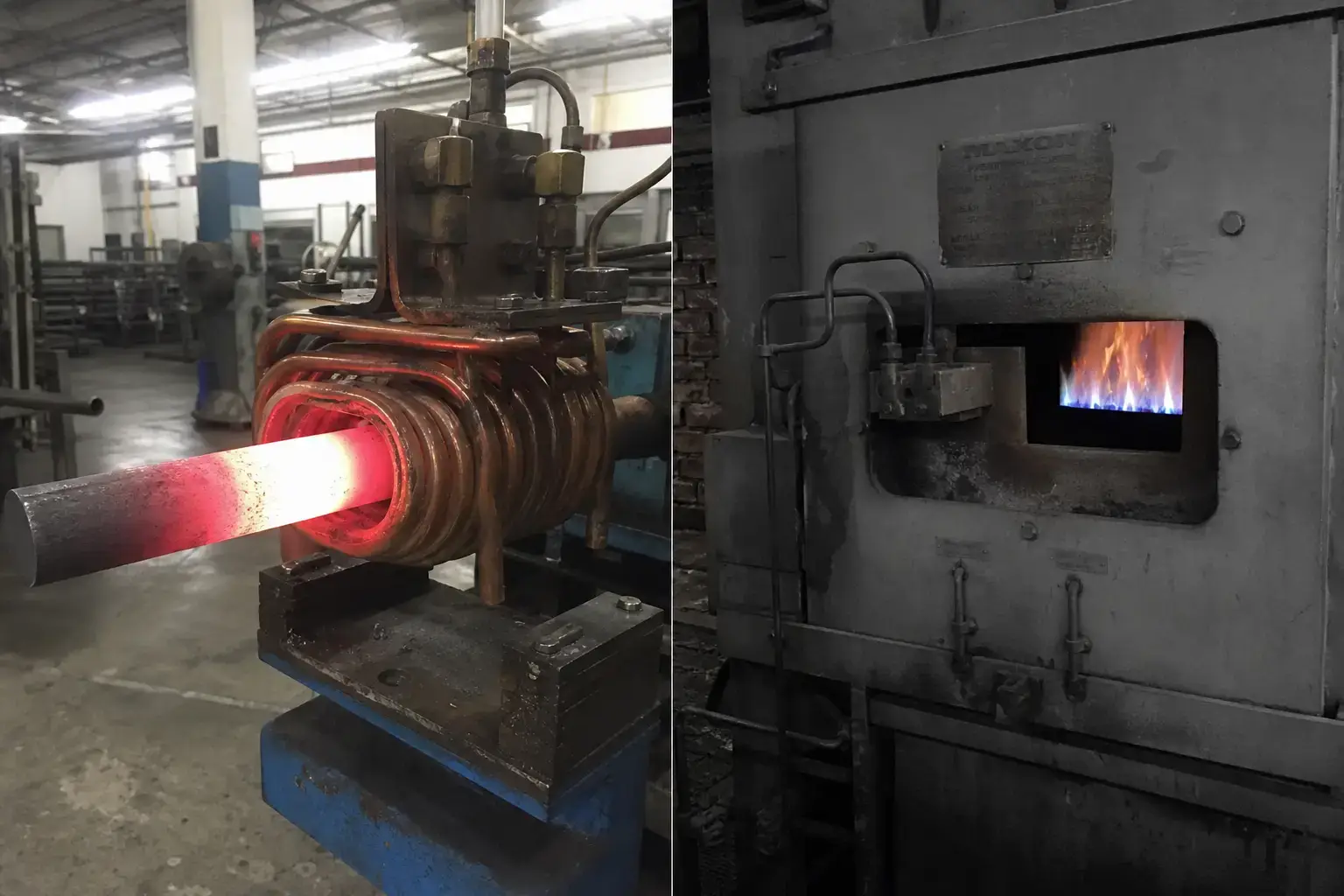
1. How Each Technology Works
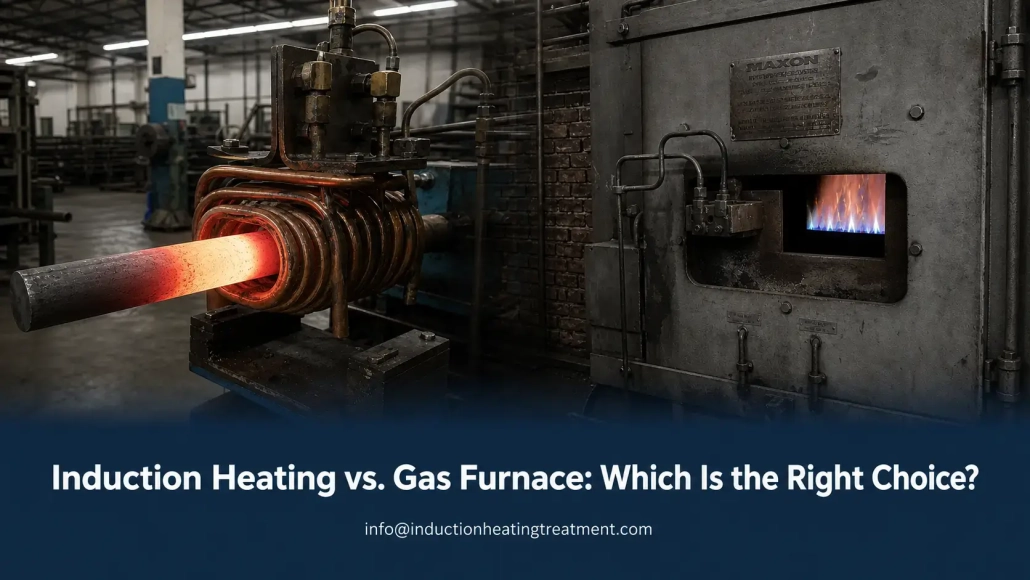
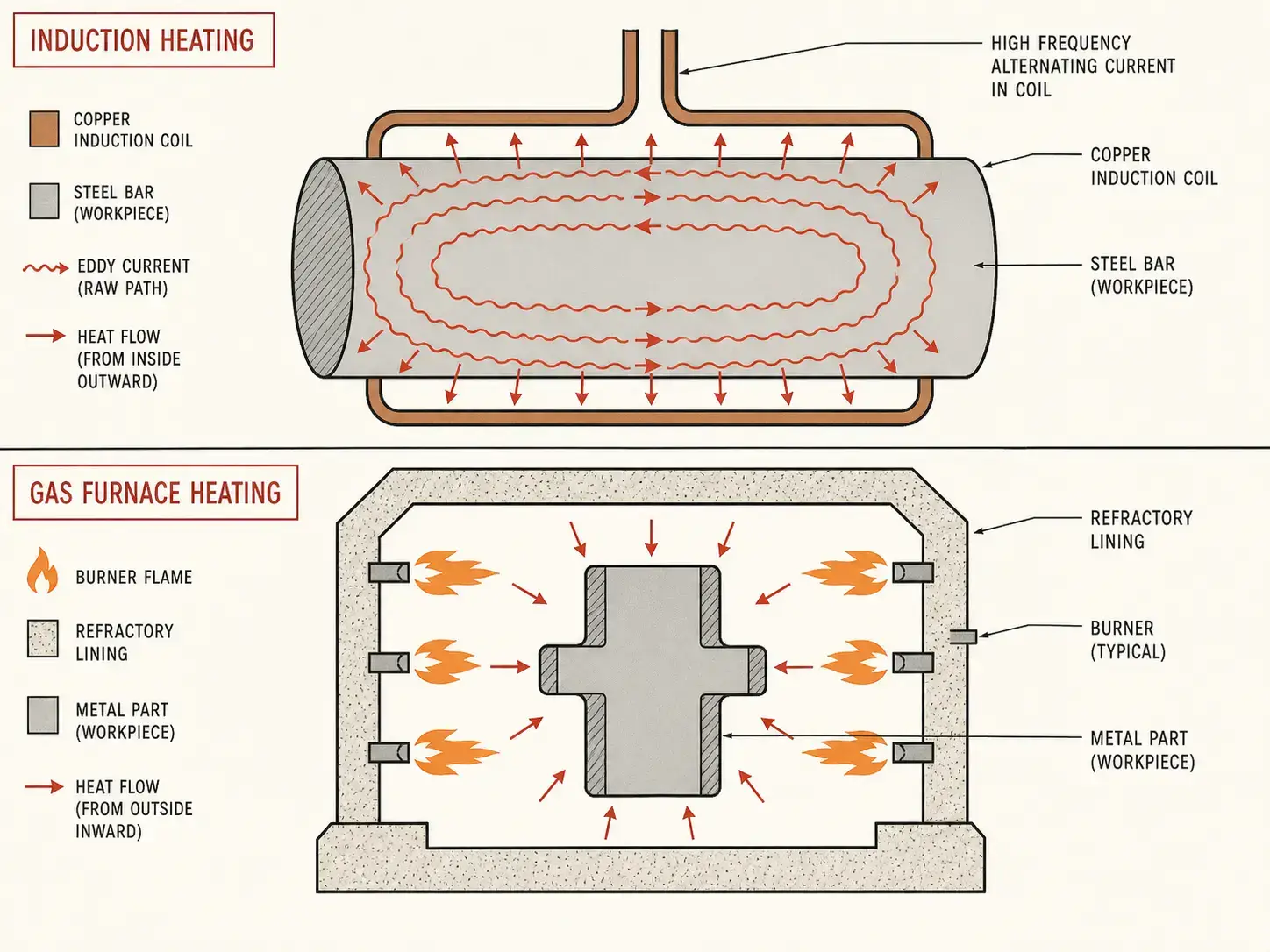
Induction heating uses electromagnetic energy to heat electrically conductive materials. An induction power supply sends alternating current through a copper coil, creating a magnetic field. When a metal part enters that field, electrical currents — eddy currents — are induced within the part itself. These currents generate heat directly inside the material. No flame. No hot atmosphere. The part is its own heat source.
A gas furnace burns natural gas or propane inside a refractory-lined chamber. Heat transfers to the workpiece through convection, radiation, and conduction — the chamber air gets hot, the walls get hot, and eventually the part gets hot. It is a proven, widely available technology that has powered industry for over a century.
The fundamental distinction is simple: induction generates heat inside the metal; a gas furnace pushes heat into it from the outside. That difference cascades into everything else — speed, efficiency, control, and cost.
2. Heating Mechanism: Inside vs. Outside
Because induction heats the part directly, energy is not wasted raising the temperature of the surrounding air, furnace walls, or conveyor structure. That translates to faster startup, less idle fuel consumption, and the ability to heat only the zone you care about — a gear tooth, a pipe end, a billet face.
A gas furnace heats everything inside the chamber. That is an advantage when you need uniform soaking of an entire batch, but a liability when you only need to heat a specific area. The furnace itself must reach temperature before productive heating begins, which adds warm-up time and baseline fuel consumption on every shift.
3. Speed and Energy Efficiency
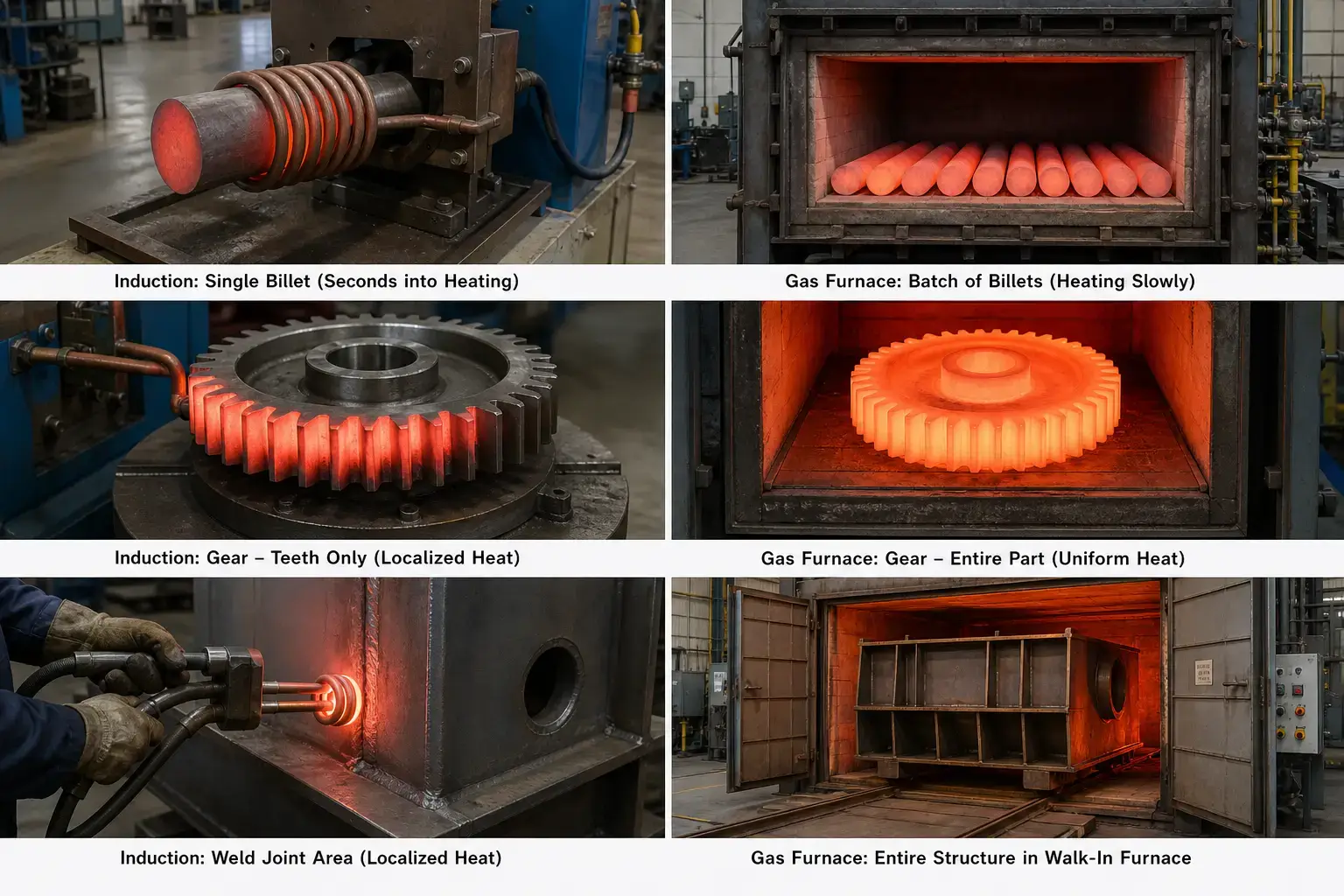
Induction heating is significantly faster for compatible materials and part geometries. A steel billet, gear, or pipe end can reach forging or brazing temperature in seconds to minutes — not the tens of minutes to hours a gas furnace typically requires. The speed gap widens as part size decreases and production tempo increases.
On the energy side, induction delivers a higher percentage of input electricity directly into the workpiece. Gas furnaces lose energy through exhaust gases, hot refractory walls, door openings, and repeated heat-up and cool-down cycles. While modern recuperative burners have improved gas furnace efficiency, they still cannot match the localized energy delivery of induction for targeted heating. For a deeper look at the numbers, see our guide on induction heating power calculation.
| Factor | Induction Heating | Gas Furnace |
|---|---|---|
| Typical heat-up time | Seconds to minutes | Minutes to hours |
| Warm-up from cold start | Instant — no preheating required | 30–90 min to bring chamber to temperature |
| Energy delivery | Direct to workpiece — minimal losses to surroundings | Heats entire chamber — losses through exhaust and walls |
| Idle energy consumption | Near zero when not cycling | Continuous fuel burn to maintain chamber temperature |
| Efficiency range | Typically 50–80% (power supply to workpiece) | Typically 15–35% (fuel to workpiece, batch-dependent) |
4. Process Control, Safety, and Emissions
Process control. Induction systems provide precise control over heating time, power level, frequency, and heat pattern. Once parameters are validated, each part receives nearly identical heating conditions — critical for applications with tight hardness or metallurgical specifications. Gas furnaces control chamber temperature well but cannot target a specific zone on a part or switch profiles in seconds.
Safety and work environment. Gas furnaces involve open flames, combustible fuel lines, hot exhaust, and high ambient heat radiating from the chamber. They require gas detection, ventilation, and operator training. Induction systems carry their own hazards — high voltage and hot water under pressure — but because heat is generated inside the workpiece, the surrounding environment stays cooler. No combustion byproducts, no open flame, and typically less demand on facility ventilation and cooling infrastructure.
Emissions. Gas furnaces produce CO₂ and potentially NOx at the point of use. Induction uses electricity and generates zero on-site combustion emissions. For facilities pursuing sustainability targets or operating in regions with strict air-quality regulations, this difference alone can tip the decision.
5. When Induction Is the Better Choice
Induction heating consistently outperforms gas furnaces when the application calls for speed, precision, and repeatability. The strongest cases for induction include:
— Localized heating — only a specific zone needs heat (gear teeth, pipe ends, brazed joints)
— High-speed production — continuous or short-cycle operation (forging billets, tube welding, wire heating)
— Repeatable heat treating — consistent case depth and hardness from part to part
— Limited floor space — compact footprint, no exhaust ducting, no fuel storage
— Automated lines — easy integration with PLC, robotics, and recipe-based changeover
— Emissions reduction — zero on-site combustion, simpler permitting, better indoor air quality
Power supply selection is critical here. Frequency must match the heating depth you need, and power must match the throughput. Our induction heating power selection guide covers that in detail.
6. When a Gas Furnace Still Makes Sense
Induction is not a universal replacement for gas. Gas furnaces remain the practical choice in several scenarios:
— Large batch processing — hundreds or thousands of parts require uniform heating at once, and cycle time is less important than total load capacity
— Long soak cycles — annealing, normalizing, and stress relieving demand extended time at temperature, where a chamber holding steady is the simpler solution
— Very large or irregular components — oversized castings, heavy weldments, and awkward geometries that do not fit easily inside an induction coil
— Non-conductive materials — ceramics, glass, and certain composites cannot be heated by induction
— Lower upfront budget with existing gas infrastructure — if natural gas service, exhaust ducting, and trained personnel are already in place, a gas furnace may have a lower barrier to entry
7. Cost: Purchase Price vs. Operating Cost
A gas furnace often carries a lower purchase price — especially when gas infrastructure already exists. Induction systems can demand a higher upfront investment when custom coils, automation, cooling systems, and specialized power supplies are required.
However, operating cost tells a different story. Induction can deliver savings through lower energy consumption, faster cycles, reduced scrap, less distortion, lower labor requirements, smaller floor space, and reduced ventilation load. For high-volume production, the operating savings can recover the upfront premium within one to three years.
A complete cost comparison should weigh all ten line items — purchase price, installation, energy, maintenance, production rate, scrap and rework, labor, emissions compliance, downtime risk, and expected equipment life. The lowest purchase price rarely equals the lowest total cost over five to ten years. If you are evaluating a full induction system purchase, factor all of these into your comparison.
8. Quick Self-Score: Does Your Application Lean Induction?
Check each statement that applies to your application. The more boxes you check, the stronger the case for induction.
☐ My workpiece is electrically conductive (steel, copper, aluminum, brass).
☐ I need to heat only a specific zone — not the entire part.
☐ Cycle time under 60 seconds matters to my throughput.
☐ Temperature precision directly affects part quality or scrap rate.
☐ Floor space is constrained, or I want to integrate heating into an existing production cell.
☐ Combustion emissions or ventilation are a permitting or compliance concern.
☐ I need PLC integration, recipe-based changeover, or automated part handling.
☐ My electricity cost per kWh is competitive with — or lower than — natural gas in my region.
Score 6–8: Induction is likely your best fit. The technology was built for these conditions.
Score 3–5: You are in the gray zone. Get a sample test run on your actual parts before deciding.
Score 0–2: A gas furnace may still be the more practical choice. Revisit Sections 6 and 7 above.
Key Takeaway
The induction heating vs gas furnace decision comes down to your application, not a universal rule. Induction wins on speed, precision, energy efficiency, and emissions for localized metal heating. Gas furnaces still hold their ground for large batch processing, long soak cycles, and oversized components. The right call is the one where the technology matches the process — not the other way around.
Q: Can induction heating fully replace a gas furnace in a heat-treating shop?
A: It depends on your part mix. If most of your work involves localized heating of conductive metals — hardening, brazing, forging billet heating — induction can replace a large share of gas furnace operations. Shops that rely on batch annealing, stress relieving large weldments, or processing non-conductive materials will likely keep gas as part of their equipment mix.
Q: What is the typical payback period for switching from gas to induction?
A: For high-volume production — forging lines, tube welding, automotive component hardening — payback commonly falls within 12 to 36 months through energy savings, faster cycles, reduced scrap, and lower maintenance. For low-volume or occasional-use applications, the payback stretches longer and gas may remain the more economical choice.
Q: Does induction heating work for large parts?
A: Yes — but it depends on geometry. Large shafts, rolls, and pipes are routinely heated by induction with properly designed coils. The limitation is not part size alone; it is whether the part can be positioned effectively within or near the coil. Very large castings or irregular weldments may still be better served by a gas furnace, while long linear parts often handle well with scan induction.
Considering the Switch from Gas to Induction?
Send us your workpiece details and production requirements. We will evaluate whether induction fits your process — and recommend a system sized to your parts, not a generic quote.