
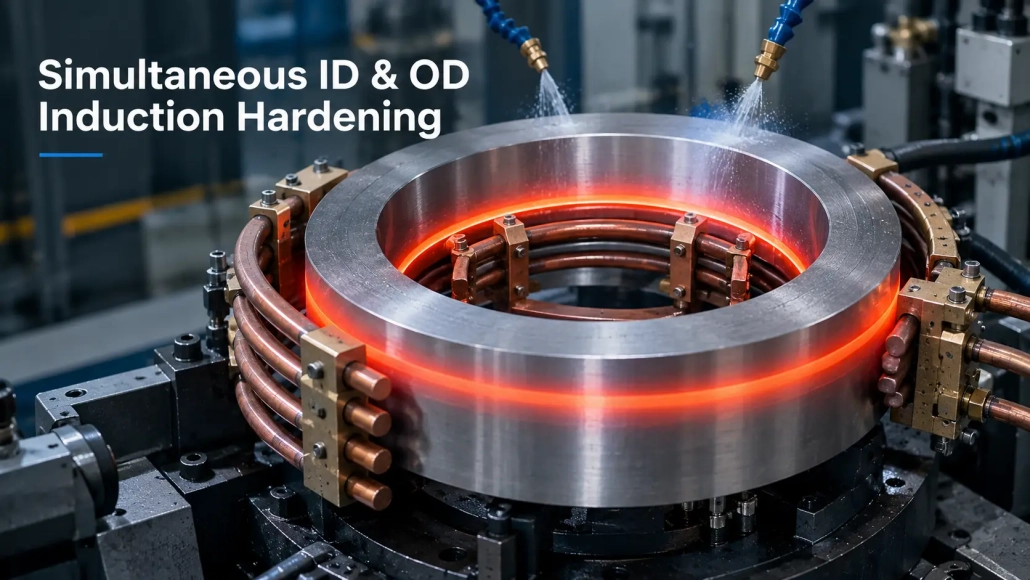
Can the Inner and Outer Diameters Be Induction Hardened at the Same Time?
Some ring-shaped components require induction hardened surfaces on both the outer diameter (OD) and the inner diameter (ID). The usual approach is straightforward: harden one surface first, then process the other.
That works, but it also creates an extra operation.
When the OD is hardened first and the ID is heated afterward, the already-hardened outer surface may need to be protected with water spray to prevent unwanted tempering during the second heating cycle. The inductor also has to be changed, and the part goes through two separate hardening operations.
For repeated production, that additional handling can become a practical problem.
A different approach is to heat the ID and OD at the same time.
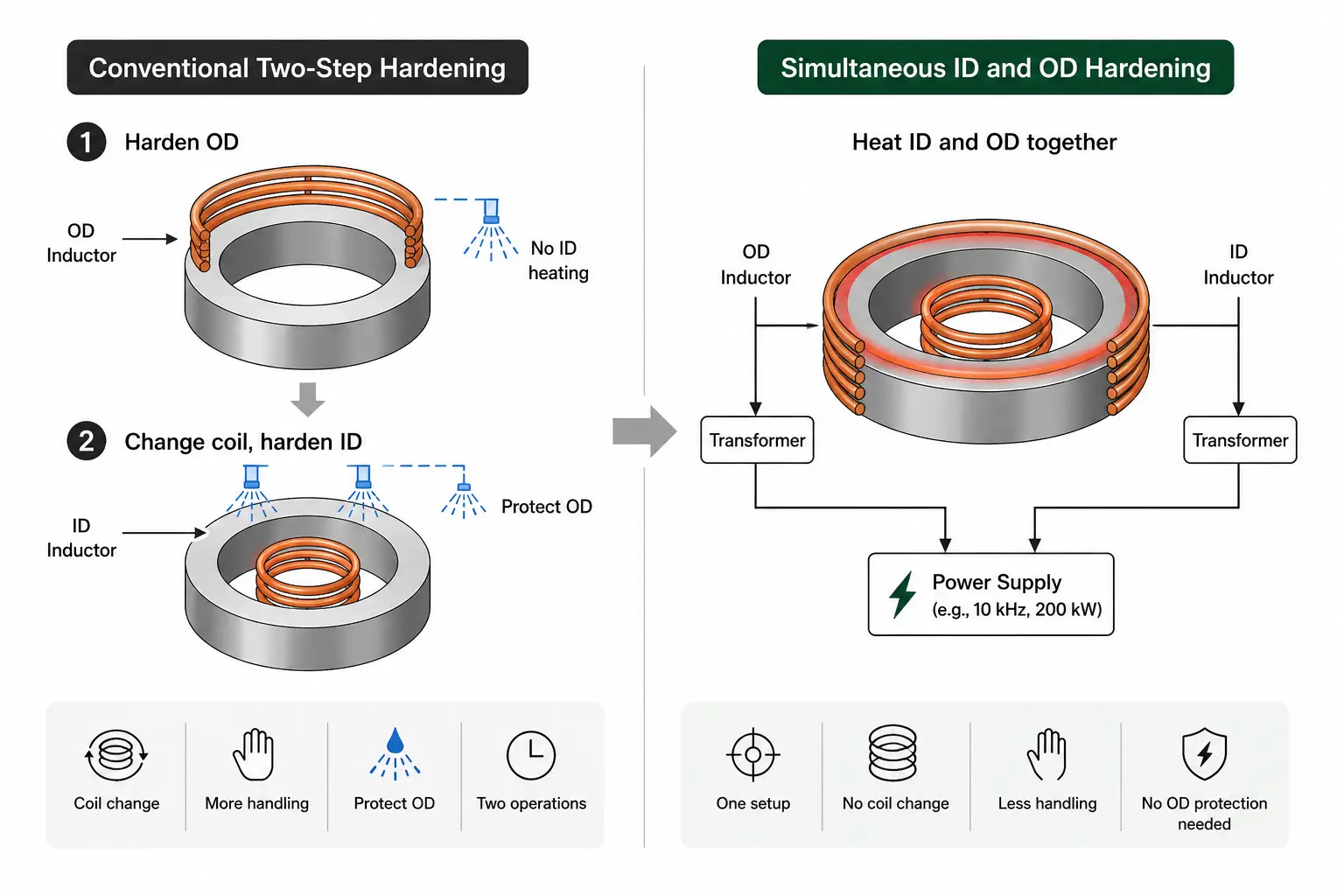
The conventional two-step route needs a coil change and a second setup; the simultaneous route heats both surfaces in one position.
| 1. How Simultaneous ID & OD Hardening Works | 2. The Difficult Part Is Power Balance |
| 3. Planetary Ring Gear Example | 4. Can the Same Principle Be Used for Other Parts? |
| 5. When Is It Worth Considering? |
1. How Simultaneous ID and OD Induction Hardening Works
In this arrangement, two inductors are positioned around the same workpiece: one for the outside surface and another for the bore.
A ring-shaped part is loaded into the hardening machine and moved into the heating position so that the OD and ID are coupled with their respective inductors at the same time.
Each inductor is connected to its own hardening transformer. In the planetary ring gear example shown below, both transformers are supplied by the same induction power source.
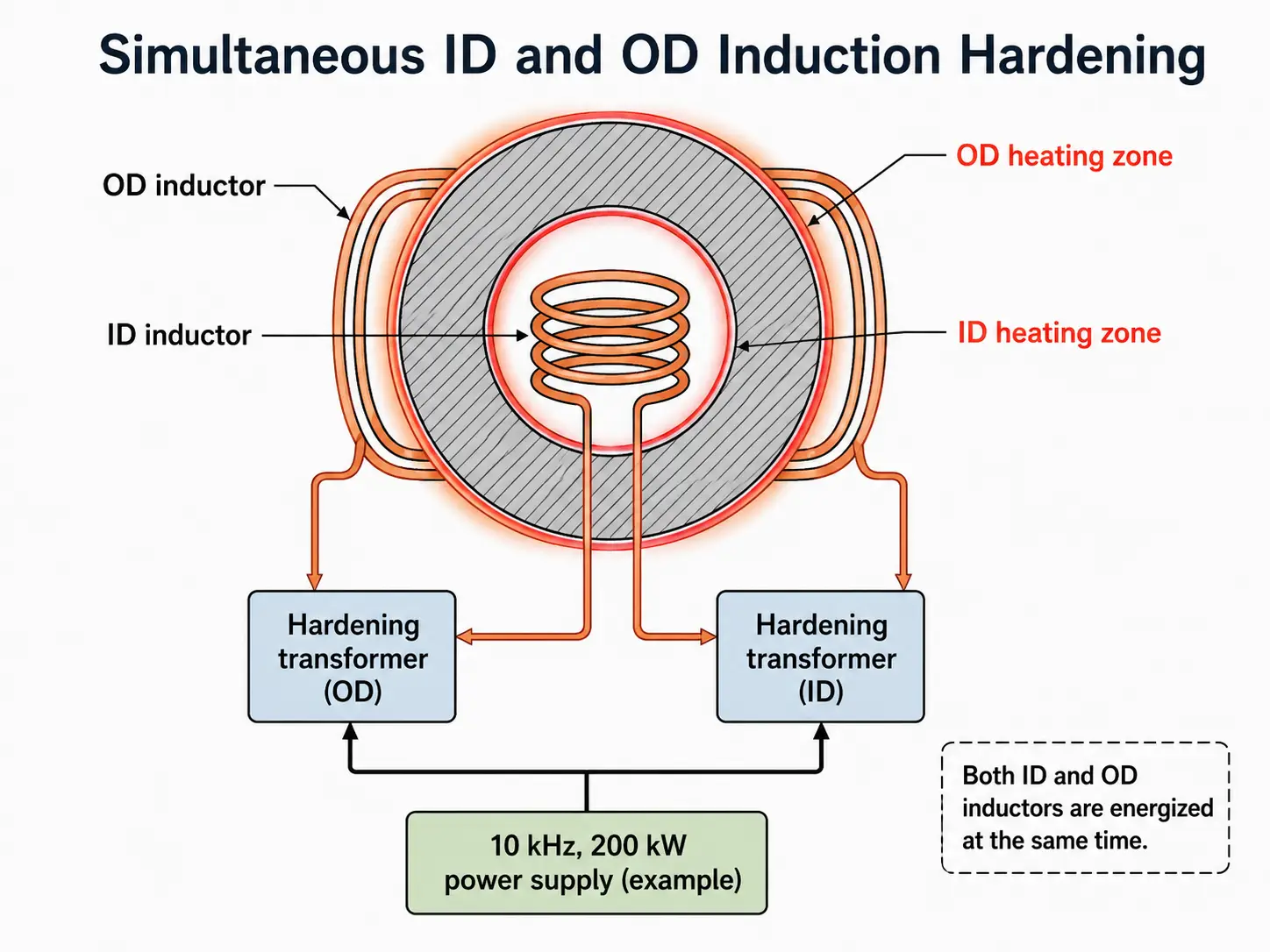
Two inductors — one around the OD, one inside the bore — each fed by its own transformer from the same power source.
This eliminates the need to harden the two surfaces in completely separate setups.
The idea itself is simple. Making the heating work correctly is less simple.
2. The Difficult Part Is Power Balance
The OD and ID inductors cannot be treated as two identical loads.
Their coil geometry, coupling with the workpiece and heating conditions are different. Simply dividing the available power equally between the two does not guarantee that both surfaces will reach the required heating condition.
Power distribution has to be matched to the application.
In the referenced process, this matching was achieved by changing the number of turns in the inductors and using magnetic flux concentrators. The purpose was to obtain a suitable distribution of power between the inner and outer heating zones.
This is one of the main technical points of simultaneous ID and OD hardening.
The question is not just whether two coils can be connected at the same time. Both heating circuits have to work together on the actual workpiece.
Wall thickness also matters. When the two surfaces are relatively close, heating from the ID and OD can interact through the section of the part. The source example does not give a universal minimum or maximum wall thickness, so this has to be evaluated for each component rather than treated as a fixed design rule.
3. Planetary Ring Gear Example
One reported application used this method for a planetary ring gear.
The workpiece had a wall thickness of 12.7 mm. A 10 kHz, 200 kW induction power supply supplied two hardening transformers, with one transformer connected to the OD inductor and the other to the ID inductor.
The two inductors heated the outer and inner surfaces in the same setup.
These numbers are useful as a real process example, but they should not be treated as standard specifications for simultaneous ID and OD hardening.
A different ring diameter, wall thickness, material or hardened area may require a different frequency, power level or inductor arrangement.
That distinction is important. In induction hardening, copying the electrical parameters from another part is rarely a substitute for matching the process to the workpiece.
4. Can the Same Principle Be Used for Other Parts?
The same concept is not limited to planetary ring gears.
The referenced process also suggests that thick-wall pin bushings can be hardened by simultaneous ID and OD scanning.
In that case, instead of heating the complete required area at one fixed position, the inner and outer surfaces can be processed as the workpiece or heating system moves through the required hardening length.
This opens the possibility of applying the method to other annular components, provided that there is enough space for the two inductors and the heating conditions can be matched properly.
That does not mean simultaneous hardening is always the better choice.
For low production volumes, parts with difficult coil access, or applications where the ID and OD require very different heating conditions, two separate hardening operations may still be simpler to develop and control.
5. When Is Simultaneous ID and OD Induction Hardening Worth Considering?
The process becomes more interesting when the same component repeatedly requires hardening on both the bore and the outside surface.
Avoiding a second setup can reduce coil changes and repeated part handling. It also removes the need to protect a previously hardened surface from the second heating cycle in the same way as the conventional two-step process.
But those advantages only matter if the two heating zones can be balanced properly.
For this reason, simultaneous ID and OD induction hardening is better treated as a workpiece-specific process rather than a standard machine function.
If you are evaluating this method for a ring gear, bushing or another annular part, the starting point should be the workpiece drawing: ID, OD, wall thickness and the exact surfaces that require hardening.
From that information, it is much easier to judge whether simultaneous hardening is practical or whether a conventional two-step process remains the better option.
Key Takeaway
Simultaneous ID and OD induction hardening is best treated as a workpiece-specific process, not a standard machine function. The setup is simple in principle, but it depends on one chain working together:
Two inductors → Two transformers → One power source → Balanced power distribution → Both surfaces hardened in one setup
The practical question is power balance — whether the two heating circuits can work together on the actual workpiece. If they can, one setup replaces two separate operations.
Frequently Asked Questions
Click a question to expand the answer.
Can the OD and ID be hardened in a single setup?
Yes. Two inductors are positioned around the same workpiece — one for the outside surface and one for the bore — and each is connected to its own hardening transformer. The challenge is not simply connecting both coils, but balancing the power between the two heating zones.
Is simultaneous hardening always the better choice?
No. For low production volumes, parts with difficult coil access, or applications where the ID and OD need very different heating conditions, two separate operations may still be simpler to develop and control.
What power supply is needed for simultaneous ID and OD hardening?
There is no single standard. A reported planetary ring gear example used a 10 kHz, 200 kW supply feeding two transformers, but a different diameter, wall thickness, material or hardened area may require a different frequency, power level and inductor arrangement.
Hardening Both the OD and ID on One Part?
Send us your workpiece drawing — ID, OD, wall thickness and the surfaces to be hardened — and we will help you judge whether simultaneous ID and OD hardening fits your part.


