
Can Stainless Steel Be Induction Hardened? Why the Stainless Steel Grade Matters
How Martensitic, Austenitic and Ferritic Stainless Steels Respond to Induction Hardening
Stainless steel can be heated by induction, but its ability to develop a hardened surface after quenching depends on the steel grade. A heating process that produces martensite in one stainless steel may produce little or no hardening in another.
This distinction matters when selecting materials for shafts, spindles, valve components and other parts that require a hard working surface while retaining specified mechanical or corrosion-resistant properties.
Quick Answer: Martensitic stainless steels such as 410, 420 and 440C can be candidates for induction hardening. Austenitic grades such as 304 and 316, and ferritic grades such as 430 and 410S, cannot be hardened through the same conventional austenitizing-and-quenching process. Precipitation-hardening grades such as 17-4PH require separate consideration because their principal strengthening mechanism is different.
2. Which Stainless Steel Grades Are Suitable for Induction Hardening?
3. Why Do Different Stainless Steel Grades Respond Differently?
4. What Makes Induction Hardening Martensitic Stainless Steel Different?
5. What Should Be Checked Before Induction Hardening Stainless Steel?
1. Can Stainless Steel Be Induction Hardened?
Yes. However, conventional induction quench hardening is suitable only for stainless steels capable of developing the required martensitic structure.
In induction hardening, an alternating magnetic field generates heat within a selected region of the workpiece. For a suitable steel, the heated region is austenitized and then rapidly cooled to form martensite, increasing its hardness.
The process can produce a hardened surface layer while limiting thermal exposure elsewhere in the component. Whether the required hardness and hardened depth can be achieved depends on both the material and the heating and quenching cycle.
Induction heating and induction hardening are different.
Induction heating describes the method of generating heat. Induction hardening requires a particular metallurgical response.
For example, 304 and 316 stainless steels can be heated by induction. Their electrical and magnetic properties influence heating behavior, but they do not prevent electromagnetic induction from generating heat.
The limitation is metallurgical: conventional heating and quenching do not transform these austenitic stainless steels into a hardened martensitic structure.
By contrast, suitable martensitic stainless steels can undergo the necessary transformation.
The important question is therefore not simply whether stainless steel can be induction heated, but whether its composition and structure allow the required hardening transformation.
2. Which Stainless Steel Grades Are Suitable for Induction Hardening?
Stainless steels are divided into several families according to their composition and metallurgical structure. The family and exact grade are more useful indicators of quench-hardening suitability than the general designation stainless steel.
| Stainless steel type | Typical grades | Conventional induction quench-hardening response |
|---|---|---|
| Martensitic | 410 | Quench-hardenable, with relatively limited hardness potential compared with higher-carbon martensitic grades |
| Martensitic | 420 | Quench-hardenable; attainable hardness depends on the particular grade and carbon content |
| Martensitic | 440C | Quench-hardenable, but its high alloy and carbide content requires careful process development |
| Austenitic | 304, 316 | No conventional martensitic hardening response after heating and quenching |
| Ferritic | 430, 410S | Not suitable for conventional martensitic quench hardening |
| Duplex | 2205 | Not suitable for this conventional hardening route |
| Precipitation-hardening | 17-4PH | Strengthened primarily through its specified precipitation-hardening treatment |
410, 420 and 440C are not interchangeable.
410 is a relatively low-carbon martensitic stainless steel. It can respond to hardening heat treatment, although its attainable hardness is generally lower than that of higher-carbon grades.
420 has greater hardening potential, but the designation covers materials with different carbon levels and specifications. The exact grade must be confirmed before establishing a hardening process.
440C contains substantially more carbon and alloy carbides. It offers high hardness and wear resistance, but achieving a suitable final microstructure can be more demanding, particularly under short heating cycles.
The industry publication Surface Hardening of Stainless Steels by Euro Inox identifies martensitic grades including 420 and 440C as induction-hardenable stainless steels.
410 and 410S must also be distinguished.
Although their designations are similar, 410S is a low-carbon, non-hardening modification of 410. Its predominantly ferritic structure and composition restrict its ability to develop martensitic hardness through quenching.
This illustrates why the exact material designation matters. A general description such as 400-series stainless steel is not sufficient for determining induction-hardening suitability.
What about 17-4PH?
17-4PH is a martensitic precipitation-hardening stainless steel. Its specified strengthening treatment involves the formation of a martensitic matrix and subsequent aging to develop strengthening precipitates.
It is not normally treated through the conventional localized induction quench-hardening route discussed here.
This does not rule out induction heating as a possible heat source for particular operations. It means that the appropriate treatment must follow the material’s precipitation-hardening requirements rather than a conventional 410 or 420 hardening cycle.
The British Stainless Steel Association’s guidance on precipitation-hardening stainless steels explains the different strengthening mechanisms used by these alloys.
3. Why Do Different Stainless Steel Grades Respond Differently?
The key difference is the material’s ability to form a suitable austenitic structure during heating and transform into martensite during cooling.
Martensitic stainless steels: transformation-based hardening
Martensitic stainless steels contain compositions that permit austenitization and subsequent martensitic transformation.
During appropriate heating, austenite forms in the region being treated. Quenching then produces martensite, which provides the principal increase in hardness.
Carbon is important because the hardness of martensite depends strongly on its carbon content. Chromium and other alloying elements influence austenite formation, hardenability and transformation temperatures.
However, the total carbon content listed in a material specification does not necessarily equal the carbon dissolved in austenite during a particular heating cycle.
Some carbon may remain in undissolved carbides, especially in higher-alloy grades. This becomes important when austenitization takes place over a short period.
Austenitic stainless steels: stable austenite
Grades such as 304 and 316 are designed to retain an austenitic structure under normal service conditions.
Nickel and other alloying elements help stabilize this structure. Conventional solution heating followed by rapid cooling therefore does not produce the martensitic quench-hardening response associated with grades such as 420.
Some austenitic stainless steels can form strain-induced martensite during cold deformation. Their hardness can also increase through work hardening.
These effects are different from thermal induction quench hardening.
Austenitic stainless steels may also receive specialized surface treatments to improve wear resistance or surface hardness, but those treatments involve different mechanisms.
Ferritic and duplex stainless steels: different phase behavior
Ferritic stainless steels, including 430 and 410S, do not possess the composition and transformation response needed for conventional martensitic quench hardening.
Duplex stainless steels are designed to contain both ferrite and austenite. Their properties depend on controlling the balance and stability of these phases rather than forming a conventional martensitic hardened case.
Heating these materials can alter their microstructure under certain conditions, but such changes are not equivalent to the desired induction-hardening transformation.
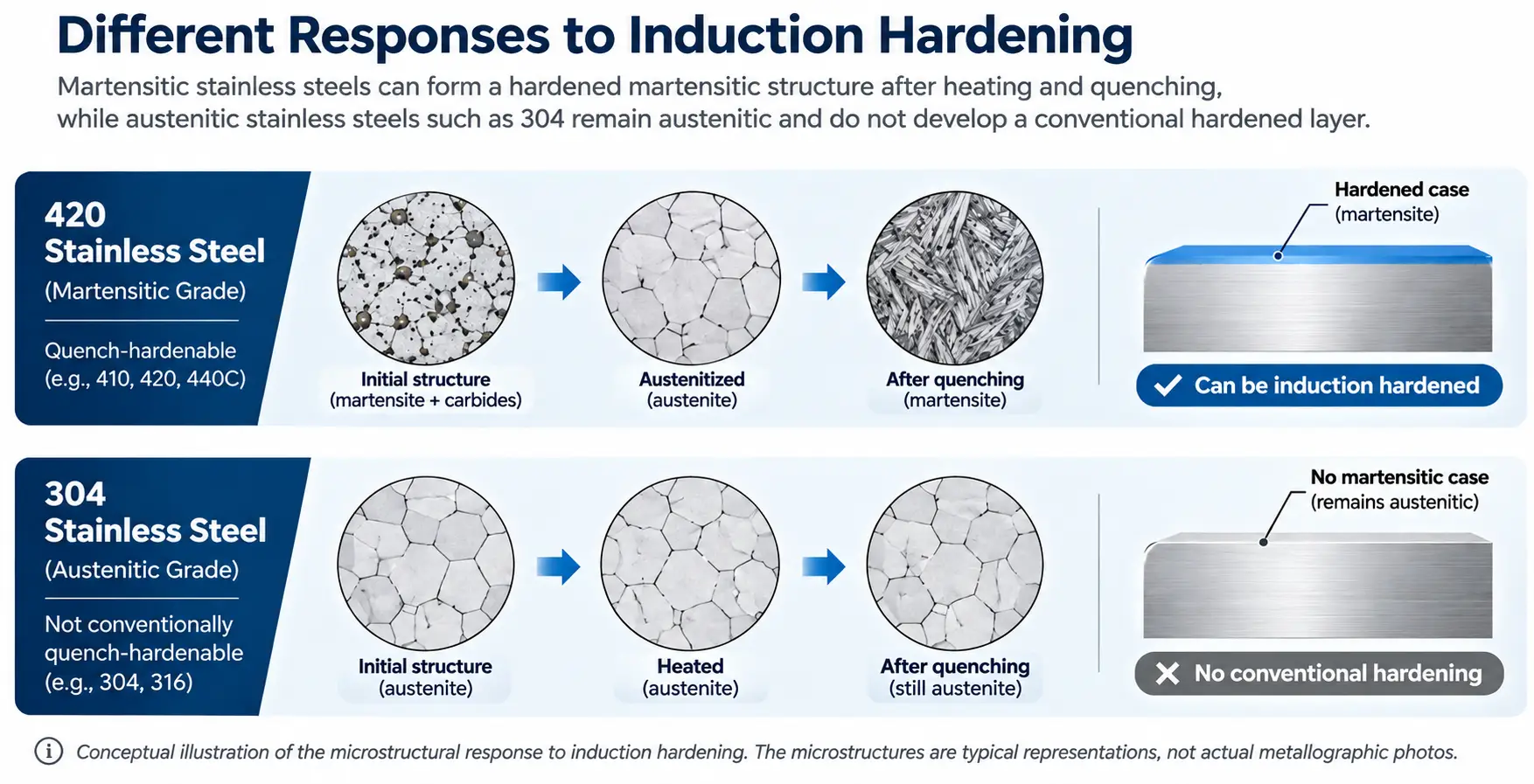
The distinction is important in material selection: corrosion resistance, induction-heating behavior and quench hardenability are separate properties.
A stainless steel selected primarily for corrosion resistance may not be suitable when the component also requires a martensitic hardened surface.
4. What Makes Induction Hardening Martensitic Stainless Steel Different?
Martensitic stainless steels can be heat treated by conventional methods, but a furnace-hardening cycle cannot simply be transferred to an induction process.
Induction hardening may involve rapid heating and short exposure at the austenitizing temperature. Under these conditions, the original microstructure and the time available for carbide dissolution can strongly influence the result.
Short heating time and carbide dissolution
Martensitic stainless steels may contain chromium-rich alloy carbides before hardening.
During austenitization, some of these carbides dissolve and release carbon and alloying elements into the surrounding austenite.
The extent of dissolution affects the composition of the austenite and therefore its subsequent transformation during quenching.
With a short induction-heating cycle, reaching a target temperature does not automatically mean that carbide dissolution and austenitization have progressed sufficiently.
A material containing coarse or unevenly distributed carbides may respond differently from the same grade in a more suitable initial condition.
Conversely, increasing the temperature or extending the heating time without considering the material response may cause unwanted changes in the final microstructure.
Evidence from ultra-short austenitization research
A 2026 study, Ultra-short austenitization and thermal cycle effects in martensitic stainless steel: phase transformation kinetics and carbide evolution, investigated rapid heating and short austenitizing cycles in X46Cr13 martensitic stainless steel.
The researchers found that variations in the thermal cycle affected carbide dissolution, austenite composition, martensitic transformation and retained austenite.
The study also demonstrated that more extensive carbide dissolution did not automatically produce the most desirable combination of microstructural properties.
These findings help explain why the short-time response of martensitic stainless steel requires attention.
The research was conducted under controlled experimental conditions using a particular steel and specimen geometry. Its individual temperature and time combinations should not be treated as universal production settings for induction hardening.
Retained austenite and final hardness
As carbon and alloying elements dissolve into austenite, they can change its stability and the temperature at which martensitic transformation begins.
Under some conditions, a portion of the austenite remains untransformed after quenching.
Retained austenite can influence hardness and dimensional stability. Its presence and significance depend on the grade, thermal cycle and finished-component requirements.
For higher-carbon martensitic stainless steels, achieving the required final hardness involves more than maximizing the amount of carbon dissolved during heating.
The balance between martensite, retained austenite and remaining carbides can be important.
Tempering and corrosion requirements
A suitable tempering treatment may be needed after quenching to obtain the required combination of hardness and toughness.
The tempering response varies with stainless steel composition, so a treatment developed for conventional carbon steel may not provide the desired result.
Corrosion performance also remains an important consideration. Heat treatment and subsequent finishing can affect carbide distribution, surface oxidation and the condition of the corrosion-resistant surface.
The extent of any effect depends on the specific material and processing conditions.
For components exposed to corrosive environments, the final heat-treated and finished condition should be assessed against the application requirements rather than judged by hardness alone.
5. What Should Be Checked Before Induction Hardening Stainless Steel?
A successful process begins with the material specification and the required finished properties.
Confirm the exact grade and starting condition
Identify the material using its applicable standard designation and composition requirements.
Check whether it is martensitic, austenitic, ferritic, duplex or precipitation-hardening stainless steel.
For a quench-hardenable grade, the starting condition also matters. Annealed, previously hardened and tempered materials may contain different carbide distributions and respond differently during short-time heating.
Define the required hardened region
Specify the working surface or region to be hardened, along with the required hardness and applicable case-depth criteria.
Core properties, dimensional tolerances and corrosion-resistance requirements may also influence the acceptable treatment.
These requirements should be established before selecting the heating cycle.
Evaluate the actual hardening response
For a suitable martensitic grade, representative process trials can determine whether the required hardened region and properties are achievable.
Evaluation may include:
— Surface or cross-sectional hardness measurements.
— Hardness traverses where a defined hardened depth is required.
— Metallographic examination of the hardened structure.
— Checks for cracking, distortion and other unacceptable changes.
— Additional assessment of retained austenite or corrosion performance when specified.
The general inspection methods are covered separately in How to Inspect Induction-Hardened Parts.
Select another hardening route when the grade requires it
If the component is made from 304, 316 or another stainless steel that does not respond to conventional martensitic quench hardening, changing the induction frequency or increasing heating power will not create the missing transformation mechanism.
Material substitution or an appropriate alternative surface treatment may be necessary, depending on the required properties.
For precipitation-hardening grades such as 17-4PH, the specified solution-treatment and aging sequence must guide the heat-treatment decision.
The practical starting point is therefore the material’s hardening mechanism. Once the grade is confirmed as suitable, the induction process can be developed and verified against the finished-component requirements.
Key Takeaway
Stainless steel induction hardening works only on grades that can form martensite — primarily 410, 420 and 440C. Austenitic, ferritic and duplex grades do not respond to conventional quench hardening. For a suitable martensitic grade, the short induction cycle means carbide dissolution and austenitization must be verified, not assumed.
Frequently Asked Questions
Click a question to expand the answer.
Can 304 or 316 stainless steel be induction hardened?
No. 304 and 316 are austenitic grades; conventional heating and quenching does not transform them to martensite, so there is no quench-hardening response. They can be induction heated, but not hardened through this route.
What is the difference between 410 and 410S?
410S is a low-carbon, non-hardening modification of 410. Its predominantly ferritic structure prevents it from developing martensitic hardness, which is why the exact designation must be confirmed before hardening.
Can a furnace hardening cycle simply be transferred to induction?
Not directly. Induction uses rapid heating and short time at temperature, so carbide dissolution and austenitization may be incomplete. The starting microstructure and thermal cycle must be verified for the specific grade.
Does induction hardening affect corrosion resistance?
It can, through changes in carbide distribution and surface oxidation. For corrosive service, the final heat-treated and finished condition should be assessed against the application rather than judged by hardness alone.
Need to Induction Harden a Stainless Steel Part?
Send your material grade and part drawing — we’ll confirm whether it’s quench-hardenable and develop a verified process.


