
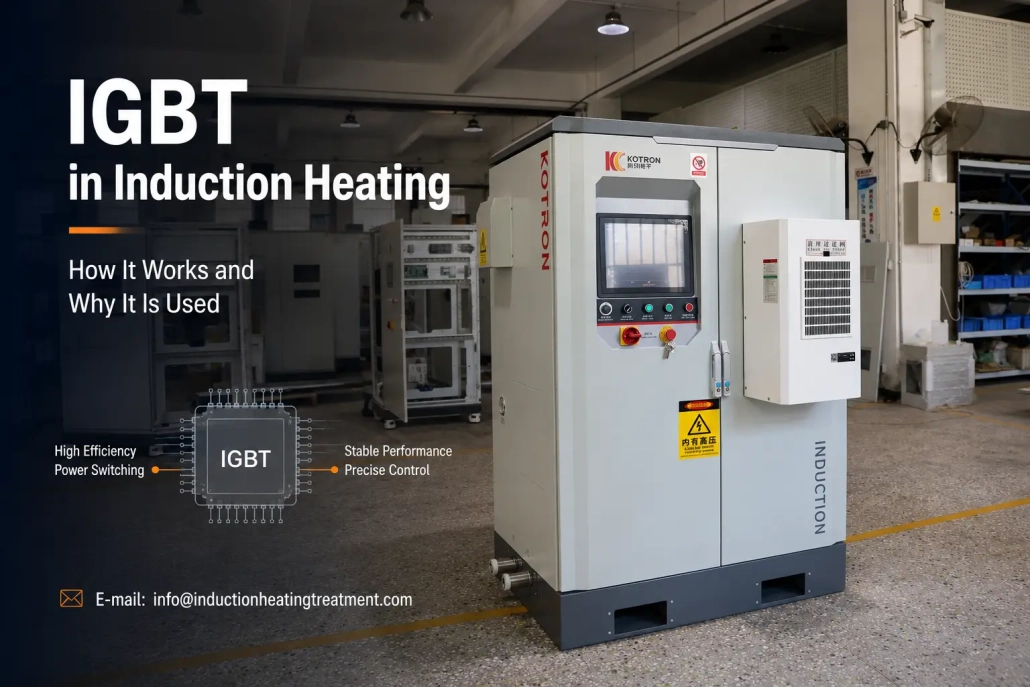
IGBT in Induction Heating Power Supplies: How It Works and Why It Is Used
IGBT is one of the most common power semiconductor devices used in industrial induction heating equipment. In a typical induction heating power supply, it sits inside the inverter stage and switches DC power into the alternating electrical energy required by the resonant circuit and induction coil.
A simplified power path is:
AC Input → Rectifier → DC Bus → IGBT Inverter → Resonant Circuit → Induction Coil → Workpiece
The IGBT does not determine the heating result by itself. It is one part of a system in which the inverter, resonant components, induction coil and load have to work together.
| Ⅰ. What Is an IGBT? | Ⅳ. IGBT Switching and the Resonant Heating Circuit |
| Ⅱ. Why Use IGBTs in an Induction Heating Power Supply? | Ⅴ. What Do IGBT and DSP Each Do? |
| Ⅲ. IGBT or MOSFET? |
Ⅰ. What Is an IGBT?
IGBT stands for Insulated Gate Bipolar Transistor. It is a power semiconductor device with three main terminals: gate, collector and emitter.
For induction heating equipment, the important point is fairly simple: an IGBT can switch relatively high voltage and current while being controlled from its gate. This makes it suitable for many medium- and high-power inverter designs.
Inside an induction power supply, the IGBT is normally operated as a switch. It repeatedly turns on and off rather than working as a linear amplifier.
This switching converts the DC bus into a controlled AC output at the required operating frequency.
IGBT technology has been widely adopted in industrial heating because it offers a useful balance of power capability, switching performance, reliability and cost. It is not the only option, however. Conventional MOSFETs and SiC MOSFETs are also used, particularly as switching frequency and efficiency requirements change.
Ⅱ. Why Use IGBTs in an Induction Heating Power Supply?
The induction coil needs alternating current at a frequency appropriate for the heating process. Ordinary mains power cannot simply be connected directly to the coil.
The incoming AC power is first rectified. The inverter then switches the resulting DC bus and supplies the resonant heating circuit.
This is where the IGBT comes in.
The resulting current flows through the induction coil and creates an alternating magnetic field. When a conductive workpiece enters this field, electrical currents are induced in the metal and heat is generated in the workpiece.
For an industrial system, device selection is made at the converter level rather than from a simple rule such as “high power means IGBT.”
A high-power steel bar heating system running at a moderate frequency, for example, creates a very different electrical requirement from a compact high-frequency heating unit.
Voltage, current, switching frequency, topology, cooling and the resonant load all affect the choice.
There is another practical point. The load seen by an induction power supply is not completely fixed.
When a steel part enters the coil, the electrical load reflected back to the inverter changes. As the part heats, its resistivity changes, and ferromagnetic materials also change magnetic behavior with temperature. The inverter and control system therefore have to operate reliably while the load itself is changing.
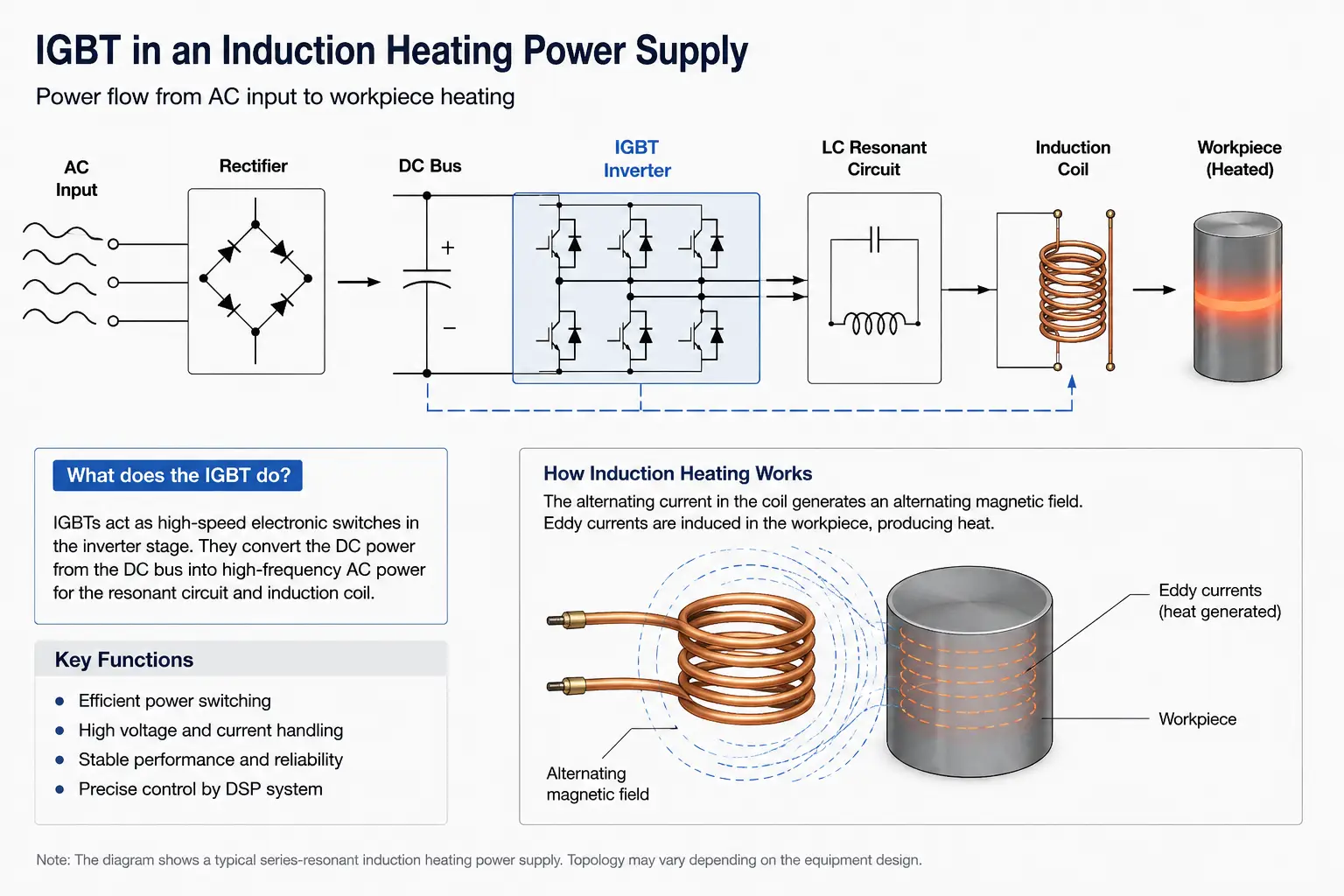
Power flow through an IGBT induction heating power supply.
Ⅲ. IGBT or MOSFET?
Silicon MOSFETs generally switch faster and are widely used where higher switching frequency is required. IGBTs remain a practical choice in many industrial systems where substantial voltage and current have to be handled at frequencies suited to the device.
SiC MOSFETs have moved this boundary further. They combine high-voltage capability with faster switching, although device cost, gate-drive design, protection and system layout also have to be considered.
One limitation of the IGBT is its turn-off behavior. Stored charge inside the device produces a tail current, which contributes to switching loss. As switching frequency increases, this loss becomes increasingly important.
This does not mean an IGBT has a single fixed maximum frequency for every application. Device generation, current, voltage, junction temperature and whether the inverter uses hard or soft switching all matter.
In induction heating equipment, semiconductor selection is therefore made against the actual power level, frequency range, resonant circuit, cooling conditions and expected load.
Ⅳ. IGBT Switching and the Resonant Heating Circuit
Most industrial induction heating power supplies use a resonant load.
The induction coil provides inductance, while capacitors are added to form the required resonant circuit. Depending on the power-supply design, this may use series resonance, parallel resonance or another resonant arrangement.
The basic relationship can be viewed as:
IGBT Inverter → Resonant Circuit → Induction Coil → Workpiece
The current flowing through an industrial induction coil can be very large. Resonance helps the system handle the exchange of energy between the inductive and capacitive parts of the circuit while the inverter supplies the real power consumed by the workpiece and electrical losses.
This is also why the inverter cannot be designed independently of the coil.
Changing the inductor, workpiece geometry or operating condition changes the load. In a production machine, those changes have to remain within the working range of the power supply.
Soft-switching techniques are often used to reduce semiconductor losses. Rather than forcing the IGBT to switch under the worst combination of voltage and current, the circuit is operated so switching occurs under more favorable electrical conditions.
The exact implementation depends on the inverter topology.
In many resonant induction heating inverters, the switching frequency is closely related to the operating frequency of the resonant circuit. The exact relationship depends on the inverter topology and control method.
Ⅴ. What Do IGBT and DSP Each Do?
Modern induction heating equipment often combines IGBT power conversion with DSP digital control.
Their jobs are different.
The IGBT handles power switching.
The DSP handles control, monitoring and protection.
Depending on the power-supply configuration, the DSP control system may process voltage and current signals, regulate output power, control or track operating frequency, manage heating time and respond to fault conditions.
In automated equipment, the same control platform can also exchange information with PLC or production-line systems. Temperature feedback, process recipes, alarm limits and production records can be added where the selected system supports them.
This becomes particularly useful in continuous production. Changes in line speed, workpiece specification or heating requirement may call for a different operating condition, and the power supply needs to follow that process in a controlled way.
For this reason, describing an induction heater simply as an “IGBT machine” does not say very much about its actual performance.
Neither the IGBT nor DSP works in isolation. Stable induction heating depends on the inverter, resonant circuit, induction coil, cooling system and control strategy being matched to the load.
Key Takeaway
An IGBT switches the DC bus inside the inverter; it does not by itself determine the heating result. Usable performance comes from the inverter, resonant circuit, induction coil, cooling and control being matched to the load. The choice between IGBT, MOSFET and SiC follows from power, frequency, topology and the changing load.
Frequently Asked Questions
Click a question to expand the answer.
Is the IGBT the only power device used in induction heating?
No. Silicon MOSFETs and SiC MOSFETs are also used, particularly at higher switching frequencies. The IGBT remains a practical choice where substantial voltage and current must be handled at frequencies suited to the device.
What is IGBT tail current, and why does it matter?
Tail current is the current that continues to flow briefly at turn-off because of stored charge in the device. It adds to switching loss, and the loss grows as switching frequency increases.
Does higher power always mean the inverter should use IGBTs?
Not necessarily. Device selection is made against power level, frequency range, resonant circuit, cooling and expected load — not from a simple “high power means IGBT” rule.
What does the DSP do in an IGBT induction heating power supply?
The IGBT handles the power switching; the DSP handles control, monitoring and protection — regulating output power, tracking frequency, managing heating time and responding to faults.
Specifying an Induction Heating Power Supply?
Send us your power level, operating frequency and workpiece details. We can help you evaluate the inverter, resonant circuit and control approach for your application.


