
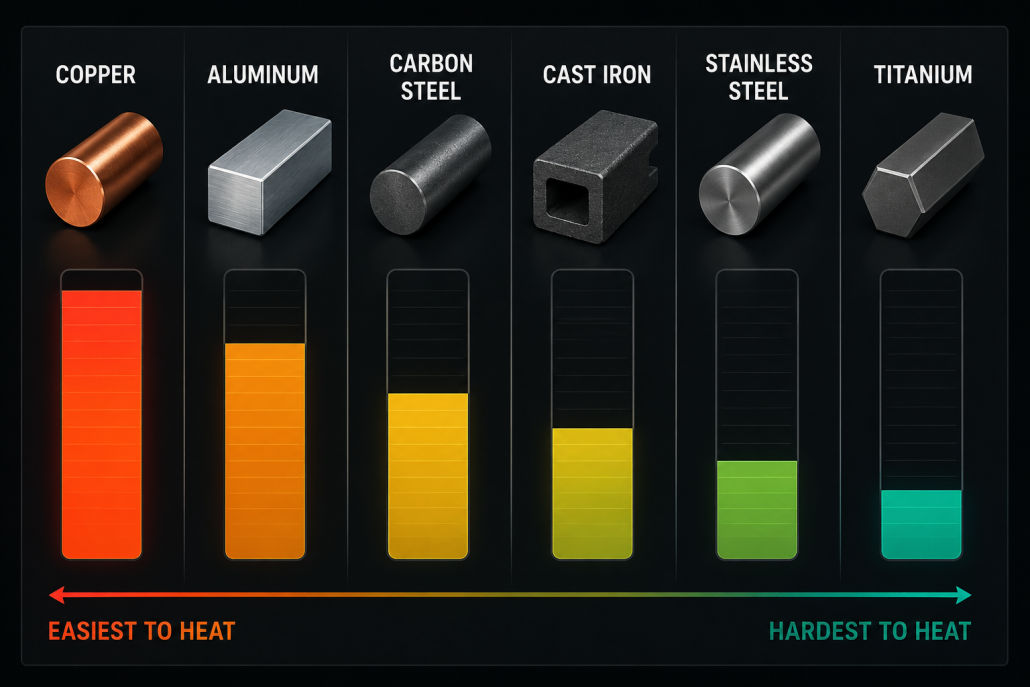
How Material Properties Affect Induction Heating Efficiency: 2 Critical Factors
Material properties induction heating efficiency is a topic that separates experienced engineers from beginners. You can own the most advanced DSP-controlled induction power supply on the market — but if you do not understand how your workpiece material interacts with the electromagnetic field, you will waste energy, oversize your equipment, or fail to reach target temperature altogether. Two physical properties decide the outcome: relative magnetic permeability and electrical resistivity.
Table of Contents
The Two Material Properties That Control Heating Speed
Induction heating transfers energy without physical contact — but the material itself is not a passive participant. It actively shapes how much electromagnetic energy gets absorbed and how quickly that energy converts to heat. Two intrinsic material properties govern this process:
| Property | What It Controls | Unit | Practical Effect |
|---|---|---|---|
| Relative Magnetic Permeability (μr) | How strongly the material concentrates magnetic flux | Dimensionless | Determines if the material “grabs” the field or lets it pass through |
| Electrical Resistivity (ρ) | How much the material resists eddy current flow | Ω·m | Determines how fast induced current converts to heat |
These two properties work together. A material with high permeability and high resistivity heats explosively fast. A material low in both barely responds to the coil at all. Let us examine each in detail.
Magnetic Permeability — The Gatekeeper of Energy Transfer
Magnetic permeability describes how easily a material allows a magnetic field to pass through it — or, more importantly for induction heating, how strongly it concentrates that field within itself. Higher permeability means denser magnetic flux lines cutting through the workpiece, which directly translates to more induced eddy currents and faster heating. Materials fall into two camps.
Ferromagnetic Materials — The Energy Amplifiers
Ferromagnetic materials — primarily iron and most carbon and alloy steels — possess relative magnetic permeability values ranging from 100 to over 10,000. Under the influence of an alternating magnetic field, these materials spontaneously magnetize. Their internal magnetic domains align with the applied field, pulling flux lines inward and multiplying the local flux density a hundredfold or more compared to the surrounding air.
This is why a plain carbon steel bar heats in seconds under an induction coil: the material itself is doing half the work. It draws the field in, concentrates it, and delivers intense eddy current density right at the surface where hardening matters most. Cast iron, despite its high carbon content, behaves similarly because its iron matrix remains ferromagnetic — though graphite flakes introduce local resistivity variations that require adjusted process parameters.
Key point: When the workpiece temperature exceeds the Curie point (typically 720–770°C for steel), the material loses its ferromagnetism and permeability drops to ~1. The coil must compensate for this sudden efficiency loss — which is why accurate power sizing matters at high temperatures.
Diamagnetic and Paramagnetic Materials — The Energy Transmitters
Diamagnetic materials — copper, aluminum, gold, and many austenitic stainless steels (300 series) — have a relative magnetic permeability effectively equal to 1. They do not concentrate magnetic flux at all. The field passes through them almost as if they were air, with virtually zero amplification. Paramagnetic materials like titanium and aluminum alloys behave similarly, with permeability only marginally above 1.
In practical terms, heating these materials via induction requires overcoming a double handicap: the coil must generate an exceptionally strong magnetic field to induce meaningful currents, and the material contributes nothing to flux concentration. This demands higher frequencies, tighter coil coupling, and substantially more input power — typically 2–5 times the kW per kilogram needed for carbon steel at the same throughput.
Electrical Resistivity — The Joule Heating Engine
Once eddy currents are induced in the workpiece, the second material property takes over: electrical resistivity. The physics is straightforward — induced currents encounter resistance as they circulate through the material, and this resistance dissipates electrical energy as heat (Joule’s first law: P = I²R). Higher resistivity means more heat per ampere of induced current.
High-Resistivity Metals — The Fast Heaters
Carbon steels, alloy steels, and cast irons have relatively high electrical resistivity — typically 0.15 to 0.60 μΩ·m at room temperature, increasing with carbon content and alloying elements. Every induced eddy current ampere encounters significant opposition, converting electrical energy to thermal energy rapidly. This is why a medium-carbon steel shaft reaches austenitizing temperature (850°C+) in a matter of seconds under a well-tuned coil — high resistivity makes every amp count.
Low-Resistivity Metals — The Reluctant Heaters
Copper has an electrical resistivity of just 0.017 μΩ·m — roughly 10 to 35 times lower than carbon steel. Aluminum sits at about 0.028 μΩ·m. These metals conduct electricity so efficiently that induced eddy currents circulate with minimal resistance, producing far less Joule heating for the same induced current. To compensate, the power supply must drive much higher current through the coil, which increases I²R losses in the coil itself — making the entire system less efficient.
This double penalty — low permeability failing to concentrate the field, and low resistivity failing to convert current to heat — is why copper and aluminum are among the most challenging industrial metals to induction-heat. For a deeper dive into the physics, see our article on eddy currents vs. hysteresis in induction heating, which explains the current-generation side of the equation.
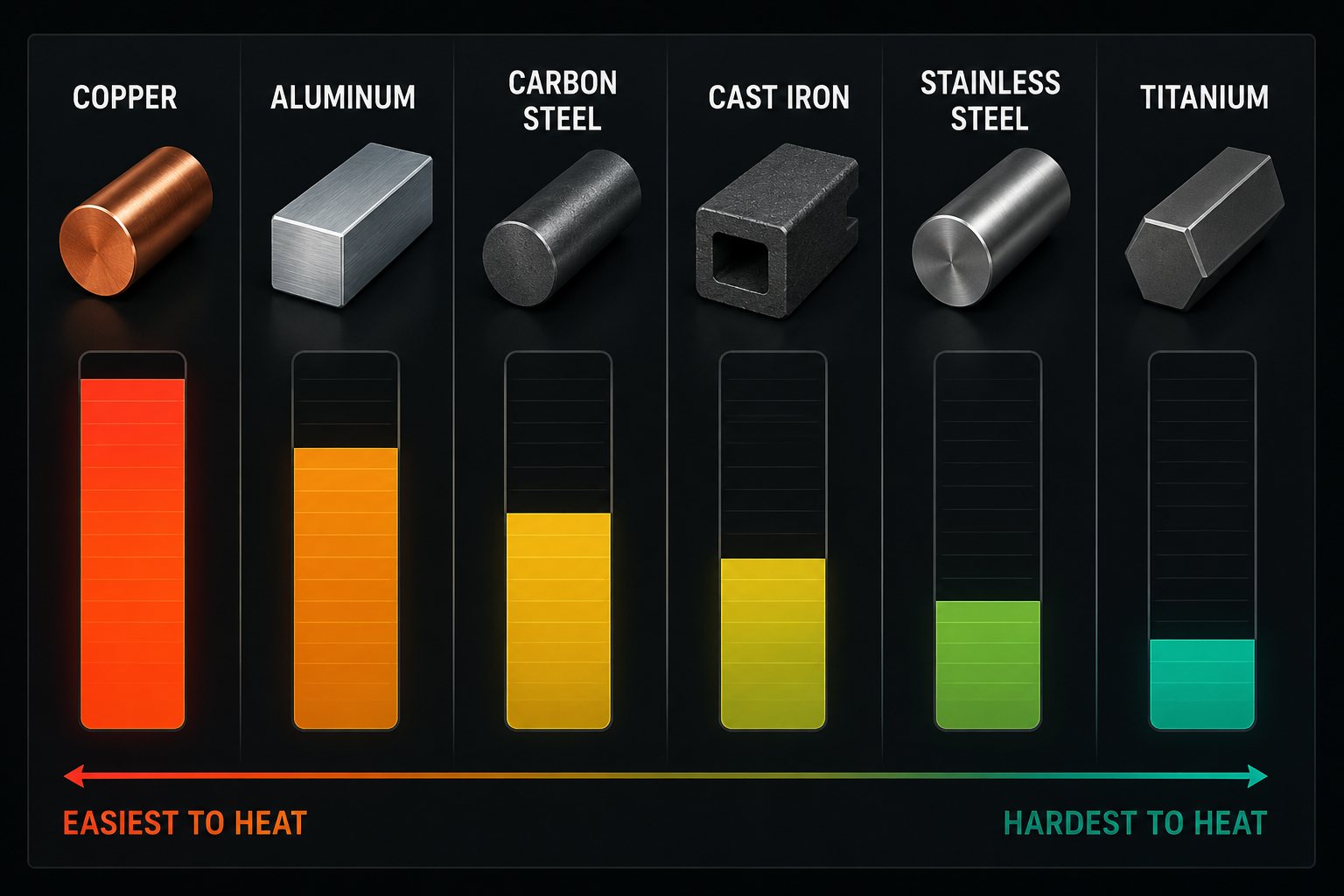
Material-by-Material Heating Behavior
The table below summarizes how common industrial metals perform under induction, ranked by the combined effect of permeability and resistivity:
| Material | Magnetic Type | μr | Resistivity (μΩ·m) | Heating Ease | Power Demand |
|---|---|---|---|---|---|
| Carbon Steel (1045) | Ferromagnetic | 100–800 | 0.17–0.22 | Excellent | Low |
| Cast Iron (Gray) | Ferromagnetic | 60–300 | 0.40–0.80 | Excellent | Low |
| Alloy Steel (4140) | Ferromagnetic | 80–600 | 0.22–0.28 | Very Good | Low |
| Stainless Steel (304) | Paramagnetic* | ~1 | 0.72 | Moderate | Medium-High |
| Stainless Steel (420) | Ferromagnetic | 40–500 | 0.55 | Very Good | Low-Medium |
| Titanium | Paramagnetic | ~1 | 0.42–0.55 | Moderate | Medium |
| Copper | Diamagnetic | ~1 | 0.017 | Poor | Very High |
| Aluminum | Paramagnetic | ~1 | 0.028 | Poor | Very High |
* 304 stainless may become slightly magnetic after cold working, but its permeability remains far below ferromagnetic steels.
What This Means for Equipment Selection
The material properties table above translates directly into equipment decisions. Here is the practical framework:
Ferromagnetic + High Resistivity (Carbon Steel, Cast Iron, Alloy Steel)
Ideal conditions. These materials heat at maximum thermodynamic efficiency. Standard medium-frequency power supplies (1–100 kHz) with conventional copper induction coils work well. Power requirements are predictable — a 0.3–0.5 kW per kg rule of thumb often suffices for through-heating. Focus your optimization efforts on coil geometry and process speed rather than fighting the material.
Paramagnetic + Moderate Resistivity (Austenitic Stainless Steel, Titanium)
Requires adaptation. These materials have usable resistivity (they do generate Joule heat) but zero magnetic amplification. Expect to need 1.5–3 times the power density compared to carbon steel at equivalent throughput. Higher frequencies (50–400 kHz) help by increasing induced voltage in the workpiece, partially compensating for the lack of flux concentration.
Diamagnetic + Low Resistivity (Copper, Aluminum)
Maximum challenge. These materials fight you on both fronts: no flux concentration and almost no resistive heating. Induction heating copper or aluminum for industrial processes (as opposed to consumer induction cooktops with ferrous cookware) demands purpose-designed systems with high-frequency inverters (100–500 kHz), tightly coupled multi-turn coils, and power densities of 5–10 kW per kg or more. Always consult the equipment manufacturer before committing to a system for these materials — off-the-shelf steel-rated machines will underperform dramatically.
Key Takeaway
- Two material properties dominate induction heating efficiency: magnetic permeability (flux concentration) and electrical resistivity (current-to-heat conversion).
- Ferromagnetic + high-resistivity materials like carbon steel and cast iron represent the ideal case — rapid heating with standard equipment and low power demands.
- Materials low in both properties (copper, aluminum) require purpose-engineered systems with high frequency, tight coupling, and 5–10x the power density.
- Always evaluate the workpiece material first when sizing a new induction heating system. The material defines the power requirement — not the other way around.
- For diamagnetic and low-resistivity metals, work with your equipment supplier early to match inverter frequency and coil coupling to the material’s physical limitations.
FAQ
Why does carbon steel heat so much faster than stainless steel under the same coil?
Two compounding reasons. First, carbon steel is ferromagnetic (μr of 100–800), so it concentrates the magnetic field within itself — multiplying eddy current density at the surface. Austenitic stainless steel (304) is paramagnetic with μr ≈ 1 — it does not amplify the field at all. Second, while 304 stainless has higher resistivity (0.72 vs. 0.17–0.22 μΩ·m), the loss of flux concentration dominates — fewer eddy currents are generated in the first place. Net result: carbon steel heats 3–5 times faster at the same power setting.
What happens to permeability when steel reaches the Curie temperature?
Above the Curie point (~720–770°C for most carbon steels), the material undergoes a phase transition from ferromagnetic to paramagnetic. Relative permeability collapses from hundreds to ~1, and the material stops concentrating flux. The heating rate drops sharply at this threshold. This is why induction hardening systems are designed to deliver peak power during the initial heat-up phase (when permeability helps) and sustain power through the Curie transition to reach austenitizing temperature. Multi-stage power profiles in modern induction heating systems compensate for this behavior automatically.
Can induction heating work on non-conductive materials like ceramics or glass?
Not directly. Induction heating requires the workpiece to be electrically conductive — eddy currents cannot flow in insulators. However, a conductive susceptor (typically a graphite or metal crucible) can be induction-heated, and the thermal energy conducted or radiated to the non-conductive material inside. This indirect approach is standard practice in induction melting of glass and certain ceramic sintering processes.
How do I know if my material is ferromagnetic or not?
The simplest field test: hold a magnet to it. If a permanent magnet sticks, the material is ferromagnetic at room temperature — and will induction-heat efficiently. If the magnet does not stick, expect the material to heat slowly and require higher frequency and power. This test works for initial screening, but note that some materials (like 304 stainless) may show weak magnetism after cold working while still behaving largely paramagnetic under induction.
Need to Heat a Challenging Material?
Tell us your workpiece material, dimensions, and target temperature — our engineers will recommend the right frequency, power, and coil design to match your material properties.


