
Eddy Currents vs Hysteresis in Induction Heating: 5 Critical Differences That Determine Your Heating Result
Every induction heating process generates heat inside the workpiece through electrical currents induced by a magnetic field. But not every application generates heat the same way. Eddy currents vs hysteresis in induction heating describes two distinct physical mechanisms — and only one of them does the heavy lifting in most industrial processes. Confusing the two leads to wrong assumptions about power requirements, frequency selection, and what happens when the part crosses the Curie temperature. This article separates how each mechanism works, what each actually contributes, and why the distinction matters the moment you move from theory to production.
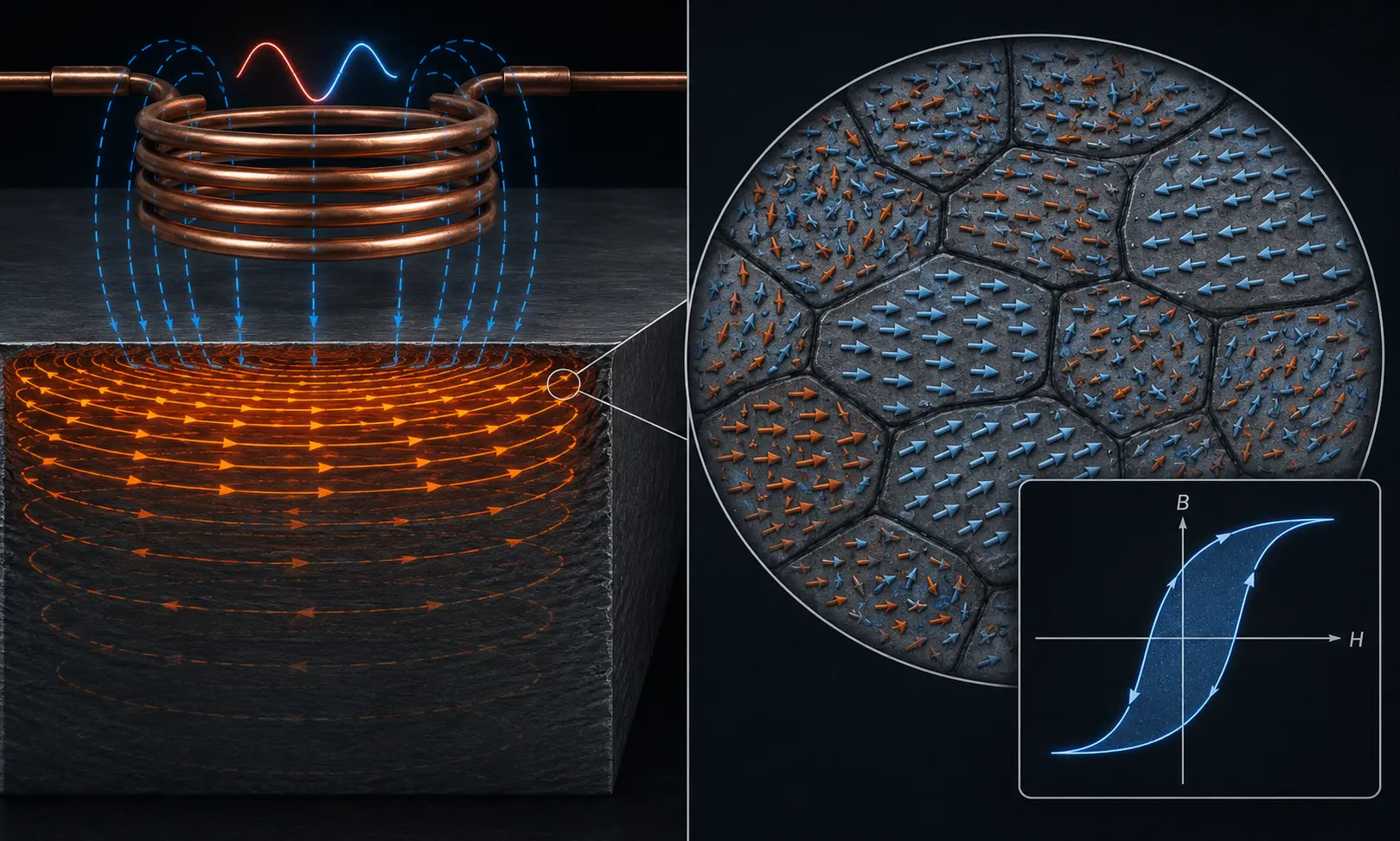
Table of Contents
1. Eddy Current Heating: The Primary Mechanism
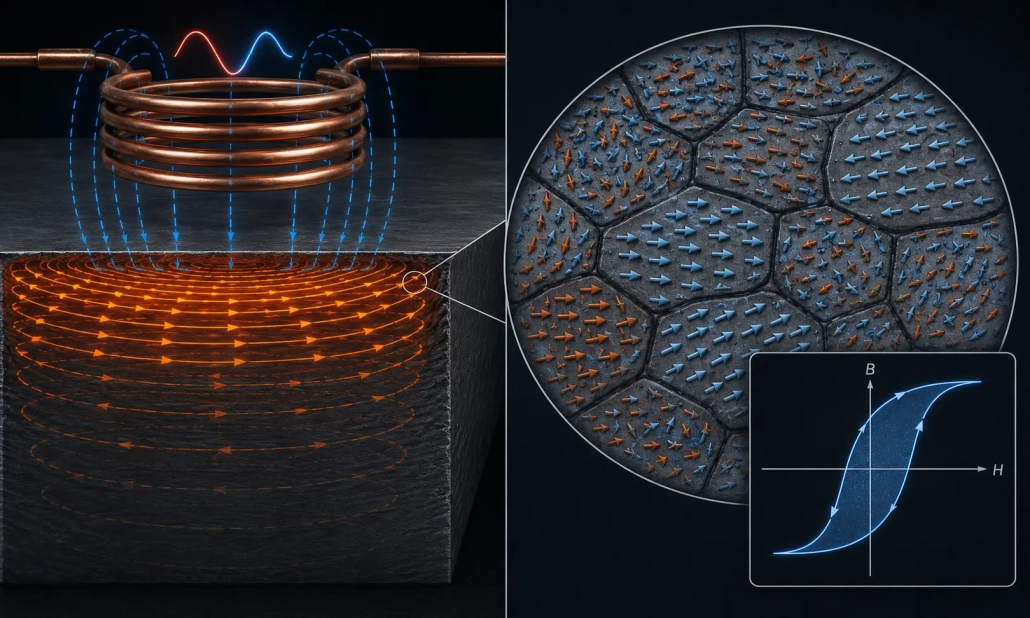
Eddy currents are circulating loops of electrical current induced inside the workpiece by the alternating magnetic field from the induction coil. They are called “eddy” currents because they flow in closed circular paths — like eddies in a stream — within the metal itself. This is the same principle covered in our guide to how induction heating works: the coil’s alternating magnetic field induces a voltage in the workpiece, and because the workpiece is electrically conductive, that voltage drives current through it.
The heating comes from resistive (I²R) losses. The induced current flows through the electrical resistance of the steel, and that resistance converts electrical energy into heat — exactly the same physics as a resistive heating element, except the current is induced wirelessly rather than delivered through wires. The amount of heat generated depends on the current density (how much current flows per unit area) and the material resistivity (how much the material resists that flow). Steel, with its relatively high resistivity compared to copper or aluminum, heats efficiently under induction for this reason.
Eddy currents are also where frequency becomes the dominant control parameter. Because of the skin effect, higher frequency confines eddy currents to a thinner surface layer — and therefore a smaller cross-section with higher effective resistance — producing faster, shallower heating. This is why how frequency affects induction heating is inseparable from how eddy currents behave: frequency sets the depth at which eddy currents flow, and that depth sets the heating pattern.
2. Hysteresis Heating: The Secondary Mechanism
Hysteresis heating is fundamentally different from eddy current heating — it is magnetic, not resistive. Ferromagnetic materials like steel are composed of microscopic regions called magnetic domains, each with its own magnetic orientation. In an unmagnetized state, these domains point randomly and their fields cancel out. When an external magnetic field is applied — such as the field from an induction coil — the domains rotate to align with it. When the field reverses (as it does every half-cycle of AC), the domains flip to realign in the opposite direction.
This flipping is not frictionless. Each realignment dissipates a small amount of energy as heat — an effect called magnetic hysteresis loss. The energy lost per cycle is proportional to the area enclosed by the material’s B-H curve (magnetic flux density vs. magnetic field strength), and the total hysteresis heating power increases linearly with frequency — more cycles per second means more domain flips per second, which means more heat.
The critical constraint: hysteresis only occurs in ferromagnetic materials — steels, cast irons, nickel alloys — and only while they remain magnetic. Non-magnetic materials like aluminum, copper, austenitic stainless steel, brass, and titanium experience exactly zero hysteresis heating. For those materials, eddy currents are the sole heating mechanism, and any process design that counts on hysteresis contribution will fail.
3. The Real Contribution Split
In ferromagnetic steel from room temperature up to the Curie point (≈770°C), both mechanisms are active — but they are not equal contributors. Eddy currents provide approximately 80–90% of the total heat under typical industrial induction hardening conditions (medium to high frequency, moderate to high power density). Hysteresis contributes the remaining 10–20%. The exact split varies with material grade, frequency, and flux density, but eddy currents always dominate in any practical hardening process.
This split is not a design choice — it is dictated by physics. Hysteresis loss per cycle is fixed by the material’s B-H loop area, which is a material property. Eddy current loss, by contrast, scales with the square of both frequency and flux density — so as frequency and power increase toward industrial hardening levels, eddy currents pull further ahead. At the frequencies and power densities used in gear induction hardening and shaft hardening (3–40 kHz, high flux density), hysteresis is a minor side effect, not a design lever.
The one scenario where hysteresis matters more is low-frequency, low-flux-density heating — for example, certain preheating or stress-relief applications below the Curie point where eddy current intensity is intentionally limited. In those narrow cases, hysteresis can approach 30–40% of total heating. But these are the exception, not the rule.
4. The Curie Point: Where Hysteresis Ends
Steel undergoes a fundamental change at approximately 770°C (the Curie temperature): it loses its ferromagnetic properties and becomes paramagnetic. The magnetic domains that enabled hysteresis heating cease to exist. Above the Curie point, hysteresis contributes exactly zero — every joule of heat from that point onward comes from eddy currents alone.
This transition has a measurable effect on the heating curve. Below the Curie point, the combined eddy current + hysteresis heating follows one rate. At the Curie point, hysteresis drops out and the heating rate shifts — but because eddy currents were already providing the majority of the heat, the drop is noticeable but not dramatic. Operators familiar with their process can often identify the Curie transition from a slight change in the power draw or heating rate on the machine display.
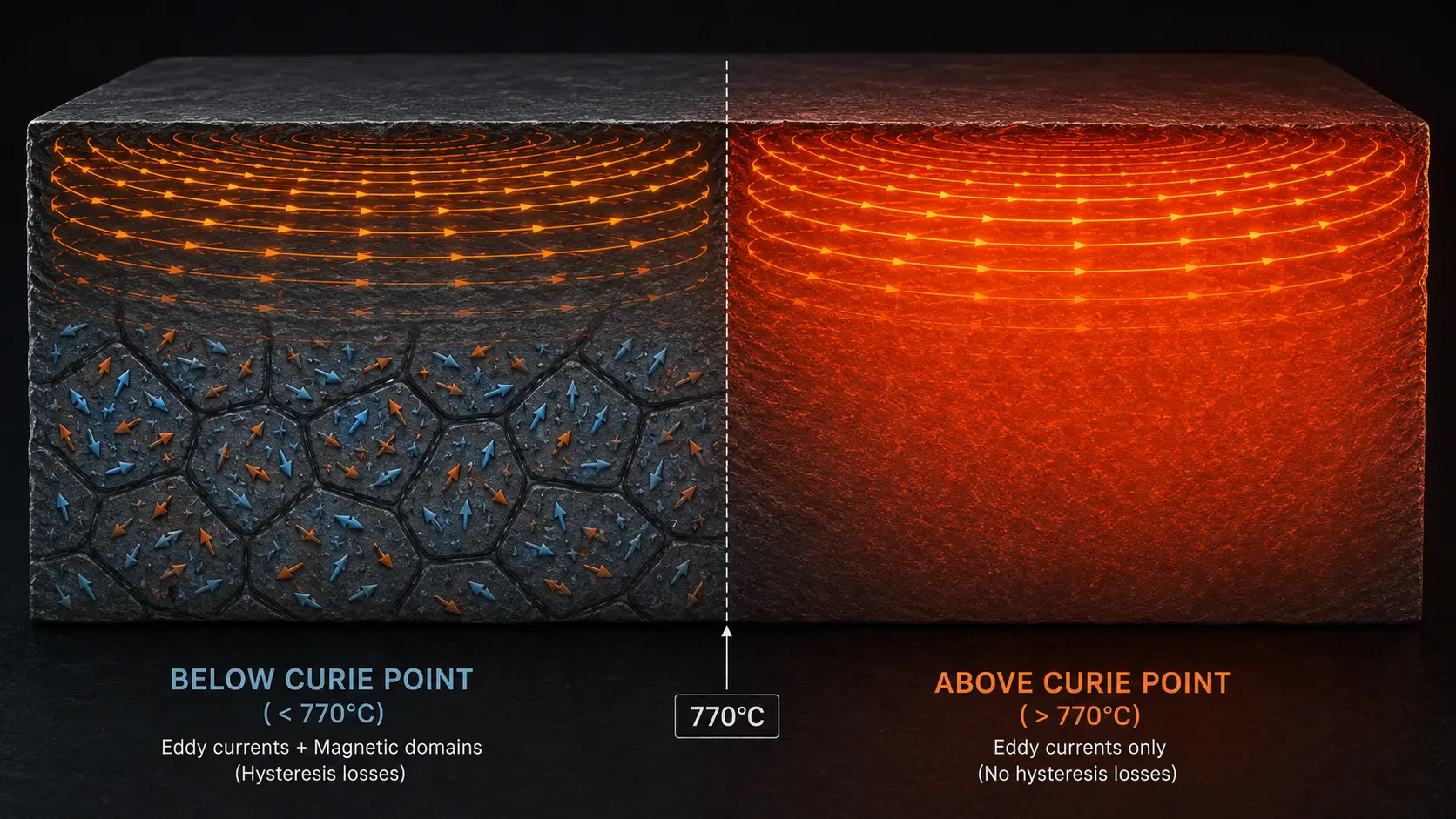
A second effect compounds this transition: when steel loses its magnetic permeability at the Curie point, the skin depth increases. Current that was tightly compressed near the surface by the magnetic permeability suddenly penetrates deeper. This changes the eddy current distribution — and therefore the heating pattern — at exactly the same moment hysteresis disappears. The two effects are distinct but coincide, and distinguishing between them matters for process troubleshooting. The permeability-driven skin depth change typically has a larger impact on the overall heating behavior than the loss of hysteresis alone.
For non-magnetic materials — aluminum, copper, austenitic stainless steel — the Curie point is irrelevant because hysteresis was never contributing in the first place. Their heating is pure eddy current from start to finish, which makes their heating behavior more linear and predictable once the power and frequency are set. This is one reason why induction heating power selection for non-magnetic materials follows a simpler calculation — there is no hysteresis contribution to account for and no Curie transition to manage.
5. Why the Distinction Matters for Process Design
If eddy currents dominate and hysteresis is secondary, why does the distinction matter at all? Because misunderstanding the two mechanisms leads to three specific design errors that show up in production.
Error 1 — Assuming hysteresis helps non-magnetic materials. If a process designed for carbon steel is adapted to stainless steel or aluminum without recalculating power requirements, the result will be under-heating. The process lost not only the small hysteresis contribution but also the magnetic permeability that compressed eddy currents into a thin, high-resistance layer. The effective heating efficiency drops by more than the 10–20% hysteresis share would suggest.
Error 2 — Ignoring the Curie transition in cycle timing. For processes that heat steel through the Curie point (which includes virtually all hardening applications), the heating rate is not constant. The rate changes as hysteresis disappears and skin depth expands. A cycle time that works at one power setting may produce a different temperature profile at another setting because the time spent below vs. above the Curie point changes the proportion of the cycle that benefits from hysteresis. This is relevant when scaling a process from prototype parameters to production speeds.
Error 3 — Misattributing the Curie transition effects. When the heating rate changes at 770°C, operators sometimes attribute the entire change to hysteresis loss, when in fact the permeability change and the resulting skin depth expansion is the larger effect. Correctly identifying the root cause matters because the two effects have different implications for how you adjust the process — changing frequency addresses the skin depth effect; the hysteresis loss, however, cannot be compensated for by any parameter adjustment — once the part passes the Curie point, that 10–20% contribution is simply gone.
For induction coil design, the eddy-currents-vs-hysteresis distinction influences how tightly the coil must couple to the part. Since eddy currents are induced by the local magnetic field strength, coupling distance directly controls eddy current intensity — and therefore the dominant heating mechanism. A loose-coupled coil produces weak eddy currents, and for magnetic steels below Curie, that shifts the contribution balance slightly toward hysteresis — an inefficient operating regime. Tight coupling maximizes eddy current intensity and minimizes the proportion of power that relies on the secondary mechanism.
Understanding the frequency classification of induction equipment also benefits from this distinction. Lower frequencies produce deeper eddy current penetration and lower current density at the surface — which slightly increases the relative contribution of hysteresis (more material volume experiencing lower-intensity eddy currents). Higher frequencies compress eddy currents into a thin, intense surface layer where I²R heating dominates overwhelmingly. This is another reason why high-frequency processes are easier to control: the outcome depends almost entirely on the predictable eddy current behavior, with negligible hysteresis influence.
🔑 Key Takeaway
Eddy currents and hysteresis are the two heating mechanisms in induction heating — but they are not equal partners. Eddy currents (resistive I²R heating) provide 80–90% of the heat in industrial hardening processes. Hysteresis (magnetic domain friction) contributes the remaining 10–20% — and only for ferromagnetic materials below the Curie point (≈770°C).
Above the Curie point, hysteresis disappears entirely. For non-magnetic materials, it never existed. Process design should treat eddy currents as the primary mechanism, hysteresis as a secondary booster that is present only under specific conditions, and the Curie transition as a predictable shift in heating behavior that must be accounted for in cycle timing and power programming — not as a mystery to troubleshoot after scrap appears.
FAQ
Which is more important: eddy currents or hysteresis in induction heating?
Eddy currents are the dominant mechanism, providing approximately 80–90% of the heat generated in typical industrial induction hardening processes. Hysteresis contributes 10–20% and only for ferromagnetic materials (carbon steels, alloy steels, cast iron) below the Curie temperature of roughly 770°C. For non-magnetic materials like aluminum, copper, or austenitic stainless steel, hysteresis contributes zero — eddy currents are the sole heating mechanism.
What happens to induction heating above the Curie point?
At the Curie temperature (≈770°C for steel), the material loses its ferromagnetic properties. Two things happen simultaneously: hysteresis heating stops completely (magnetic domains cease to exist), and the skin depth increases because magnetic permeability drops to near-unity, allowing eddy currents to penetrate deeper into the part. The heating rate changes measurably — but the skin depth expansion typically has a larger impact on the overall heating behavior than the loss of hysteresis alone. This transition is predictable and must be accounted for in cycle timing.
Does induction heating work on non-magnetic materials?
Yes — induction heating works effectively on non-magnetic materials including aluminum, copper, brass, titanium, and austenitic stainless steels. These materials heat through eddy currents alone, with no hysteresis contribution. Because they never undergo a Curie transition, their heating behavior is more linear and predictable across the entire temperature range. However, materials with very low electrical resistivity (copper, aluminum) require higher current density to achieve the same heating rate as steel, because the I²R loss per unit of induced current is lower.
Need Process Engineering Support for Your Induction Heating Application?
Whether you are hardening magnetic steels or heating non-magnetic alloys, our engineering team can analyze your part material, geometry, and production targets to design a process that accounts for the real physics — not simplified assumptions. Send your requirements for a technical assessment.


