How Prior Microstructure Affects Induction Hardening Results
Why Rapid Induction Austenitizing Makes the Starting Condition of Steel Important
Two steel parts can have the same grade, similar dimensions and the same induction hardening recipe, yet still produce different hardness profiles or effective case depths.
One possible reason is the prior microstructure—the metallurgical condition of the steel before induction hardening. Because induction heating is rapid and the austenitizing time is short, different starting structures can respond differently before quenching.
2. How Prior Microstructure Changes Austenite Formation and Carbide Dissolution
3. Ferrite-Pearlite, Spheroidized and Quenched-and-Tempered Structures Can Respond Differently
4. How Prior Microstructure Can Affect Hardness and Effective Case Depth
5. Why the Same Steel Grade Can Behave Differently Between Batches
6. How to Determine Whether Prior Microstructure Is Affecting the Result
7. What Prior Microstructure Means for Process Development
1. Why Prior Microstructure Matters During Rapid Induction Heating
Induction hardening differs from slower furnace heat treatment because the required surface region can be heated through the transformation range in a relatively short time.
Before quenching can produce the required hardened structure, sufficient austenite must first form. During this period, phase transformation, carbide dissolution where relevant, and carbon redistribution are taking place.
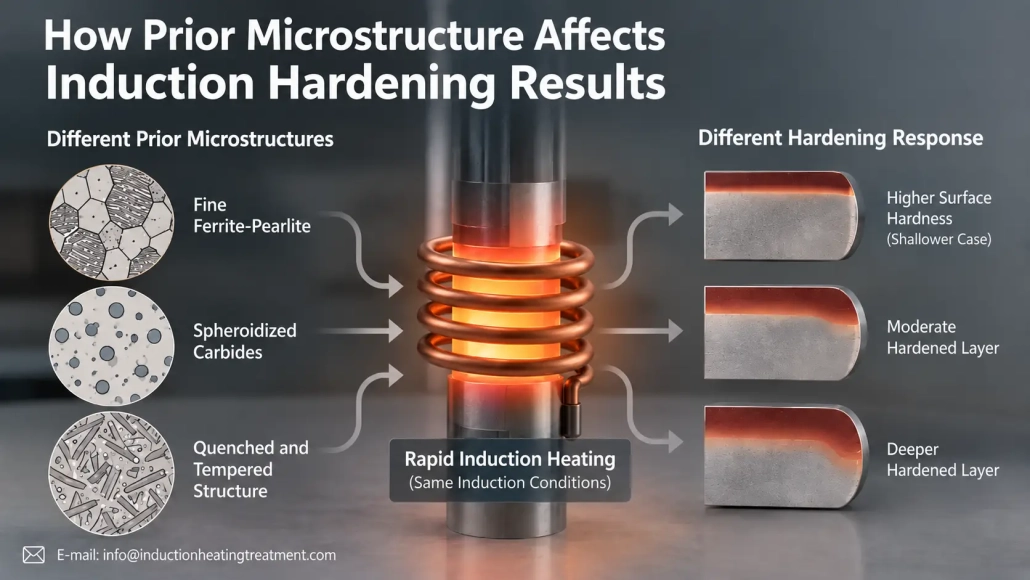
With a short heating cycle, the condition of the steel before heating can therefore become important. A fine ferrite-pearlite structure, a coarse ferrite-pearlite structure and a spheroidized carbide structure may not reach the same austenitized condition after being exposed to the same thermal cycle.
The important distinction is:
Reaching a temperature does not necessarily mean that two different prior microstructures have reached the same metallurgical state.
This is one reason induction-hardening process development needs to consider the incoming material condition together with power, frequency, heating time and quenching conditions.
2. How Prior Microstructure Changes Austenite Formation and Carbide Dissolution
The metallurgical sequence can be simplified as:
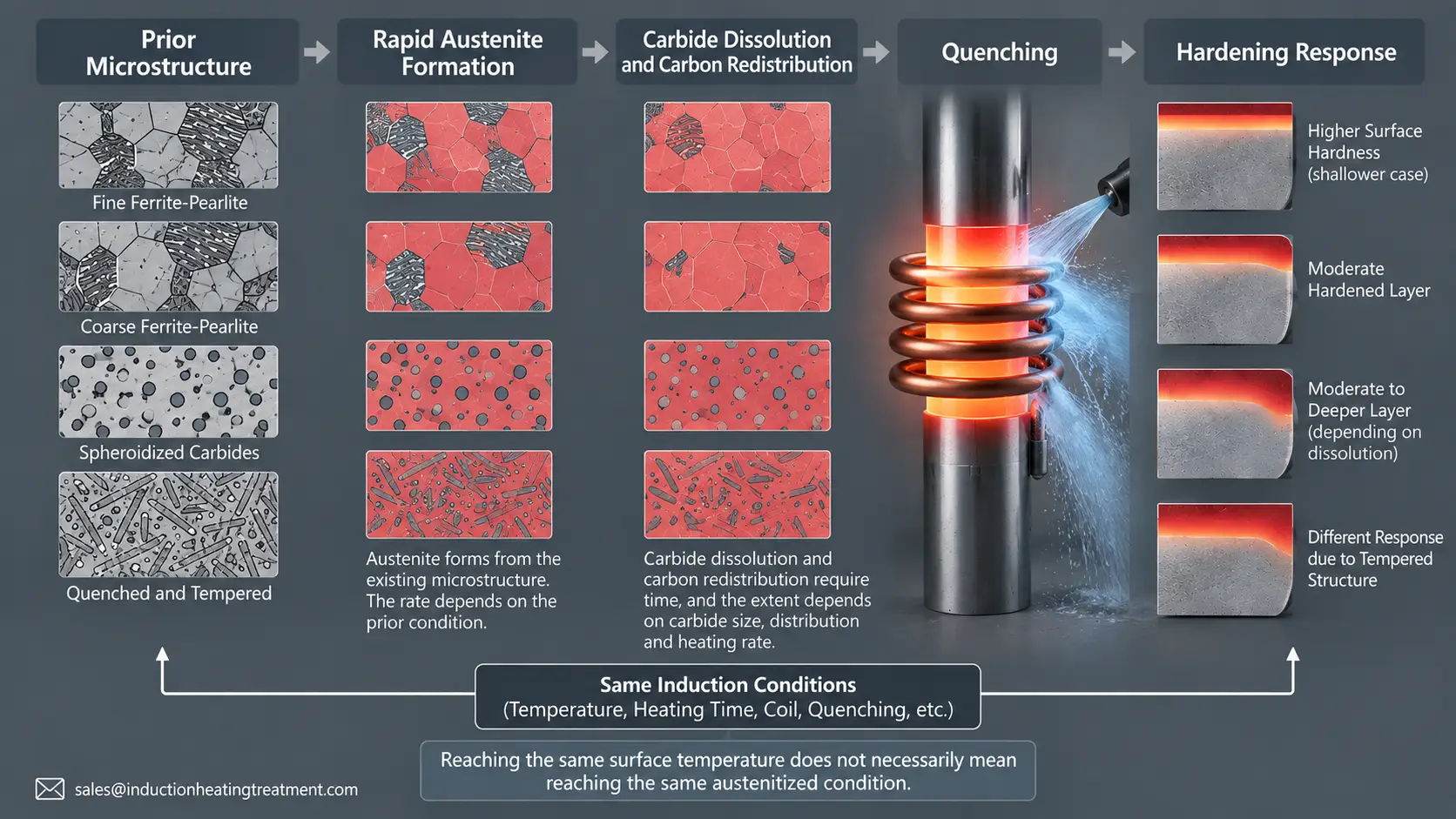
The metallurgical sequence from prior microstructure to the final hardening response.
The rate of each stage depends on the material already present when heating begins.
In ferrite-pearlite steel, austenite forms from the existing ferrite and pearlite structure. The fineness of that structure affects transformation distances and the rate at which austenite develops during rapid heating.
Where carbon is present in carbide particles, the size and distribution of those carbides also matter. During austenitizing, sufficient carbide dissolution and redistribution are needed to establish the austenite condition required for the subsequent quench.
A short induction cycle may therefore expose differences that would be less important during a much longer thermal cycle.
Heating rate adds another complication. Rapid heating can shift the temperatures and times associated with transformation compared with slow-heating equilibrium assumptions. Process development should therefore consider not only the measured temperature, but also whether the required transformation has had enough time to occur.
3. Ferrite-Pearlite, Spheroidized and Quenched-and-Tempered Structures Can Respond Differently
These prior conditions should not be treated as a ranking from “best” to “worst.” Their response depends on the steel grade, microstructural scale, heating cycle and required final result.
| Prior condition | Main consideration during rapid austenitizing |
|---|---|
| Fine ferrite-pearlite | Austenite formation and relatively short redistribution distances |
| Coarse ferrite-pearlite | Coarser structure can require more time for transformation and homogenization |
| Spheroidized structure | Carbide size and dissolution become especially important |
| Normalized structure | Often finer and more uniform than a coarse annealed condition, depending on material history |
| Quenched-and-tempered structure | Tempered martensitic matrix and carbide distribution produce a different re-austenitizing response |
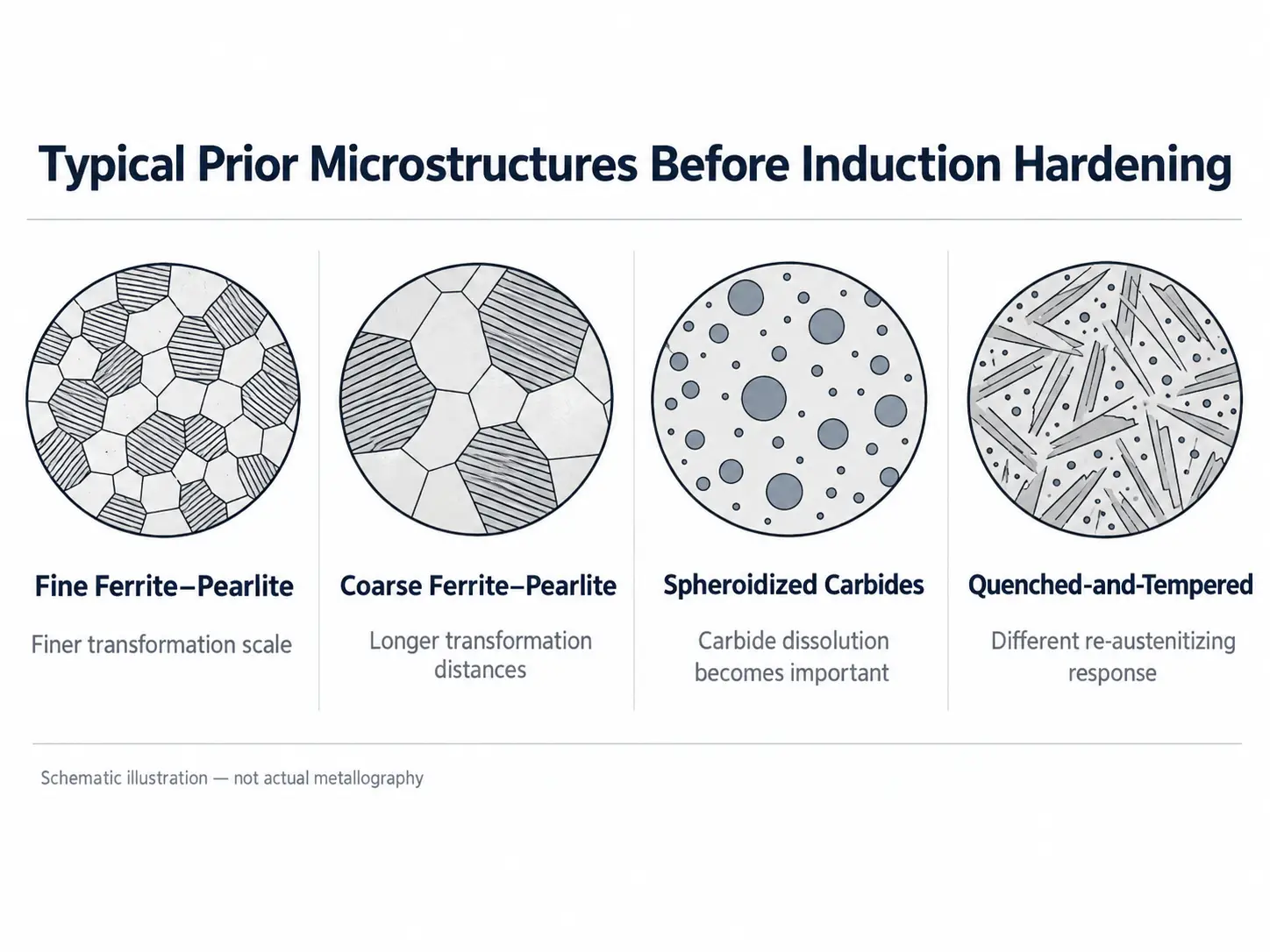
Different prior microstructures can produce different hardening responses under the same induction cycle.
Ferrite-pearlite
The description “ferrite-pearlite” alone is not enough to predict induction-hardening response. Pearlite spacing, ferrite grain size and overall structural uniformity can vary considerably.
Two parts can therefore carry the same broad microstructure description while still responding differently to the same short heating cycle.
Spheroidized structures
Spheroidizing is often used before machining or forming in suitable steels. For later induction hardening, however, carbide dissolution becomes part of the austenitizing problem.
Relatively large spheroidized carbide particles may not dissolve to the same extent as finer carbides during a short heating cycle. That can influence the carbon available in the newly formed austenite before quenching.
This does not mean that spheroidized steel is unsuitable for induction hardening. It means the process needs to be developed for the actual prior condition.
Quenched-and-tempered structures
A quenched-and-tempered structure presents a different matrix and carbide distribution from ferrite-pearlite or spheroidized steel.
A 2025 study on JIS SCM440 compared spheroidized, annealed, normalized and quenched-and-tempered prior conditions. Under the experimental conditions used, the prior microstructure affected microhardness, hardening width and residual-stress distribution after induction hardening. The authors related part of this difference to cementite size and the amount of cementite dissolved into austenite.
That result should not be generalized into a rule that one prior condition is always superior. It demonstrates why microstructure type and microstructure scale both matter.
4. How Prior Microstructure Can Affect Hardness and Effective Case Depth
The influence of prior microstructure becomes visible after quenching and inspection.
Hardness response
If two prior structures produce different degrees of austenite formation or carbide dissolution during the available heating time, the resulting austenite may not have the same carbon distribution.
After quenching, this can contribute to different hardness responses.
The SCM440 study above found measurable differences in microhardness and hardened-region dimensions between specimens with different prior microstructures under the tested conditions.
Hardness profile
The difference may appear through the hardened layer rather than only in a single surface-hardness reading.
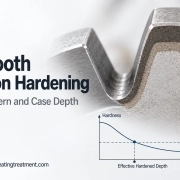
If transformation progresses differently with depth, the resulting hardness profile can also change.
Effective case depth
Prior microstructure does not independently determine effective case depth. Power, frequency, heating time, coil-to-part relationship, geometry and quenching also influence the final hardened region.
However, when effective case depth is defined by a specified hardness threshold, a change in hardening response can shift the depth at which that threshold is reached.
This is why a material-condition change may appear as a change in effective case depth even though the programmed machine parameters have not been deliberately changed.
For a detailed discussion of surface hardness, hardness profiles, case-depth measurement and metallographic inspection, see How to Inspect Induction-Hardened Parts: Why Surface Hardness Alone Is Not Enough.
5. Why the Same Steel Grade Can Behave Differently Between Batches
A common production situation is that the part drawing, steel grade, induction coil and machine program remain unchanged, but the hardening result changes after a new material batch is introduced.
The chemical grade may be the same while the prior microstructure is not.
Differences can result from previous:
Even when two batches are supplied under the same nominal material condition, their microstructures may still differ in pearlite fineness, ferrite grain size, carbide size, carbide distribution or degree of spheroidization.
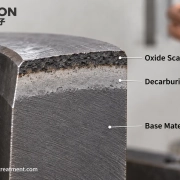
Surface decarburization or segregation may introduce additional variation in some applications.
This is why same steel grade does not automatically mean same induction-hardening response.
If an established process begins producing different results after a material change, the incoming metallurgical condition should be checked before assuming that the machine or induction power supply has changed.
6. How to Determine Whether Prior Microstructure Is Affecting the Result
The most useful approach is usually to compare a material batch that produced the expected result with one that did not.
Check the previous processing history
Determine whether both batches went through the same forging, rolling and heat-treatment route.
A change from normalized to annealed material, for example, can alter the structure entering induction hardening even though the steel designation remains unchanged.
Compare incoming hardness
Incoming hardness does not identify a microstructure by itself, but a meaningful difference between batches can indicate that the material conditions are not equivalent.
Compare the prior microstructure
Metallographic examination can be used to evaluate features such as:
•ferrite-pearlite morphology
•pearlite fineness
•carbide size and distribution
•degree of spheroidization
•structural uniformity
•decarburization where relevant
A direct comparison between a known-good batch and a problematic batch is generally more informative than examining one specimen without a reference condition.
Correlate the material condition with the hardened result
Then compare the resulting:
•hardness response
•hardness profile
•effective case depth
•final microstructure
If the induction process remains controlled while different prior material conditions consistently produce different results, the prior microstructure becomes a stronger candidate for explaining the variation.
This should still be distinguished from ordinary induction-hardening process problems. Coil position, heating distribution, workpiece runout, scanning conditions and quenching can also produce hardness variation.
For a broader troubleshooting sequence covering these process-related causes, see Uneven Hardness After Induction Hardening: Causes of Soft Spots and How to Prevent Them.
7. What Prior Microstructure Means for Process Development
Process-development samples should represent the metallurgical condition expected in production.
If a hardening recipe is established using normalized parts but later production parts arrive in a substantially different annealed or spheroidized condition, the same program should not automatically be assumed to produce an identical metallurgical response.
For new applications, useful material information includes the steel grade, previous heat-treatment condition, incoming hardness and representative prior microstructure, together with the required final hardness and effective case depth.
The same principle applies when a supplier, manufacturing route or intermediate heat treatment changes after the induction-hardening process has already been qualified. A significant change in the incoming material condition may justify checking the established process again.
This is especially important in repeated production, where one induction recipe is expected to produce comparable results over many material batches.
Key Takeaway
Prior microstructure matters because induction hardening does not begin with a metallurgically blank workpiece. The steel already carries the effects of its previous manufacturing and heat-treatment history. Under a short, rapid austenitizing cycle, that prior microstructure can influence austenite formation, carbide dissolution and the final hardening response.
Frequently Asked Questions
Click a question to expand the answer.
Does a different prior microstructure always change the induction-hardening result?
Not necessarily. The response depends on the steel grade, microstructural scale, heating cycle and the required final result. The prior condition should not be treated as a ranking from best to worst.
Why did my hardening result change when the steel grade stayed the same?
The chemical grade can be the same while the prior microstructure is different. Differences in pearlite fineness, ferrite grain size, carbide size or degree of spheroidization between batches can change the austenitizing response, even when the machine program is unchanged.
How do I check whether prior microstructure is causing the variation?
Compare the processing history, incoming hardness and prior microstructure of a known-good batch against the problematic one. Metallographic examination of pearlite fineness, carbide size and structural uniformity is more informative than checking one specimen without a reference condition.
Evaluate Your Prior Microstructure
Send your steel grade, previous heat-treatment condition and incoming hardness — we can help you determine whether prior microstructure is affecting your induction-hardening results.