
Induction Hardening
Induction hardening stands as a core, high-efficiency application of induction heating technology in metal heat treatment. Engineered to boost the wear resistance and fatigue strength of metal workpieces, this advanced process delivers localized surface hardening while preserving the toughness of the workpiece core—ideal for critical industrial components.
How It Works: Fast, Controlled & Reliable
- Rapid Induction Heating
The workpiece is positioned within a custom induction coil. As alternating current flows through the coil, a high-frequency magnetic field is generated, inducing eddy currents in the workpiece’s surface. These currents rapidly heat the target area to the austenitizing temperature in seconds to tens of seconds—far faster than conventional heating methods.
- Precision Quenching & Cooling
Immediately after heating, the hot surface is quenched with water, oil, or specialized quenching media. This rapid cooling transforms the surface microstructure into ultra-hard martensite, while the workpiece core remains in its original ductile state. The result: a perfect balance of hard, wear-resistant surfaces and tough, shock-absorbent cores.
Why Choose Induction Hardening? Key Advantages for Your Production Line
-
Eco-Friendly & Cost-Effective
No open flames, minimal exhaust emissions, and low energy consumption. Reduces workpiece deformation and rejects, minimizing rework costs and maximizing production yields.
-
Targeted Strengthening
Hardens only the wear-prone areas (e.g., gear teeth, shaft journals, rail surfaces) without altering the core properties. Eliminates the need for post-process machining and reduces material waste.
-
Unmatched Efficiency
Cuts heat treatment cycles drastically compared to flame or furnace hardening. Enables seamless integration with automated production lines, boosting throughput and lowering unit costs for mass manufacturing.
-
Exceptional Process Control
Adjust coil design, current frequency, and power output to precisely tailor the depth and area of the hardened layer. Ensures consistent, repeatable results that meet the strictest industrial standards.
Typical Application
Automotive Manufacturing: Hardening of crankshafts, camshafts, transmission gears, and brake components—critical for enhancing vehicle durability and performance.
Machine Tool Industry: Precision hardening of machine tool guide rails, spindles, and cutting tool holders—ensuring long-term stability and machining accuracy.
Construction Machinery: Wear-resistant treatment of excavator track shoes, loader pins, and hydraulic cylinder rods—extending service life in harsh working conditions.
| Induction Hardening | Conventional Quenching (Flame/Furnace) |
|---|---|
| Ultra-fast: Surface temperature reaches austenitizing level in seconds to tens of seconds, drastically shortening the heat treatment cycle. | Slow: Furnace hardening requires hours of heating; flame hardening has uneven heat transfer and long heating time. |
| Highly controllable: Adjust induction coil shape, current frequency, and power to precisely define the hardened area and layer depth; no impact on non-target regions. | Poor precision: Flame hardening is easily affected by operator skills; furnace hardening heats the entire workpiece, leading to overall performance changes. |
| Minimal deformation: Localized heating avoids thermal stress on the whole workpiece; post-processing (e.g., grinding) workload is significantly reduced. | Severe deformation: Whole-piece heating causes large thermal expansion and contraction; high rework rate for precision components. |
| High efficiency: Energy is directly converted to heat on the workpiece surface; almost no heat loss to the surrounding environment. | Low efficiency: Furnace hardening wastes a lot of heat on furnace body heating and heat dissipation; flame hardening has heat loss due to radiation. |
| Fully integrable: Matches automated production lines for continuous, unmanned operation; consistent batch processing quality. | Low automation level: Flame hardening relies on manual operation; furnace hardening requires manual loading/unloading, with high labor costs. |
| Eco-friendly: No open flame, no exhaust gas, and low noise; meets strict industrial environmental standards. | Polluting: Flame hardening produces smoke and noise; furnace hardening may emit waste gas depending on heating fuels. |
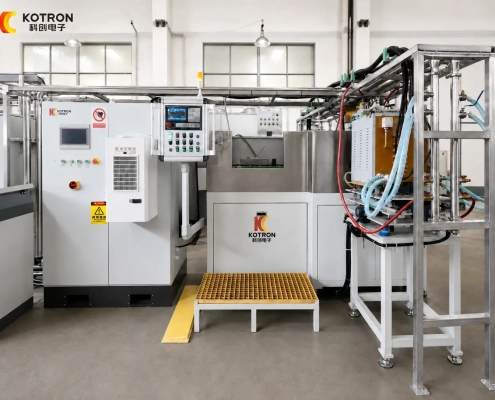 https://www.inductionheatingtreatment.com/wp-content/uploads/2026/08/Multi-Station-Pickaxe-Induction-Hardening-Machine.webp
1086
1448
cui yanan
https://www.inductionheatingtreatment.com/wp-content/uploads/2025/12/kclogo2.webp
cui yanan2026-08-27 07:33:382026-09-07 02:49:31Multi-Station Pickaxe Induction Hardening Machine
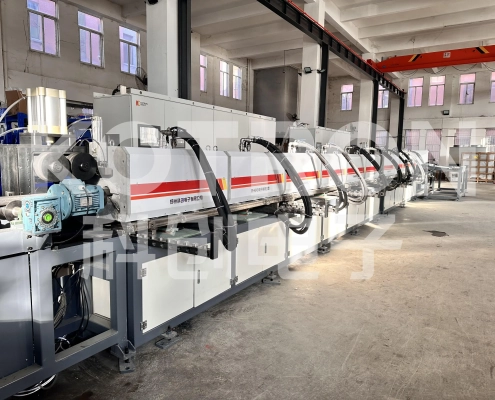 https://www.inductionheatingtreatment.com/wp-content/uploads/2026/08/Steel-Bar-Hot-Rolling3-scaled.webp
1920
2560
cui yanan
https://www.inductionheatingtreatment.com/wp-content/uploads/2025/12/kclogo2.webp
cui yanan2026-08-26 05:48:052026-09-07 02:50:283000 kW Steel Bar Hot Rolling, Quenching and Tempering Line
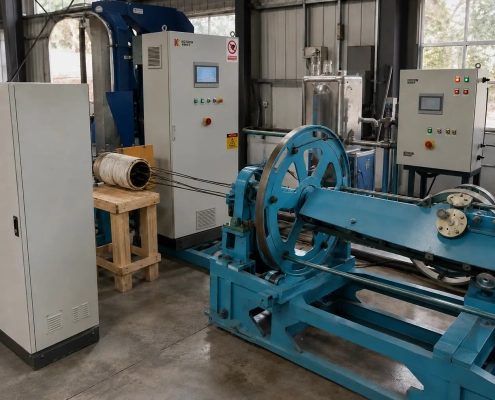 https://www.inductionheatingtreatment.com/wp-content/uploads/2026/08/Epoxy-Coated-PC-Strand-Production-Line.webp
1254
1254
cui yanan
https://www.inductionheatingtreatment.com/wp-content/uploads/2025/12/kclogo2.webp
cui yanan2026-08-25 02:37:482026-09-22 08:42:26Epoxy-Coated Prestressing Steel Strand Production Line


