
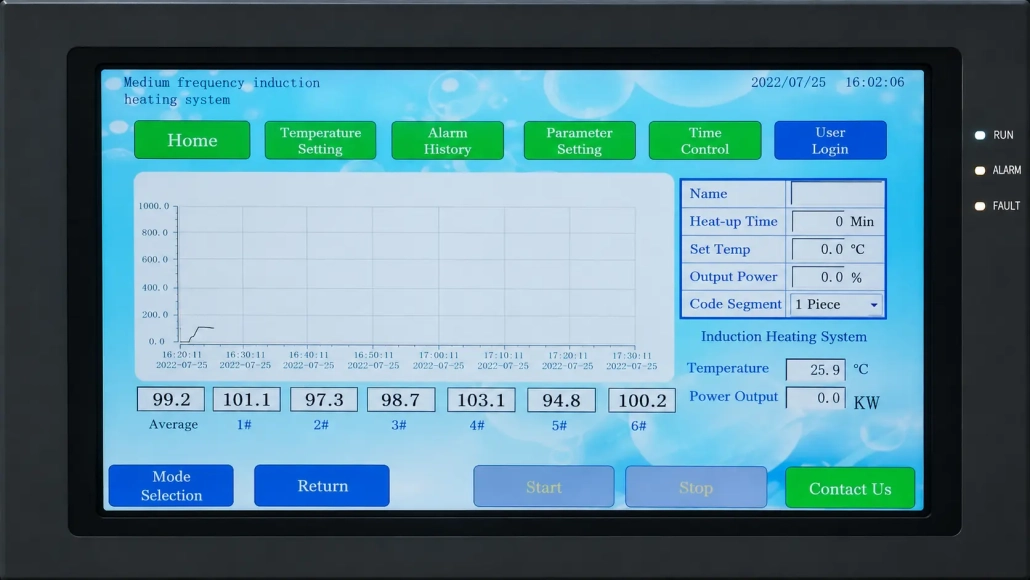
Digital Induction Heating Power Supply with Real-Time Power Monitoring
Real-time power monitoring in induction heating transforms production from guesswork into controlled, data-driven manufacturing. For factory owners, production managers, and B2B buyers, choosing induction heating equipment is not only about buying a machine — it is about selecting a reliable heating solution for daily production. A digital induction heating power supply with real-time monitoring allows operators and managers to see critical heating data during production: power output, working status, and energy consumption. This visibility makes it easier to manage quality, reduce energy waste, and identify problems before they cause scrap parts or downtime. This article explains how real-time monitoring solves the four most common induction heating production problems — and what to look for when selecting a system.
📋 Table of Contents
4 Production Problems Solved by Real-Time Monitoring
Many factories still face heating problems even when they already own induction heating equipment. These issues may not appear every day — but when they do, they cause scrap parts, production delays, higher power costs, and customer complaints. Here is how real-time monitoring changes the equation:
| Problem | Without Real-Time Monitoring | With Real-Time Monitoring |
|---|---|---|
| 1. Unstable Heating Results | One part heated correctly, another underheated or overheated — quality varies by shift and operator | Power output verified every cycle; consistent energy input across all batches |
| 2. Hidden Energy Waste | No visibility into energy consumption; cost control is guesswork | Cycle-level energy data enables process comparison and cost optimization |
| 3. Difficult Troubleshooting | Operator only knows result is bad — cannot tell if cause is power, coil, cooling, or setup | Process data pinpoints what went wrong; faster root cause analysis, less downtime |
| 4. Lack of Process Traceability | No production records — cannot prove the process was controlled when customers audit | Key process parameters logged; audit-ready documentation for quality systems |
1. Unstable Heating Results
In heat treatment and induction hardening, stable heating is non-negotiable. If power fluctuates, one part may be heated correctly while the next is underheated or overheated — affecting hardness, case depth, strength, and service life. For production managers, unstable heating means more inspection work and higher rejection risk. With real-time power monitoring, the operator sees the actual power output during every cycle. If a deviation occurs, it is visible immediately — not discovered hours later at the quality inspection station.
2. Hidden Energy Waste
Induction heating equipment consumes significant electricity. Without real-time energy monitoring, inefficiency is invisible — a machine may run at poor efficiency for months without anyone noticing, simply because there is no data. With energy monitoring, factories can compare energy consumption across different process settings, identify abnormal usage patterns, and optimize heating parameters. This is especially valuable in high-volume production where small per-cycle improvements accumulate into meaningful annual savings.
3. Difficult Troubleshooting
When a heating problem occurs, operators without monitoring data can only see that the result is poor. They cannot identify whether the root cause is the power setting, coil condition, cooling water temperature, part positioning, or machine status. With digital monitoring, the power supply records what happened during the process — power output curve, frequency stability, and fault events. Maintenance teams can review this data to find the cause faster and reduce downtime. What previously took hours of trial-and-error testing can often be diagnosed in minutes.
4. Lack of Process Traceability
In automotive parts, construction machinery, tooling, and heat treatment services, customers increasingly require proof that the heating process was controlled. If a factory cannot produce process data, it becomes harder to demonstrate production consistency during audits or quality disputes. A digital induction heating system with monitoring supports traceability by recording key process parameters — power output, heating time, and equipment status — for each production batch. For a foundational understanding of the technology, see our guide on how induction heating works.
How This Technology Helps in Daily Production
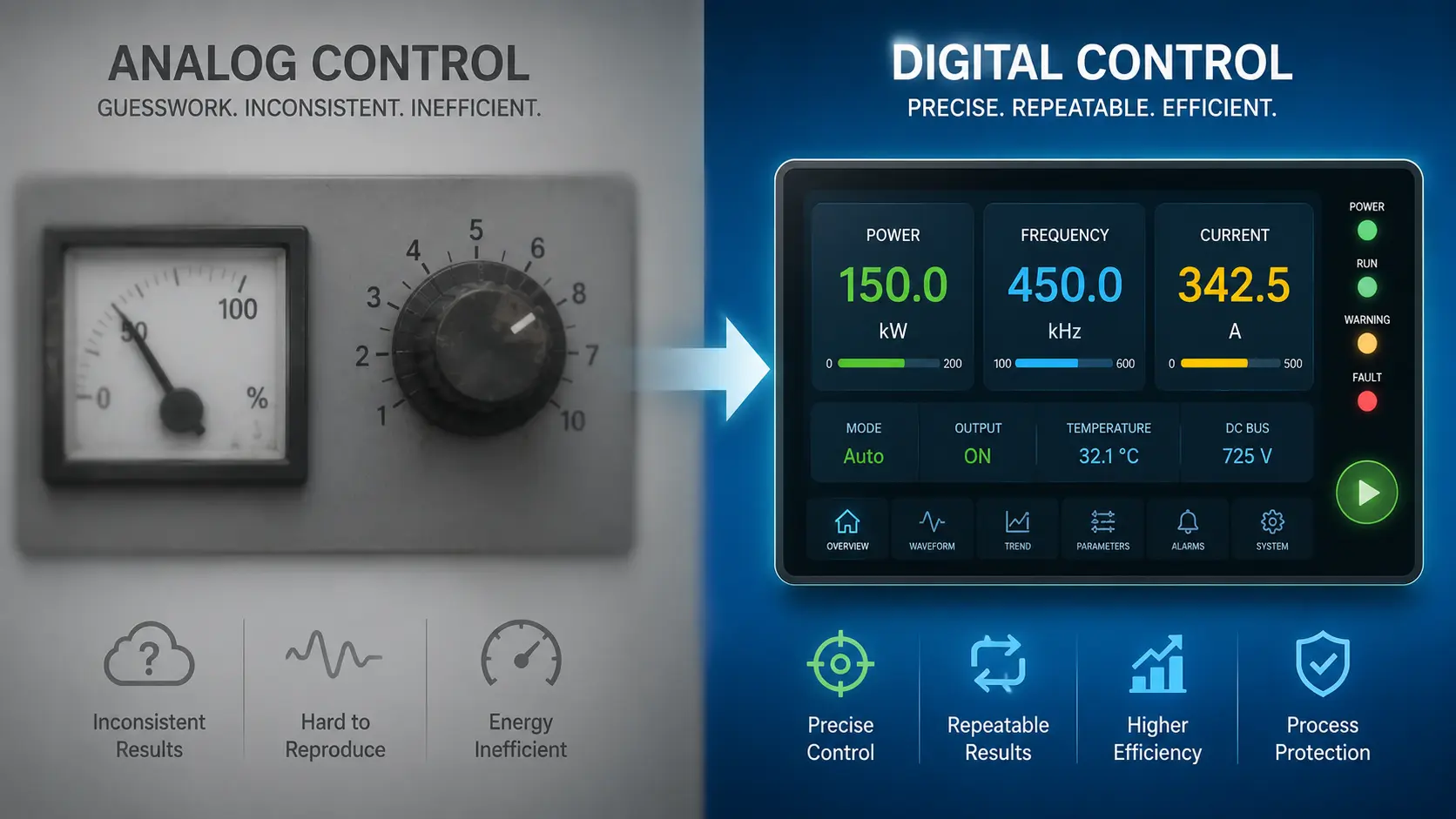
A digital induction heating power supply changes the heating process from manual judgment to controlled production. It does not make the process more complicated — it gives the operator clearer information and better control.
During production, the power supply converts electrical energy into high-frequency or medium-frequency power for the induction coil. The coil creates a magnetic field, and the metal workpiece heats up quickly through electromagnetic induction. The digital control system manages the power output with precision, while real-time monitoring displays the actual operating condition. Rather than relying solely on experience — “it looks about right” — operators can verify that every heating cycle meets the target parameters.
Practical example: If a part is not heated as expected, the operator checks whether the actual power output was stable during that cycle. If energy consumption trends higher than normal across a shift, the maintenance team investigates the coil condition, cooling system, or machine settings — guided by data, not guesswork. This eliminates repeated trial-and-error adjustments that waste production time.
5 Key Benefits for Industrial Buyers
1. Better Quality Control
Stable heating quality is the primary reason buyers choose digital induction heating equipment with monitoring. When power output is controlled and verified cycle by cycle, heating results become repeatable — critical for induction hardening, annealing, tempering, brazing, and welding preheating. For engineers, this means easier process adjustment. For production managers, fewer rejected parts. For buyers, a machine suitable for long-term industrial use rather than occasional workshop jobs.
2. Lower Energy Cost
Induction heating is inherently efficient because it heats the workpiece directly. However, real-world energy savings still depend on correct machine selection, proper coil design, suitable process settings, and disciplined daily operation. Real-time energy monitoring lets factories see exactly how energy is being used — enabling managers to compare heating recipes, identify the most efficient settings, and detect abnormal consumption caused by poor coil matching or equipment issues. The value extends beyond electricity cost: it gives the factory genuine control over production cost structure.
3. Easier Operation
A modern digital induction heating power supply is designed to simplify operation, not complicate it. Operators set parameters through a clear control interface — no manual knob calibration, no analog meter interpretation. For factories running multiple shifts with varying operator experience levels, this simplicity reduces setting errors and shortens training time for new hires. When the system displays alarms and operating data clearly, operators can respond faster to abnormal conditions, improving daily production efficiency and reducing dependence on a few highly experienced workers.
4. Process Traceability
Process traceability means the factory can review and document what happened during every heating cycle — power output, heating time, equipment status, and energy consumption. For automotive parts manufacturers and heat treatment service providers operating under IATF 16949 or ISO 9001, this documentation is increasingly a customer requirement. If a quality issue surfaces weeks after production, the factory can retrieve the process data for that specific batch and identify possible causes. Customers are not only buying finished parts — they are buying confidence that the process is controlled and repeatable.
5. Improved Equipment Reliability
Reliable equipment means fewer unplanned production interruptions. A digital power supply with monitoring supports proactive maintenance by displaying real-time operating conditions and fault alarms. If the system detects abnormal current draw, cooling insufficiency, or component temperature rise, operators can stop and investigate before a minor issue becomes a major failure. Maintenance managers benefit from machine data that enables condition-based maintenance planning — responding to early warning signs rather than waiting for sudden breakdown.
Where It Can Be Used
Digital induction heating equipment with power and energy monitoring serves a wide range of industrial heating applications. The correct configuration depends on part size, material, heating temperature, production speed, and process goal:
- Induction Hardening — Surface hardening of shafts, gears, pins, rails, sprockets, and mechanical wear components. Stable power control ensures consistent heating before quenching. For related guidance, see our articles on power selection and frequency and power matching.
- Heat Treatment — Hardening, tempering, annealing, normalizing, and stress relieving. Digital control enables precise management of heating time and power for different treatment recipes.
- Welding Preheating — Controlled, localized preheating before welding large steel structures, pipes, or heavy components. Real-time monitoring helps operators maintain target preheat temperature consistently.
- Pipe Heating — Pipeline construction, pipe coating, pipe bending, and welding preparation. Monitoring supports safe, consistent heating control across long workpieces.
- Forging Heating — Rapid heating of billets and bars to forging temperature before forming. Induction enables fast heating and compact production line integration.
- Automated Production Lines — Integration with automatic feeding, robots, conveyors, and PLC control systems. Digital power supplies communicate more easily with line-level automation than older manual systems. For setup considerations, refer to our power requirements guide.
Buyer’s Guide: 8-Point Checklist
Before purchasing induction heating equipment, evaluate more than the purchase price. A lower upfront cost may not translate to lower total cost if the system is difficult to operate, wastes energy, or causes downtime.
- Confirm your heating application — Induction hardening, welding preheating, forging, and brazing require different power levels, frequencies, coils, and cooling configurations. Prepare material grade, part dimensions, heating area, target temperature, and production rate before contacting suppliers.
- Verify power and frequency matching — Power affects heating capacity; frequency affects heating depth. The machine must match the workpiece and process. An experienced supplier should recommend the correct configuration based on your actual production needs, not just quote a standard model.
- Ask about real-time monitoring functions — Confirm whether the power supply supports real-time power monitoring and energy monitoring. Ask what data can be displayed, recorded, and exported. This is essential for buyers who need quality control and traceability.
- Evaluate the control interface — The system should be easy for operators to use. A clear display, simple parameter setting, understandable alarm messages, and stable control reduce errors. For multi-shift factories, ease of operation directly affects production consistency.
- Check cooling and safety protection — Confirm cooling water quality, flow rate, pressure, and temperature requirements. Verify that the system includes over-temperature protection, water flow monitoring, overcurrent protection, and fault alarms. For detailed specifications, see our cooling system guide.
- Do not overlook coil design — The induction coil is central to heating performance. Even the best power supply cannot compensate for a poorly designed coil. Ask whether the supplier provides coil design support based on your part drawings or samples.
- Plan for future production needs — If your production volume may grow, choose a system that supports production line integration, data communication, automation, and multiple recipe storage. Retrofitting these capabilities later is more expensive than specifying them upfront.
- Evaluate supplier support — Technical communication, installation guidance, spare parts availability, operator training, troubleshooting assistance, and after-sales service are all part of the equipment investment. A qualified supplier helps you understand the process — not just sell a machine.
Frequently Asked Questions
What is a digital induction heating power supply?
A digital induction heating power supply is the main control unit of an induction heating system. It converts electrical input into precisely controlled high-frequency or medium-frequency power for the induction coil, using digital control to manage heating output. Compared with older analog systems, it offers clearer operation, real-time monitoring, and more stable process control.
Why is real-time power monitoring important?
Real-time power monitoring lets operators see the actual power output during every heating cycle. This confirms whether the machine is operating as expected — rather than relying on experience or post-process inspection. It is a practical tool for quality control, troubleshooting, and continuous process improvement.
Can energy monitoring help reduce electricity cost?
Yes. Energy monitoring helps factories understand how much power each heating cycle or batch consumes. It enables managers to compare process settings, detect abnormal energy usage, and optimize production parameters. Actual savings depend on the application, machine selection, coil design, and operating practices — but the first step is always visibility.
Is this equipment suitable for automated production lines?
Yes. Many digital induction heating systems are designed for production line integration — working with automatic feeding systems, PLC controllers, robots, and conveyors. Buyers should specify communication and control interface requirements (Profinet, EtherCAT, Modbus, etc.) during the project stage to ensure compatibility.
What information should I provide before requesting a quotation?
Provide the material grade, part dimensions, heating area, target temperature, required heating time, production rate, and process purpose (hardening, preheating, forging, brazing, etc.). If possible, share part drawings, photos, or videos of your current process. The more specific the information, the more accurate the supplier’s recommendation will be.
Looking for Induction Heating Equipment with Real-Time Monitoring?
Tell us your application and production requirements. We will recommend a digital induction heating system with the right power, frequency, monitoring functions, and automation compatibility for your process.


