
Mastering Air-Cooled Induction Heating: 3 Proven Cooling Strategies to Prevent Downtime
Air-cooled induction heating systems eliminate the need for water pipes, chillers, and complex plumbing, but they also have clear performance limits. By understanding where air cooling makes sense and where it does not, you can avoid buying a machine that overheats from day one or spending money on cooling capacity you will never need.
Table of Contents
Why cooling matters in induction heating
Every induction heating machine generates waste heat—and a lot of it. The IGBT modules, capacitors, transformer, and work coil all convert part of the input power into heat. Without sufficient cooling, component temperatures rise quickly, triggering thermal protection shutdowns or causing permanent damage.
In a typical induction heating system, approximately 10–15% of the input power is converted into waste heat that must be dissipated. In a 15 kW machine, this amounts to 1.5–2.25 kW of heat, comparable to a small space heater running inside a closed electrical cabinet. If you are still sizing your machine, read our guide on how much power you need for induction heating to accurately determine your power requirements first.
The cooling method you choose directly affects machine reliability, duty cycle, ambient noise, installation complexity, and acquisition cost. Make the wrong decision, and even the most expensive machine can become a paperweight.
Air cooling vs. water cooling: the central trade-off
Induction heating equipment uses two fundamentally different approaches to thermal management:
| Factor | Air-cooled | Water-cooled |
|---|---|---|
| Typical power range | ≤ 15–25 kW | 5–500+ kW |
| Installation | Plug-and-play — no water installation | Requires water supply, chiller or cooling tower, piping |
| Acquisition costs | Lower | Higher (machine + chiller) |
| Operating costs | Electricity for the fans only | Electricity for pump + chiller + water treatment |
| Noise level | 60–75 dB (depending on the fan) | 50–65 dB (pump + chiller fan) |
| Sensitivity to ambient temperature | High — power derating in hot environments | Low — the chiller compensates for ambient variations |
| Mobility | Excellent — usable anywhere with a power outlet | Limited — tied to water infrastructure |
| Maintenance effort | Low — clean filters, check fans | Moderate — water quality, leaks, pump seals |
In summary: air cooling stands out for its simplicity and mobility; water cooling, for its high heat dissipation capacity and environmental compatibility. The choice mainly depends on one indicator — your power level. You will find a more complete overview for selecting the right machine in our guide to induction heating machines.
Power thresholds — When air cooling makes sense
The practical viability of air cooling is determined by the amount of waste heat the system generates — and this scales directly with input power. Here is how the threshold values appear in practice:
Up to 10 kW — Air cooling is ideal
At this level, waste heat is less than 1.5 kW. A well-designed forced-air system, with two to four high-CFM axial fans, can safely keep IGBT junction temperatures below 125°C even with a 100% duty cycle. Most manual induction heating equipment, benchtop units, and portable bearing heaters fall into this category. These machines are true Plug-and-play solutions — no cooling infrastructure is required.
10–20 kW — Air cooling works with good design
This is the gray area. Waste heat is between 1.5 and 3 kW — manageable with forced air, but only if the airflow path inside the enclosure is properly designed. Machines in this range need guided airflow, directing cool air directly over the heat sinks before exhausting it, as well as thermal protection logic that reduces output power when the internal temperature exceeds the set thresholds. Expect duty cycle limitations at ambient temperatures above 35°C (95°F).
Above 20–25 kW — Air cooling reaches its limits
Above about 25 kW, the air volume needed to remove more than 3 kW of waste heat is no longer practical. Fan noise exceeds 75 dB, the enclosure becomes bulky, and sensitivity to ambient temperature becomes a serious reliability risk. At this point, water cooling is no longer optional — it is the only viable approach. Virtually all industrial induction hardening, forging, and melting equipment uses water cooling for this reason.
Fan types and airflow design
Not all air-cooled induction machines are the same. The fan configuration directly determines how much heat can be removed and how reliably the machine operates.
Axial fans — High flow rate, low pressure
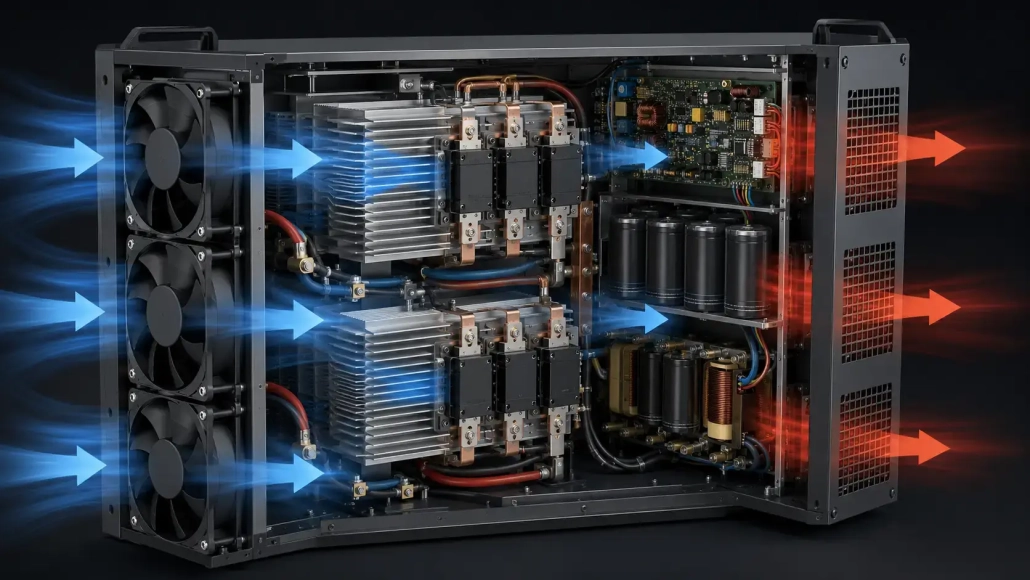
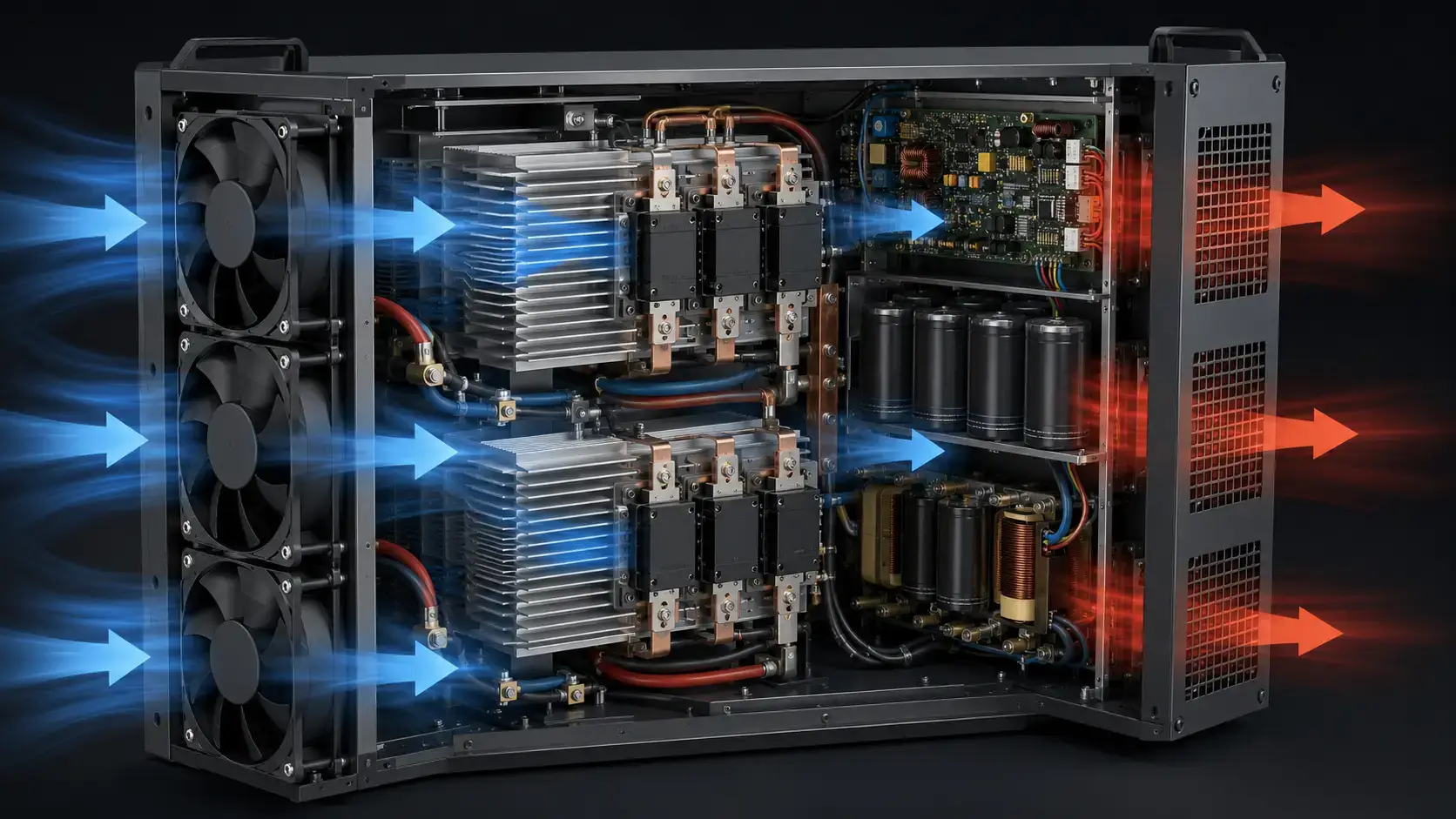
Axial fans move large volumes of air at low static pressure. They are the standard choice for most air-cooled induction equipment because they are compact, economical, and efficient at moving air through an open enclosure. Typical configurations use two to six 120 mm or 150 mm axial fans, mounted on the rear or side wall, driving air in a straight line over the heat sinks and exhausting it through the opposite side.
Best suited for: machines under 15 kW with an open internal layout and large ventilation grilles. Expect 60–70 CFM per fan at 2,000–3,000 rpm.
Radial fans (blowers) — High pressure, directed airflow
Radial fans generate higher static pressure and are therefore suitable for machines with a denser internal layout, where air must pass through narrow gaps between cooling fins or around multiple obstacles. They are noisier than axial fans with comparable airflow, but they maintain performance better under flow resistance.
Best suited for: machines in the 15–25 kW range with densely packed IGBT modules and multiple heat-generating components in the airflow path.
Variable-speed fans (PWM-controlled)
Higher-quality air-cooled machines use PWM-controlled fans, coupled to internal temperature sensors. At low power or during idle phases, the fans spin slowly — reducing noise and dust intake. When the internal temperature rises, fan speed increases proportionally. This is the most efficient approach: the machine operates quietly when possible and only switches to maximum ventilation speed when necessary.
Push-pull configuration
In machines in the upper air-cooled power range (15–25 kW), a push-pull fan arrangement — intake fans on one side and exhaust fans on the opposite side — creates a pressure differential that overcomes internal airflow resistance. This configuration can improve cooling efficiency by 20–30% compared with push-only or pull-only designs, as it maintains higher air velocity throughout the entire chassis.
When you should switch to water cooling
Air cooling is not a universal solution. Several scenarios require water cooling regardless of power level:
1. High ambient temperatures. If your production facility regularly exceeds 35°C (95°F), the temperature delta between the heat sink and the ambient air is drastically reduced. Air cooling loses effectiveness because there is simply not enough thermal gradient to drive heat transfer. A properly sized water cooling system with a chiller ensures consistent cooling regardless of ambient conditions.
2. Continuous duty cycle. Applications such as induction forging, continuous bar heating, or high-throughput hardening lines operate at or near a 100% duty cycle. Air-cooled systems from 15 kW upward reach thermal saturation in 15–30 minutes under these conditions and activate a protective derating function. Water cooling provides the thermal mass and continuous heat dissipation required for uninterrupted operation.
3. Dusty or contaminated environments. Foundries, forges, and grinding workshops generate airborne particles that clog air filters and coat heat sink fins — causing cooling capacity to decline over time. Although air filters help, a closed water-cooled electrical cabinet completely eliminates this failure cause.
4. Space-constrained installations. Air-cooled machines need clearance — typically 200–300 mm on the air inlet and outlet sides to ensure sufficient airflow. In tight equipment enclosures or automated production cells, this clearance may not be available. Water-cooled machines can be installed in considerably smaller areas, because heat is removed by liquid rather than air.
5. Noise restrictions. A 25 kW air-cooled machine with multiple high-speed fans can exceed 75 dB — loud enough to require hearing protection in many jurisdictions. Water-cooled systems move the noise source to a chiller, which can be placed remotely or outside the work area.
Maintenance: keeping air-cooled systems reliable
One of the main selling points of air cooling is its low maintenance — but “low” does not mean “zero”. Neglecting these three tasks is the fastest way to damage an air-cooled machine:
1. Clean or replace the air filters monthly
Most air-cooled induction machines have foam or fabric intake filters. In a typical industrial environment, these filters can accumulate enough dust in one month to reduce airflow by 30–40%. Wash foam filters with mild detergent and water; let them dry completely before reinstalling them. Replace paper or synthetic media filters — do not try to clean them.
2. Inspect the heat sink fins quarterly
Even with filters, fine dust eventually reaches the heat sinks. Inspect the IGBT and rectifier heat sink fins every three months. If the fins are clogged, clean them with compressed air blown against the normal direction of airflow (backward through the air outlet) to dislodge adhered deposits.
3. Check fan operation
A failed fan often goes unnoticed until the machine shuts down due to overtemperature in the middle of a cycle. Listen for bearing noise (a sign of imminent failure), visually check at startup that all fans are spinning, and verify that PWM-controlled fans increase their speed when the machine is under load. Replace any fan that shows bearing play or irregular speed.
4. Monitor internal temperature
If your machine has an internal temperature indicator, record the initial value when the machine is operating under a typical load. A gradual upward trend over weeks or months indicates a decrease in cooling capacity — clogged filters, failing fans, or dust-covered heat sinks — long before a thermal shutdown occurs.
Key takeaway
- Air cooling is viable up to 20–25 kW with proper fan design; above that range, water cooling is essential.
- PWM-controlled fans in a push-pull configuration represent the high-end air-cooled design for the 15–25 kW range.
- Ambient temperature, duty cycle, and dust load — not just power — determine whether air cooling works in your application.
- Monthly filter cleaning and quarterly heat sink inspection prevent the gradual thermal deterioration that destroys air-cooled machines without being noticed.
- With high ambient temperatures, continuous operation, or dusty environments, water cooling is the safer option — even at lower power levels.
FAQ
Can I convert a water-cooled induction heater to air cooling?
Generally, no. Water-cooled machines are designed with internal liquid-cooled heat sinks, which lack the fin geometry and surface area needed for effective air cooling. IGBT modules and resonant capacitors are physically different from their air-cooled equivalents. Retrofitting air cooling to a water-cooled machine would require replacing the entire power stage — it is almost always more cost-effective to buy the right machine for your cooling method from the start.
How noisy is an air-cooled induction heater?
At no load, 50–55 dB (conversation volume). At full load, with all fans at maximum speed, 65–75 dB, depending on the power level and fan configuration. A 15 kW machine with four 120 mm axial fans at full speed typically measures approximately 68–72 dB at a distance of 1 meter — comparable to a vacuum cleaner. If noise is an important factor, look for a machine with PWM fan control, which keeps sound emissions low during partial-load operation.
Does air cooling affect heating efficiency?
Not directly — the energy used to heat the workpiece is the same, regardless of how the machine itself is cooled. However, an air-cooled machine that reaches thermal saturation activates protective power derating, which reduces output power. In this sense, insufficient cooling indirectly reduces effective heating performance. A properly sized air-cooled system operates continuously at its intended power level with full efficiency.
Can I use an air-cooled induction heater outdoors?
Yes — with limitations. Air-cooled machines are actually better suited for temporary outdoor use than water-cooled machines, as there is no risk of water lines freezing. However, you must protect the machine from direct rain (most air-cooled equipment is IP20–IP32, not weatherproof), direct sunlight (which increases the thermal load), and windborne dust. A simple shelter with open sides for air circulation is usually sufficient.
Not sure which cooling method suits your application?
Tell us your power level, duty cycle, and workshop environment — we will recommend the right induction heating system with the appropriate cooling configuration.


