
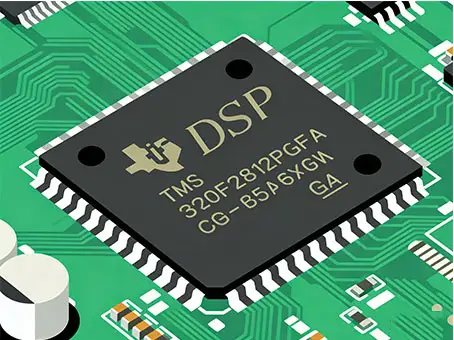
5 Proven Advantages of DSP-Controlled Induction Heating Power Supplies for Modern Manufacturing
For years, the industrial conversation around induction heating power supplies gravitated toward an unavoidable trade-off: choose parallel systems for stability, or series systems for cost-efficiency. DSP-controlled induction heating power supply technology has fundamentally changed that equation. By combining a series resonant topology with advanced DSP (Digital Signal Processor) full-digital control, manufacturers like Kechuang Electronics have developed high-efficiency, high-precision systems that deliver both — greater operational stability and lower system cost — without compromise.
Table of Contents
Why Series Resonant — and Why It Struggled Before DSP
To understand the value of this combination, it helps to revisit the fundamental difference between the two main topologies.
In a parallel resonant circuit, the resonant capacitor is connected in parallel with the load coil. This configuration is naturally more forgiving of load variation, which made it the default choice for processes with inconsistent workpiece geometry. However, it requires larger capacitor banks, a more complex matching transformer arrangement, and draws higher circulating currents — all of which translate into greater system volume, higher component count, and elevated energy losses.
In a series resonant circuit, the capacitor is connected in series with the load coil, forming a tighter, lower-impedance loop. This inherently reduces component count and system size, and allows the inverter to operate at higher efficiency. The historical weakness was control: analog circuits could not track the shifting resonant frequency fast enough when load conditions changed, leading to instability. DSP eliminates that weakness entirely.
Understanding this distinction is critical when selecting an induction heating power supply for your specific application — the topology directly impacts both performance and total cost of ownership.
1. The Core Value of Digital Control: Overcoming the Limitations of Analog Circuits
Conventional series resonant power supplies rely on analog control circuits, which are prone to component aging, thermal drift, and slow frequency tracking response. This is the root cause of the long-standing perception that series systems lack stability.
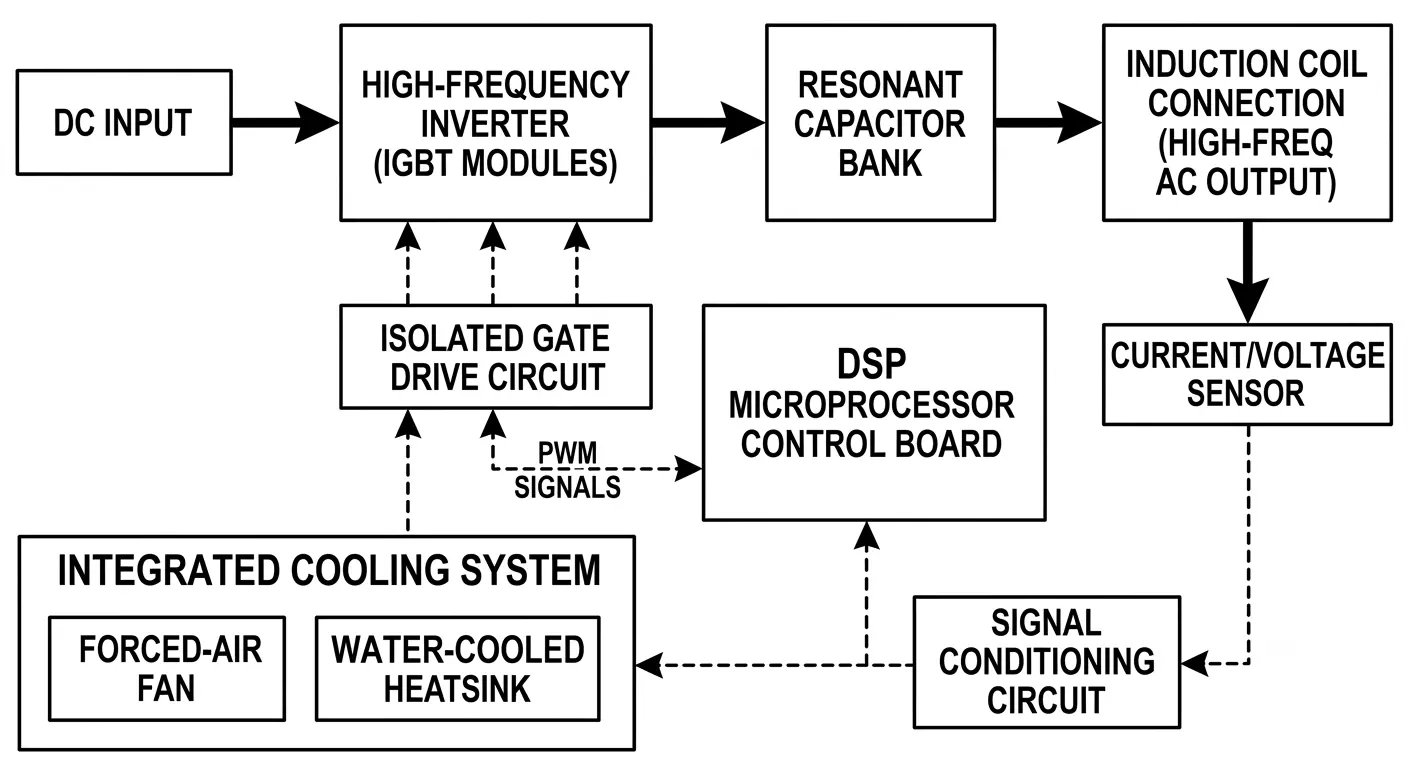
Our systems are built around a high-speed DSP microprocessor as the control core, capable of executing complex closed-loop control algorithms within microseconds. The control loop works as follows: the DSP continuously samples the output voltage and current waveforms, calculates the instantaneous phase difference between them, and adjusts the inverter switching frequency in real time to maintain zero-voltage switching (ZVS) conditions. This keeps the system locked onto the resonant point regardless of how the load impedance shifts during heating.
Excellent Thermal Stability
Digital processing eliminates the precision errors caused by ambient temperature fluctuations in analog components, maintaining consistent control accuracy across a wide operating temperature range. This is a decisive advantage in heavy industrial environments where ambient conditions fluctuate significantly throughout the day.
Fast Frequency Tracking Response
The DSP continuously calculates the phase and frequency of the resonant circuit, ensuring the inverter always operates close to the resonant point — remaining stable even under rapidly changing load conditions typical of quenching and forging processes. This microsecond-level response is something analog frequency control systems simply cannot match.
2. Key Advantages of Kechuang’s DSP Series Resonant Systems
The integration of DSP digital control with series resonant topology delivers five measurable benefits that directly impact production quality and operating costs.
Intelligent Load Matching
The DSP control module automatically detects and adapts to different induction coil designs and workpiece geometries, significantly simplifying coil matching and commissioning. This makes the system highly versatile for mixed-product production lines — a key advantage of modern induction heating treatment over conventional methods.
Lower System Bill-of-Materials Cost
The series resonant topology requires fewer components than a parallel resonant circuit, resulting in a noticeably smaller system footprint and lower overall material cost. The integration of DSP control on top of this topology achieves a sound balance between reliability and cost, with competitive factory-direct pricing.
Full-Digital Protection and Fault Self-Diagnostics
The DSP continuously monitors critical parameters including voltage, current, frequency, and cooling water temperature. Upon detecting any abnormality — such as a coil short circuit or overcurrent condition — the system triggers a protective shutdown within microseconds, well within the safe operating limits of the IGBT modules, and displays a precise fault code on the HMI screen for immediate troubleshooting. This level of response speed is only achievable through digital control; analog protection circuits simply cannot react fast enough to prevent component damage under sudden fault conditions.
High Power Factor and Reduced Operating Energy Costs
The power factor is maintained at a high level across all power ranges, minimizing reactive power losses and helping reduce the actual electricity costs of your facility — a consideration that grows more important as energy prices continue to rise globally.
3. Ideal Application Scenarios for High-Precision Industrial Heat Treatment
The precise control provided by DSP makes the system reliably stable in applications where process consistency is critical:
Precision Hardening: Scanning hardening of shafts and gears, with consistent case depth. For deeper insight into gear-specific challenges, refer to our detailed guide on common gear induction hardening defects and how to avoid them. Similarly, shaft induction hardening presents unique challenges that DSP precision helps overcome.
Rapid Brazing: Carbide tool and copper pipe brazing with controlled heat input, reducing the risk of overheating and ensuring consistent joint quality across production runs.
Continuous Annealing: Uniform heating of wire, tube, and strip, with high temperature uniformity along the line — essential for downstream forming and fabrication processes.
Whether integrated into a CNC hardening machine for scanning induction hardening, or applied to precision tool brazing processes, the DSP ensures every workpiece receives a consistent heating profile, case depth, or weld quality. Explore our full range of induction heating applications for more process-specific information.
🔑 Key Takeaway
The era of choosing between reliability and cost is over. DSP-controlled induction heating power supply technology integrates high-speed digital control, high energy utilization efficiency, and industrial-grade structural reliability into a single platform — purpose-built for modern heat treatment and brazing production lines.
The three decisive upgrades over analog systems are: (1) microsecond-level real-time frequency tracking that maintains ZVS under rapidly changing loads, (2) full-digital protection that reacts fast enough to prevent IGBT damage, and (3) intelligent load matching that automatically adapts to different coil and workpiece geometries.
Frequently Asked Questions
Q: What is the difference between series resonant and parallel resonant induction heating?
In a series resonant circuit, the capacitor is connected in series with the load coil, forming a lower-impedance loop that reduces component count and improves efficiency. In a parallel resonant circuit, the capacitor is parallel to the coil, offering better tolerance to load variation but at the cost of larger capacitor banks, more complex transformers, and higher energy losses. DSP control now enables series topology to match or exceed parallel stability while retaining its efficiency advantage.
Q: How does DSP improve the stability of a DSP-controlled induction heating power supply?
The DSP continuously samples output voltage and current waveforms, calculates the instantaneous phase difference, and adjusts the inverter switching frequency in microseconds to maintain zero-voltage switching (ZVS). This real-time closed-loop control locks the system onto the resonant point even as load impedance changes during heating, something analog circuits cannot do fast enough.
Q: What applications benefit most from DSP-controlled induction heating?
Three application categories see the greatest benefit: (1) precision scanning hardening of shafts and gears requiring consistent case depth, (2) rapid brazing of carbide tools and copper pipes where controlled heat input prevents overheating, and (3) continuous annealing of wire, tube, and strip where uniform temperature along the production line is critical.
Need Application-Specific Guidance?
Contact our engineering team for a technical assessment and quotation tailored to your process requirements. We respond promptly with detailed specifications.


