
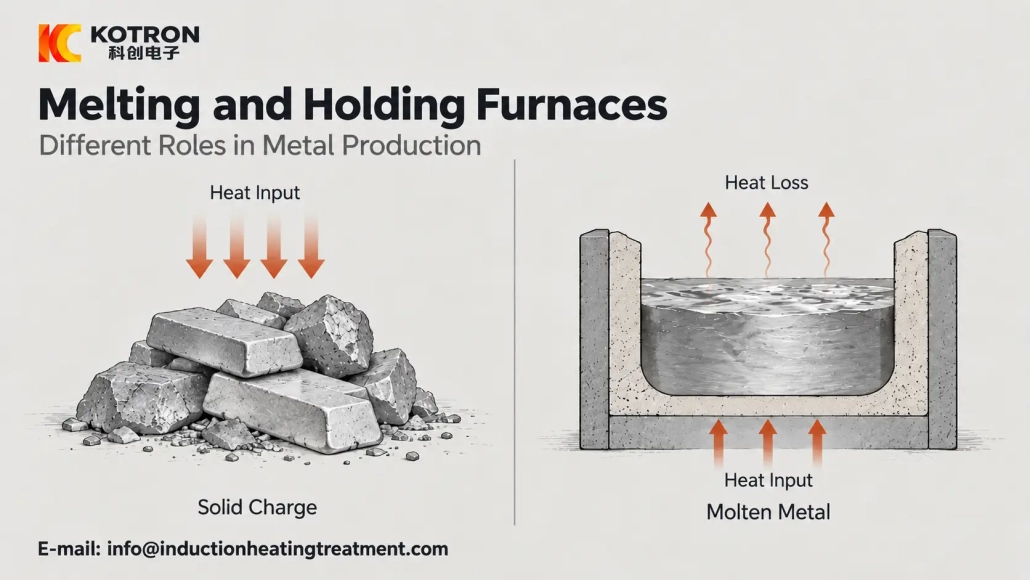
Melting and Holding Furnaces: Different Roles in Metal Production
A melting furnace works mainly with solid charge; a holding furnace usually works with metal that is already liquid. In continuous production, that difference affects furnace capacity, power demand and the way molten metal is supplied to the next process.
From Solid Charge to Molten Metal Supply
1. A Melting Furnace Starts with Solid Metal
The job of a melting furnace is to take solid feedstock and produce a usable molten bath.
The charge may be ingots, blocks, return material or other suitable metal feedstock. Heat is required to raise the charge from its initial temperature, complete melting and, if necessary, bring the liquid metal to the required operating temperature.
For an induction melting furnace, practical melting capacity depends on more than its rated kW. Metal type, batch weight, starting temperature, melting time, furnace construction and heat loss all affect the result.
A 100 kW system, for example, cannot be assigned one universal melting capacity. Zinc, aluminum and copper have different thermal requirements. A cold furnace at startup also behaves differently from a furnace already hot from the previous batch.
In practice, melting equipment is usually sized around both batch weight and required melting time.
2. A Holding Furnace Starts with Molten Metal
A holding furnace normally receives metal that has already been melted.
Its job is to keep the molten bath within the temperature range required by casting, pouring or another downstream operation. Heat is still being lost through the refractory lining, furnace opening and surrounding structure, so power has to be supplied throughout the holding period.
The operating load is different from melting a cold charge.
For example, a foundry may melt a batch of metal relatively quickly but use that metal gradually over the next several hours. The holding furnace keeps the bath available while production continues.
Temperature stability, bath capacity, holding time and the rate at which metal is removed or replenished become more important here than the initial melting rate.
A holding furnace is common where the downstream process consumes molten metal at a different pace from the melting operation.
3. Why Use Separate Melting and Holding Furnaces?
Consider a line that needs molten metal continuously.
With one furnace, the production sequence might look like this:
Melt a batch → use the molten metal → wait until the furnace is available → charge again → melt the next batch
The casting or pouring process is then closely tied to the melting cycle.
With a separate holding furnace:
Solid Charge → Melting Furnace → Holding Furnace → Casting / Pouring
the melting furnace can start preparing the next batch while metal from the previous batch remains available downstream.
Separate holding capacity is more common when the plant has continuous metal demand, when the melting and casting cycles do not match, or when a reserve of molten metal is needed between production stages.
For occasional small batches, there may be little reason to add another furnace. One furnace can often melt the metal, hold it for a short period and then empty before the next batch.
4. Melting and Holding Have Different Heat Loads
Suppose there are 500 kg of metal.
In the first case, the furnace has to take those 500 kg from room temperature to a fully molten operating condition.
In the second case, the same 500 kg is already liquid and only needs to remain at the required temperature.
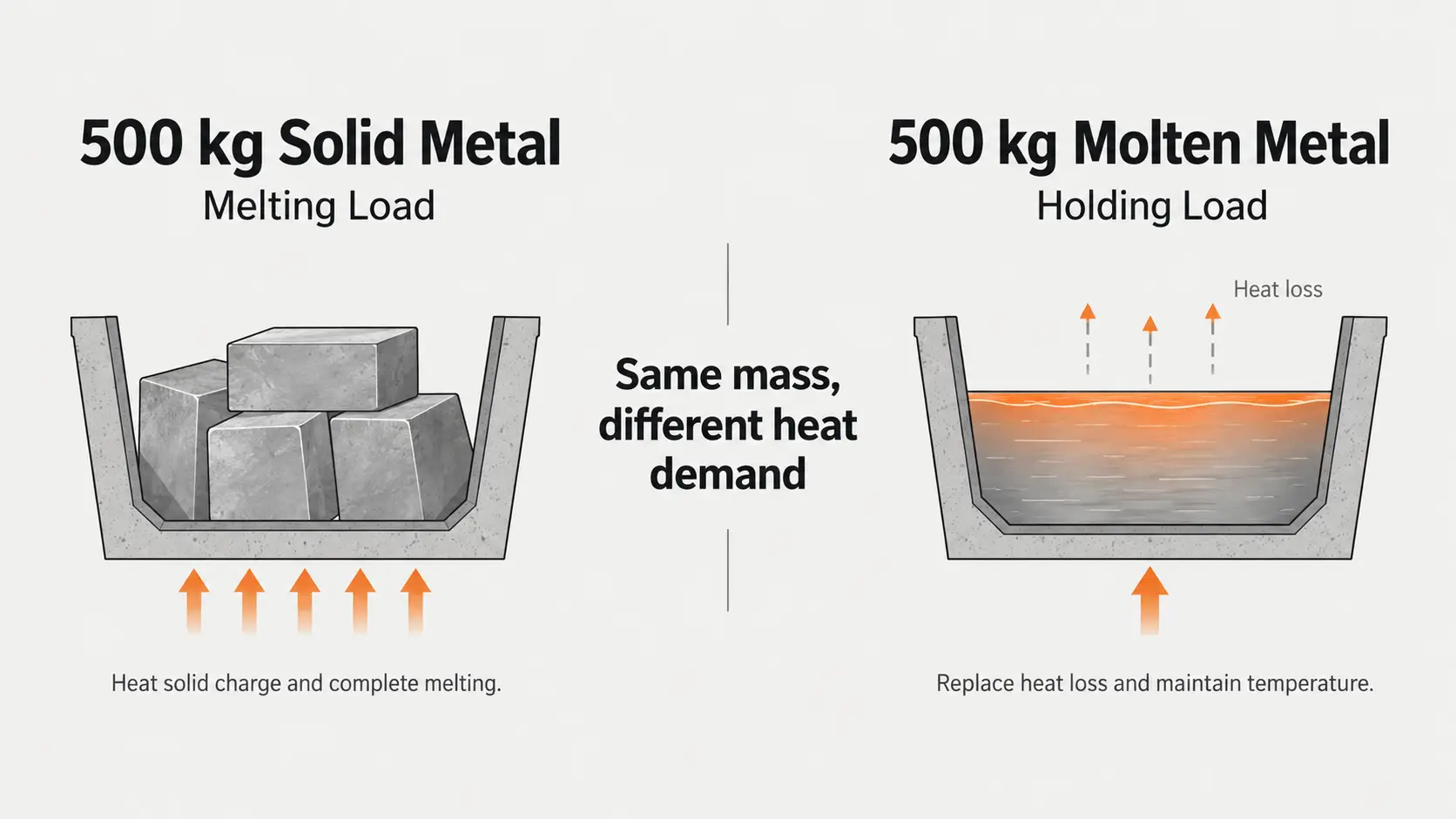
Those are very different loads.
During melting, energy goes into heating the solid charge and completing the phase change. During holding, much of the required input replaces heat lost from the furnace and corrects changes in bath temperature.
Holding power is still affected by real operating conditions. A large open bath loses heat differently from a smaller, well-covered furnace. Frequent removal of molten metal, addition of new material and long holding periods also change the load.
Two furnaces containing the same amount of metal therefore do not necessarily need the same power simply because their capacities are similar.
5. One Furnace Can Handle Both Stages
Melting and holding do not always need separate equipment.
Many batch processes use one furnace in a sequence such as:
Charge → Melt → Reach Temperature → Hold → Transfer or Pour
That arrangement may be suitable when the batch is used soon after melting.
A dedicated holding furnace becomes more useful when the molten metal needs to remain available independently of the melting schedule.
| Production Condition | Typical Arrangement |
|---|---|
| Occasional small batches | One melting furnace may be enough |
| Metal used shortly after melting | Melting furnace |
| Metal waits before the next process | Melting and holding in one furnace may work |
| Continuous downstream metal demand | Separate melting and holding may be useful |
| Large molten-metal reserve | Dedicated holding capacity may be required |
These arrangements can also change with alloy switching, furnace layout and production volume. A plant producing several alloys in short runs may prefer different equipment from one running the same alloy continuously for long periods.
6. Look at the Process After Melting
Metal type and batch weight are obvious starting points when selecting a furnace, but the next stage of production often changes the equipment decision.
If the entire molten batch is poured or transferred immediately, holding may be a minor part of the cycle.
If the metal has to wait for another machine, feed a continuous casting process, remain available for several hours or be removed gradually, holding capacity becomes much more important.
Useful information for equipment selection includes:
•Metal and alloy
•Batch weight
•Required melting time
•Target molten-metal temperature
•Required hourly output
•Batch or continuous operation
•Expected holding time
•Method of transfer or pouring
For an induction system, these conditions affect the required power supply, furnace structure, inductor, crucible or refractory lining, temperature control and cooling system.
The furnace should be selected around the complete metal flow—from solid charge to the point where the molten metal leaves the furnace—not simply around a kW rating.
Key Takeaway
A melting furnace raises solid charge to molten temperature; a holding furnace only replaces the heat an already-liquid bath loses. Size the equipment around the complete metal flow — batch weight, melting time, and what happens to the metal after melting — not around the kW rating alone.
Frequently Asked Questions
Click a question to expand the answer.
What is the difference between a melting furnace and a holding furnace?
A melting furnace takes solid charge and produces a molten bath. A holding furnace receives metal that is already liquid and keeps it within the temperature range required by the next process.
Do I need a separate holding furnace?
Not always. For occasional small batches, one furnace can often melt, hold briefly and empty. A separate holding furnace is more useful when molten metal must remain available independently of the melting schedule.
Can one furnace handle both melting and holding?
Yes. Many batch processes use one furnace in a charge → melt → hold → pour sequence when the batch is used soon after melting.
Why can’t I size the furnace by its kW rating alone?
Melting capacity depends on metal type, batch weight, melting time, heat loss and furnace construction. Two furnaces with the same kW can deliver different practical output.
Need an Induction Melting Furnace?
Tell us your metal, batch weight and required melting time, and we will recommend a melting and holding configuration for your process.


