
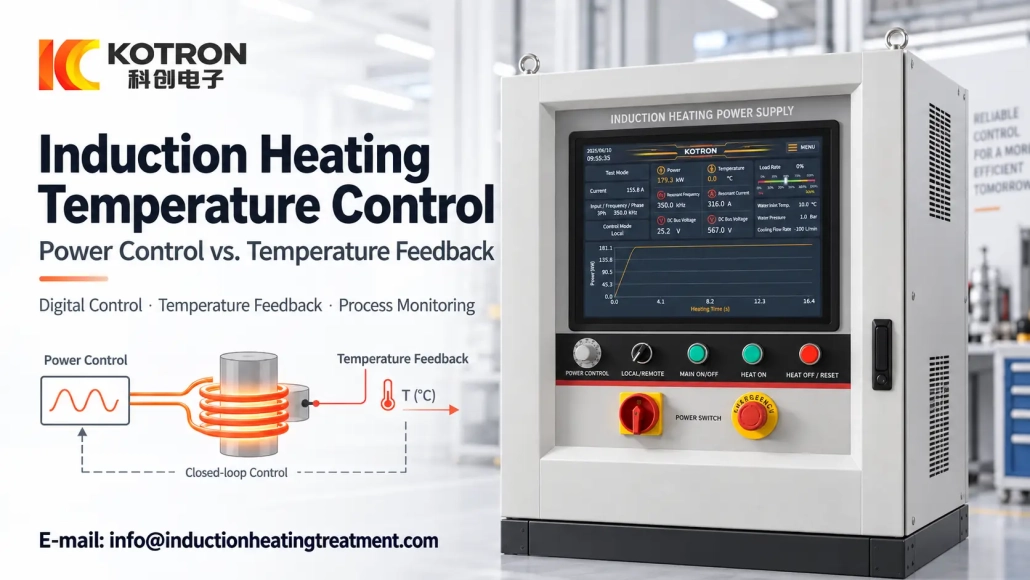
Induction Heating Temperature Control: Power Control vs. Temperature Feedback
In an induction heating system, power control and temperature feedback describe two different parts of the same process. Power control defines the electrical input; temperature feedback tells the control system how the workpiece is responding.
The two can work independently in some applications, or together when the process requires temperature-based closed-loop control.
| What Power Control Does | What Temperature Feedback Does |
| Same Power, Different Temperatures | Working Together |
| When Feedback Is Useful | What Digital Control Adds |
| Choosing a Strategy |
Ⅰ. What Does Power Control Actually Control?
Power control acts on the electrical input delivered by the induction power supply.
A digital heating process may define output power and heating time while monitoring operating values such as voltage and current. Once a suitable process has been established, these settings can be stored in a recipe and recalled for later production.
Under stable conditions — the same workpiece, material, position, inductor and production setup — a validated power-and-time recipe can provide good process repeatability.
But power is not temperature.
Setting a certain output power does not directly tell the workpiece to reach a specific temperature. It controls how electrical energy is supplied to the induction system.
Ⅱ. What Does Temperature Feedback Actually Do?
Temperature feedback looks at the thermal response of the workpiece.
Instead of asking:
What is the power supply delivering?
it answers:
What temperature is being measured on the workpiece?
Common temperature signals come from infrared pyrometers, thermocouples or other sensors selected for the application.
There is an important distinction here:
Temperature feedback does not automatically mean temperature control.
A temperature signal may simply be displayed, recorded or compared with alarm limits. It becomes part of closed-loop temperature control only when the control system uses that signal to adjust the heating output.
The quality of the measurement also matters. An infrared pyrometer can be affected by emissivity, oxide scale, viewing angle, measurement spot size, smoke or steam. Thermocouple readings depend on contact position, installation and response time.
So temperature feedback should not be treated as a perfect measurement independent of the rest of the process.
Ⅲ. Why Can the Same Power Produce Different Temperatures?
A common assumption is that identical power and heating time must always produce exactly the same workpiece temperature.
In real production, the result can also change with:
A small change in the distance between the workpiece and the induction coil, for example, can change electromagnetic coupling. A cold incoming component can also respond differently from a component that starts at a higher temperature.
This is why repeatable electrical input is important, but cannot make the rest of the process irrelevant.
Ⅳ. How Do Power Control and Temperature Feedback Work Together?
The relationship is easiest to understand as input versus response.
| Power Control | Temperature Feedback | |
|---|---|---|
| Main function | Sets electrical input | Measures workpiece temperature |
| Typical information | Power, time, voltage/current conditions | Measured temperature |
| Main value | Repeatable energy delivery | Thermal monitoring |
| Control role | Executes the commanded heating input | Can provide feedback for correction |
| Closed-loop function | Provides the adjustable output | Used to correct output when closed-loop control is enabled |
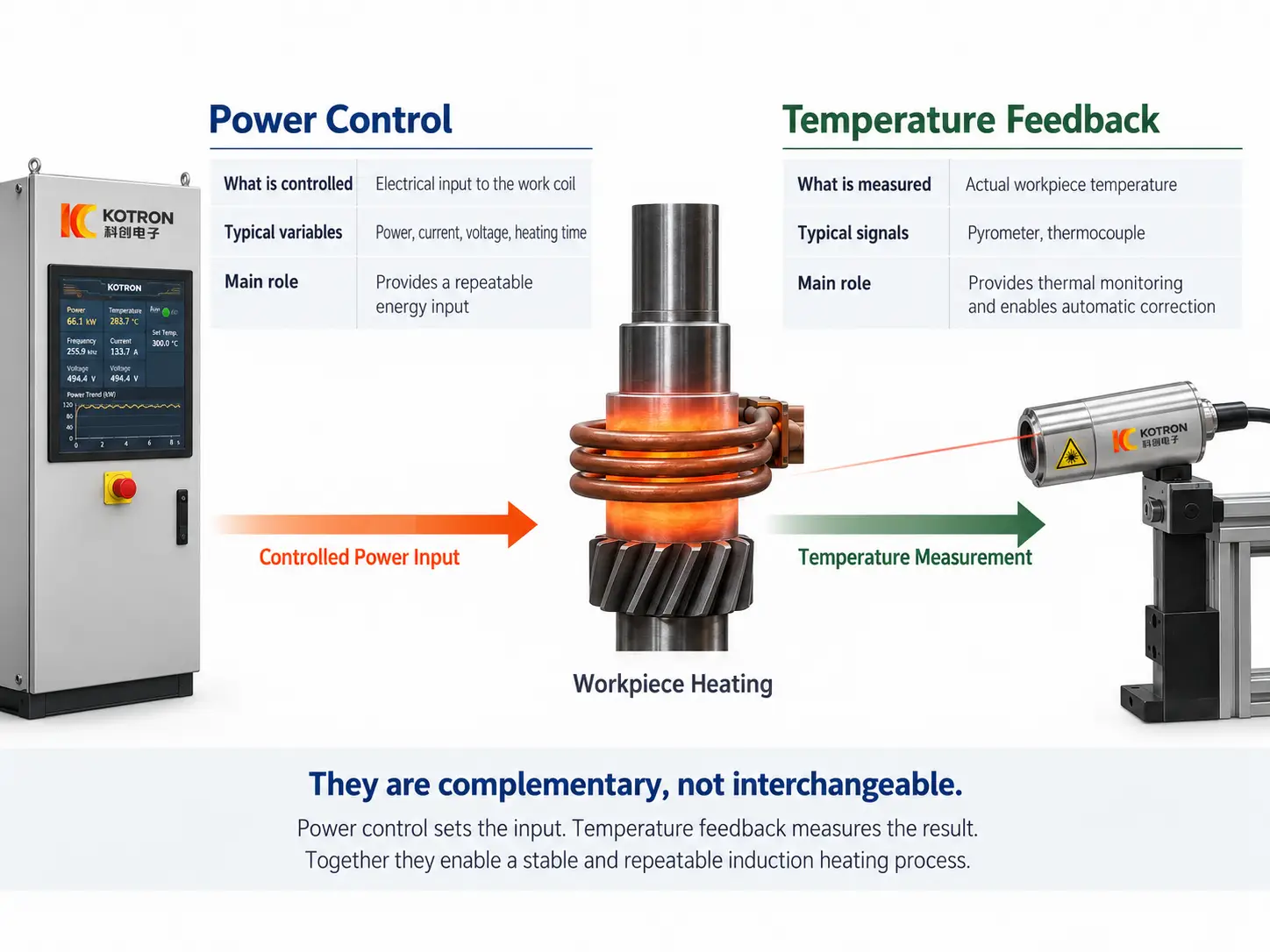
They are complementary rather than interchangeable.
In a power-and-time controlled process, the system repeatedly executes a validated heating recipe.
With closed-loop temperature control, the sensor adds another step: measured temperature is compared with the target, and the system can adjust the electrical input when required.
The power supply still provides the heating energy. Temperature feedback gives the controller information about the thermal result.
Ⅴ. When Is Temperature Feedback Useful?
Different heating processes need different levels of temperature control.
Stable Repetitive Production
When the same part is processed repeatedly with stable material, positioning, tooling and incoming conditions, a verified power-and-time recipe may already provide suitable production repeatability.
Temperature measurement can still be used for monitoring or quality records without necessarily controlling every heating cycle.
Temperature-Sensitive Processes
Some applications depend more directly on actual workpiece temperature.
In induction tempering, thermal history affects the final material condition. In shrink fitting, thermal expansion depends on how hot the component actually becomes. In controlled preheating, the process may require the part to stay within a defined temperature range.
Temperature feedback can therefore become more useful in these applications, particularly when the process requires closed-loop adjustment.
Traceability and Process Monitoring
Temperature data may also be required even when it is not the main control variable.
It can be used for:
— Temperature curves
— Upper and lower limits
— Alarm records
— Batch review
— Historical production records
The question is therefore not simply whether a machine has a temperature sensor. The more useful question is what the temperature signal is expected to do in the process.
Ⅵ. What Does Digital Control Add?
Once power settings, time, temperature signals and production data are handled digitally, the induction power supply can become part of a wider automated manufacturing system.
KOTRON’s induction systems use IGBT power conversion with DSP digital control. Available system functions include real-time acquisition of voltage, current, output power and frequency, while monitoring configurations can support process curves, parameter alarms, recipe storage and historical production records.
Temperature-controlled operation and power-and-temperature closed-loop control can also be configured where the process requires them.
A digital control environment can bring together power and time settings, temperature feedback, recipes, alarm limits, process curves and production records while communicating with PLC/HMI controls and automatic equipment.
This matters in automated production because the induction power supply no longer operates as an isolated heater. It can follow the same production recipe and machine sequence as manipulators, indexing tables, conveyors or other line equipment.
Process parameters still have to be developed for the actual material and application. Once those parameters are established, digital control makes them easier to store, monitor and repeat in production.
Ⅶ. Which Control Strategy Should You Use?
A stable, repetitive process may run successfully from a validated power-and-time recipe. A temperature-sensitive or more variable process may benefit from temperature monitoring or closed-loop control.
The right approach depends on the workpiece, heating objective, process stability, measurement conditions and production requirements.
Power control defines the electrical input. Temperature feedback shows how the workpiece responds.
Key Takeaway
Power control defines the electrical input. Temperature feedback shows how the workpiece responds. The right approach depends on the workpiece, heating objective, process stability, measurement conditions and production requirements.
FAQ
Click a question to expand the answer.
Does temperature feedback automatically mean temperature control?
No. A temperature signal can simply be displayed, recorded, or compared against alarm limits. It becomes closed-loop temperature control only when the control system uses the measured temperature to adjust the heating output.
Do I need temperature feedback for my induction heating process?
Not necessarily. For a stable, repetitive process with consistent material, positioning and tooling, a validated power-and-time recipe can provide good repeatability. Temperature feedback becomes more valuable when the process is temperature-sensitive, such as induction tempering or shrink fitting, or when you need closed-loop control and traceability records.
Why can the same power and heating time produce different temperatures?
Power controls the electrical input, not the thermal result. Initial workpiece temperature, material variation, part dimensions, coil-to-workpiece distance, electromagnetic coupling and heat loss into fixtures can all change the measured temperature even at identical power and time.
Can I add temperature feedback to an existing induction system?
In most cases, yes. The sensor choice — infrared pyrometer, thermocouple or another type — depends on the application and measurement conditions. A digital control system can accept the signal for monitoring, alarm limits or closed-loop control where the process requires it.
Match the Control Strategy to Your Process
Send your workpiece and process details. We will help you decide whether power-and-time control is enough, or whether temperature feedback and closed-loop control will improve your results.


