
Why Does an Induction Heating System Need Load Matching?
An induction power supply does not work with every coil and workpiece in exactly the same way. Change the induction coil, change its geometry, or place a different workpiece inside it, and the electrical load seen by the system changes.
Load matching brings that load into a suitable operating range for the power supply, so the available power can be transferred effectively to the induction heating process.
Ⅰ. What Is the “Load” in an Induction Heating System?
The workpiece alone is not the complete load.
At the application end of an induction heating system, the induction coil and workpiece act together as the load seen by the generator. TRUMPF describes the load in exactly this way: induction coil plus workpiece.
This matters because the workpiece is electromagnetically coupled to the coil. Put a different part into the same inductor and the electrical conditions of the heating circuit can change.
Between the power supply and this load there is also a matching and resonant circuit. Its exact design varies between systems.
A useful simplified view is:
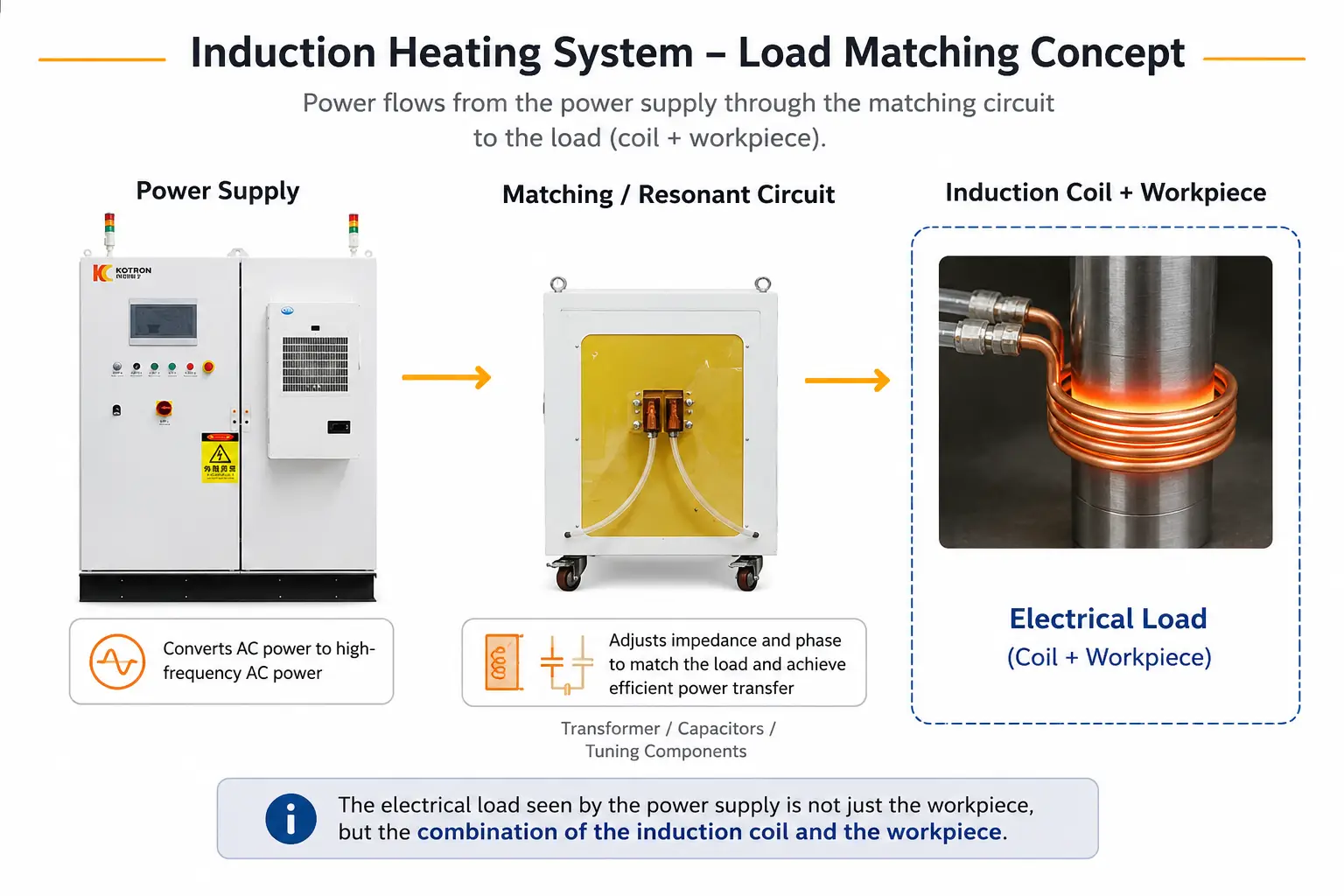
Power Supply ↔ Matching / Resonant Circuit ↔ Induction Coil + Workpiece
The important point is that an induction heating system cannot be evaluated from the kW rating of the generator alone.
Ⅱ. Why Does the Load Have to Match the Power Supply?
Every induction power supply is designed to operate within a certain electrical range.
A 100 kW rating tells you what the generator is capable of delivering under suitable conditions. It does not mean that any induction coil can simply be connected and automatically use the full 100 kW.
The load has to be suitable for the generator.
TRUMPF, for example, uses a matching transformer to adapt the coil-and-workpiece load to the RF generator so that the generator can provide its available power.
ASM treats this as two related but distinct requirements: the induction load and coil must be matched to the power supply, while the electrical circuit must also be properly tuned for efficient energy transfer.
Load matching and resonant tuning are related, but they are not simply two names for the same adjustment.
Ⅲ. Why Does Changing the Coil or Workpiece Change the Load?
Changing the inductor changes more than its physical shape.
Consider a single-turn external coil used around a shaft and a smaller multi-turn inductor used for an internal bore. Mechanically, both are simply induction coils. Electrically, however, they do not present the same load.
Changing the number of turns, coil diameter or overall geometry changes the electrical characteristics of the inductor.
The workpiece changes the situation again. A different material, diameter, geometry or position relative to the coil changes the electromagnetic coupling between the part and the inductor.
This is why an induction coil is not equivalent to an ordinary interchangeable mechanical tool.
Change the coil, and the load changes.
Change the workpiece, and the coupled load can change again.
Commercial equipment is designed around this reality. Ambrell uses multi-tap transformers for impedance matching between the induction coil, workpiece and power system.
Ⅳ. What Does Poor Load Matching Look Like?
Poor matching does not automatically mean that the workpiece will have uneven hardness or that the power supply will fail.
The more immediate problem is electrical: the generator may not be able to use its available output effectively with that particular load.
A power supply with sufficient rated kW may therefore deliver less usable power than expected until the load is brought into a suitable matching range.
This is why manufacturers provide load-matching capability in the first place. Inductoheat’s Statipower SP12, for example, uses load-tuning capacitors and a multi-tap output transformer specifically to allow a wide range of heating coils to be properly matched and to support full-power operation over different load conditions.
The practical lesson is simple:
“The power supply is large enough” and “the load is correctly matched” are two different questions.
Ⅴ. How Is Load Matching Done?
The answer depends on the electrical design of the induction power supply.
A matching transformer can change the impedance presented to the generator. Multi-tap or variable-ratio transformers allow the system to accommodate different load conditions.
Capacitors perform a related but different job. Together with the induction coil, they form part of the resonant circuit and are selected or adjusted so that the circuit operates correctly over the required frequency range.
Ambrell’s equipment illustrates this distinction clearly. Its workheads use capacitors as part of the resonant circuit while a multi-tap transformer is used for impedance matching. Ambrell also uses different series- and parallel-resonant architectures depending on the product family.
Inductor design also affects the final electrical load.
For this reason, load matching should not be reduced to:
“adjust the transformer.”
The transformer, resonant circuit, inductor and workpiece have to work together. The exact adjustment method depends on the power-supply topology.
Ⅵ. Does a New Workpiece Require a New Power Supply?
Not necessarily.
The same induction power supply can often operate with different coils and workpieces as long as the new application remains within its power, frequency and matching capability.
A new part may require a different inductor and a different matching or tuning configuration without requiring a completely different generator.
This is one reason industrial induction power supplies are often designed with adjustable matching ranges. TRUMPF provides different external matching configurations for different loads, while Inductoheat uses transformer and capacitor adjustment to accommodate a range of heating coils.
The key point is therefore not simply:
“How many kilowatts is the power supply?”
It is also: “Can this power supply and matching system operate correctly with this coil and workpiece?”
That is why induction heating equipment is better considered as a complete electrical system rather than a generator with an arbitrary coil attached to it.
Key Takeaways
— The induction coil plus its workpiece forms the electrical load — not the workpiece alone.
— Load matching and resonant tuning are related but different adjustments.
— A correctly sized power supply (kW) is not the same as a correctly matched load.
— The same generator can often run new coils and workpieces if they stay within its power, frequency and matching range.
Frequently Asked Questions
Click a question to expand the answer.
Does every new coil or workpiece require a different power supply?
Not necessarily. The same power supply can often run different coils and workpieces, as long as the new application stays within its power, frequency and matching range. You may only need a different inductor and a matching or tuning adjustment.
Are load matching and resonant tuning the same thing?
No. They are related but distinct. Load matching brings the coil-and-workpiece load into a range the generator can drive, while resonant tuning sets the coil-and-capacitor circuit to the correct operating frequency. Both must be right for efficient energy transfer.
What happens if the load is not correctly matched?
The generator may fail to deliver its full rated power to that load, even if its kW rating is high enough. Usable power can drop until the load is brought into a suitable matching range.
Not Sure Your Coil and Power Supply Are Matched?
Tell us your power supply, coil and workpiece, and we will help you confirm the matching range for your application.


