
Quenching Crack vs. Forging Crack: How to Tell the Difference
A crack discovered after quenching is not necessarily a quenching crack.
Some cracks form during the quenching process itself. Others may have originated earlier, for example during forging, and only become obvious after subsequent heat treatment.
The practical question is therefore:
When did the crack form?
That distinction matters because the corrective action is different. A true quenching crack points toward the heat-treatment process, while a forging crack means the defect may have entered the part before quenching.
| A Crack Found After Quenching | Signs of a Forging Crack |
| Quenching vs. Forging: What to Look For | Why Correct Identification Matters |
Ⅰ. A Crack Found After Quenching May Have Formed Earlier
Quenching can generate high internal stresses because the surface and core cool at different rates and the steel undergoes structural transformation during rapid cooling.
If local tensile stress becomes too high, cracking can occur.
Typical quenching cracks may appear:
— on the surface;
— along the length of slender parts;
— near grooves, notches, shoulders, or section transitions;
— close to inclusions or other stress-concentration sites.
The supplied heat-treatment material describes several common forms.
Shallow surface quench cracks may occur in high-carbon steel with surface decarburization. These cracks are usually shallow and show little oxidation.
Longitudinal quenching cracks may form in slender parts when transformation stress becomes high. They are often straight, typically propagate through grains, and may start near inclusions or stress concentrations.
Cracks near grooves or transitions can form where cooling and structural transformation are uneven. They may follow a curved path and often end in a sharp crack tip.
The important point is that these cracks form during or very close to the quenching stage.
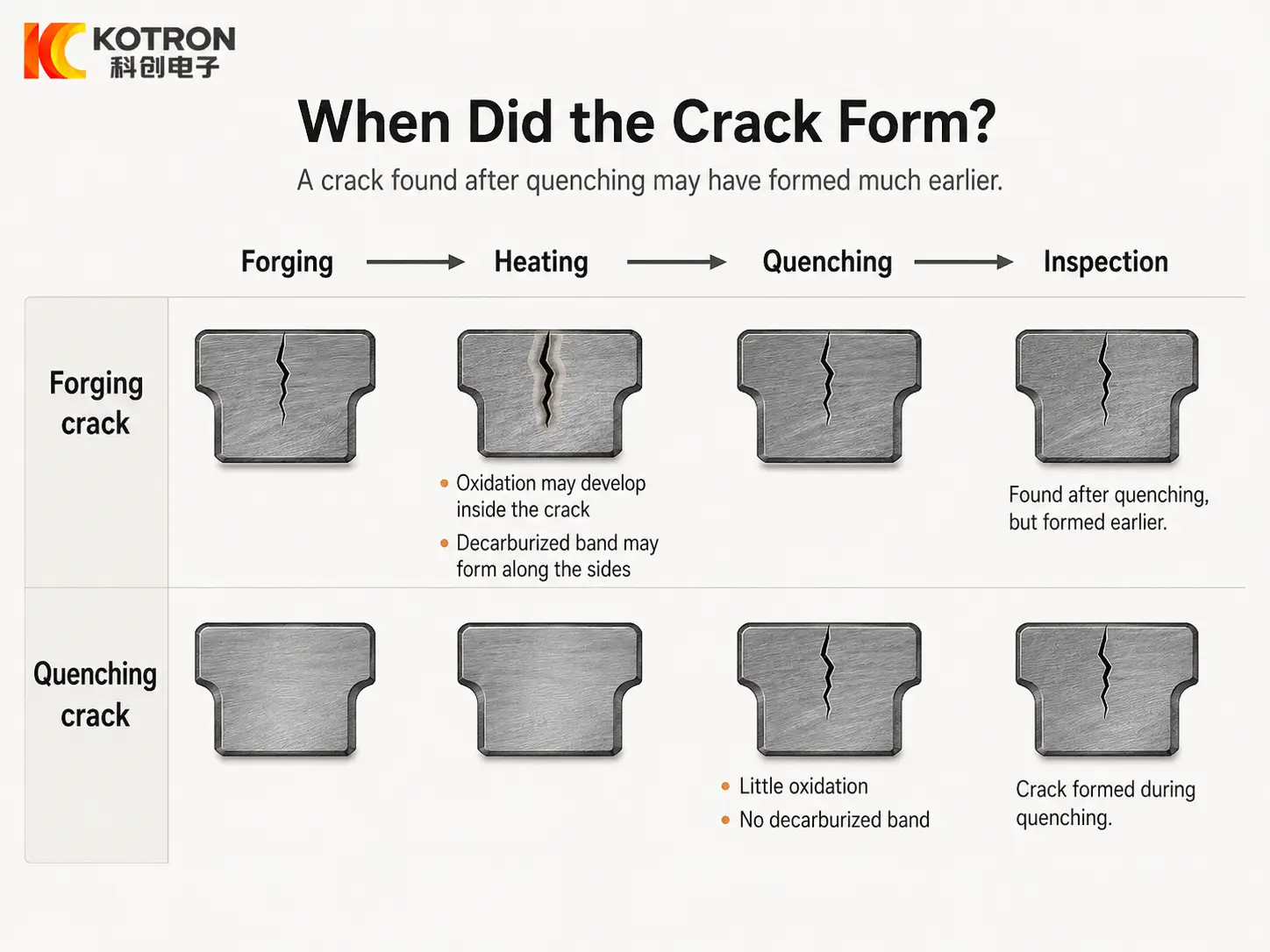
When the crack is found is not the same as when it formed.
Ⅱ. What Features Suggest a Forging Crack?
A forging crack forms earlier.
If such a crack is already present before later heat treatment, it can show signs that a newly formed quenching crack usually does not.
Two clues are especially useful.
Oxidation inside the crack
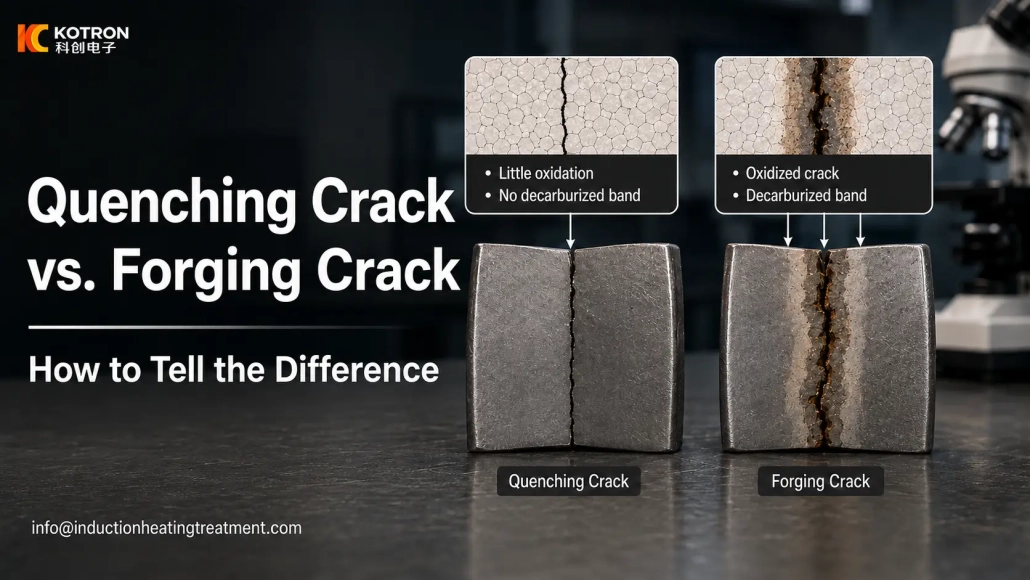
A forging crack that existed before the final quench may show oxidation on the crack surface or inside the crack.
By comparison, a crack that forms during quenching usually shows little oxidation.
Decarburization beside the crack
If metallographic examination shows decarburization along both sides of a crack, this suggests that the crack existed before the final quench and was exposed during an earlier high-temperature stage.
The supplied material gives this distinction directly:
Forging cracks may show oxidation and decarburization beside the crack, while quenching cracks show little oxidation and generally no decarburization.
This does not mean that one observation is enough to make a final diagnosis, but it is a very useful clue when combined with crack morphology and process history.
Ⅲ. Quenching Crack vs. Forging Crack: What to Look For
| Feature | Quenching Crack | Forging Crack |
|---|---|---|
| Formation stage | During quenching | During an earlier forging stage |
| Oxidation inside crack | Usually little | May be present |
| Decarburization beside crack | Generally absent | May appear on both sides |
| Crack tip | Often relatively sharp | May have been altered by later heating |
| Typical relationship | Quenching stress, structural transformation, stress concentration | Pre-existing forging defect |
| Useful evidence | Crack shape, location, microstructure, quenching history | Oxidation, decarburization, microstructure, forging history |
The strongest diagnosis comes from several observations pointing in the same direction.
Useful checks include:
①crack location
②crack direction and shape
③crack-tip appearance
④oxidation inside the crack
⑤decarburization along the crack sides
⑥surrounding microstructure
⑦inclusions or local structural transitions
⑧forging history
⑨heat-treatment history
A dark crack surface alone is not enough to prove that the crack came from forging. Likewise, the absence of obvious oxidation does not automatically prove that the crack formed during quenching.
Ⅳ. Why Correct Identification Matters
Misidentifying the crack can send troubleshooting in the wrong direction.
If a forging crack is mistaken for a quenching crack, engineers may spend time changing:
①quenching medium
②cooling conditions
③heating parameters
④part positioning
⑤heat-treatment cycle
But the defect may already have been present before the part entered the heat-treatment process.
The opposite mistake is also possible. If a true quenching crack is blamed on forging, the actual heat-treatment problem can remain unchanged.
The useful question is not simply whether the crack was found after quenching.
It is:
Which process stage introduced the crack?
Oxidation, decarburization, crack morphology, metallographic structure, and process history should be considered together before making that judgment.
Key Takeaways
— A crack found after quenching is not always a quenching crack; it may have formed earlier during forging.
— Oxidation and decarburization beside the crack point to a forging origin, while a quenching crack usually shows little oxidation and no decarburization.
— Judge from several observations together — crack morphology, metallographic structure and process history — not from a single clue.
Frequently Asked Questions
Click a question to expand the answer.
Does a dark crack surface prove the crack came from forging?
No. A dark crack surface alone is not enough to prove a forging origin. It must be checked together with crack morphology, decarburization and process history.
Does the absence of oxidation prove the crack formed during quenching?
Not automatically. Little oxidation is a useful clue, but the diagnosis should still combine crack location, direction, crack-tip appearance and process history.
Why do quenching cracks usually show little oxidation and no decarburization?
Because they form during or very close to the quenching stage, so there is little time at high temperature for oxidation or decarburization to develop.
Can one observation make a final diagnosis?
No. The strongest diagnosis comes from several observations — morphology, metallographic structure and process history — pointing in the same direction.
Not Sure Which Crack You Have?
Send your crack photos, metallographic observations and heat-treatment history — we will help you determine whether the crack came from quenching or forging.


