
Overheating vs. Overburning in Heat Treatment: What’s the Difference?
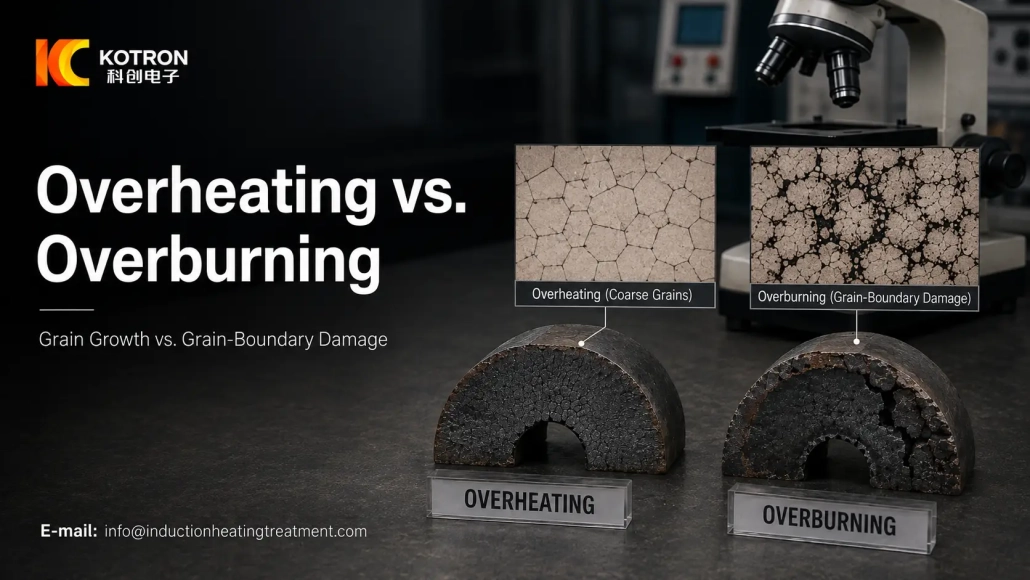
Overheating and overburning are both heat-treatment defects caused by excessive thermal exposure, but they are not the same.
The easiest way to distinguish them is to look at where the damage occurs.
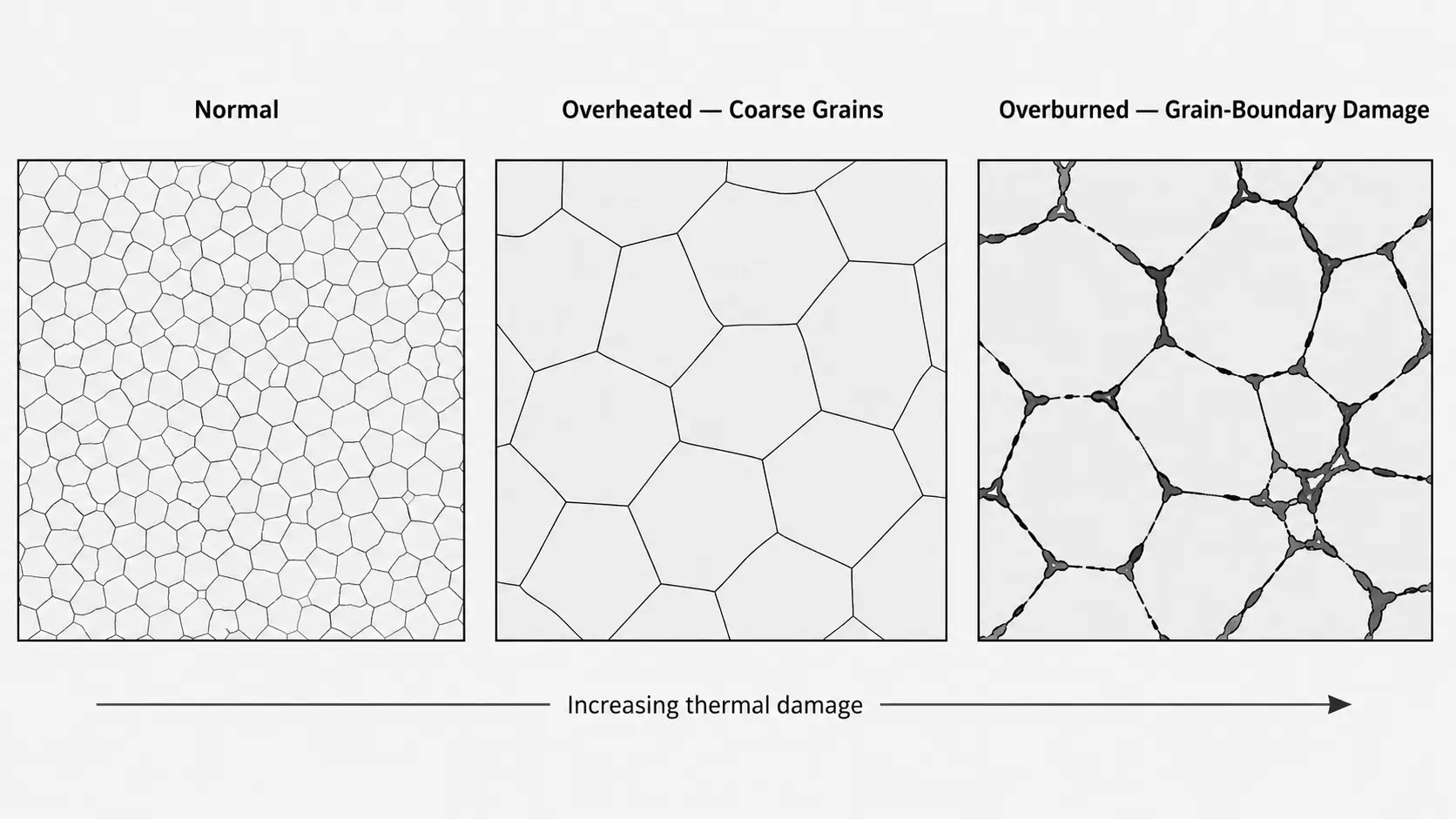
With overheating, the main problem is excessive growth of austenite grains. The steel has been heated too high or held at temperature for too long, so the internal structure becomes abnormally coarse.
Overburning is more severe. In addition to coarse grains, the grain boundaries may show local oxidation, burning, or melting.
In simple terms:
Overheating → the grains become excessively coarse.
Overburning → the grain-boundary regions begin to suffer thermal damage.
That distinction is important when analyzing a failed heat-treatment process.
Ⅱ. What Happens During Overburning?
Ⅲ. How Can You Tell Them Apart?
Ⅳ. Fracture and Microstructure Together
Ⅴ. A Dark Surface Does Not Mean Overburning
Ⅰ. What Happens During Overheating?
Overheating can occur when the heating temperature is too high or the holding time is too long.
Under excessive thermal exposure, austenite grains grow rapidly. These coarse grains then affect the structure formed during the subsequent cooling process.
After annealing or normalizing, an overheated structure may develop coarse ferrite grains or a Widmanstätten structure.
After quenching, coarse austenite grains can lead to coarse martensite.
This matters because coarse microstructures can reduce toughness. In high-carbon steel, microcracks may also appear within coarse martensite or near prior-austenite grain boundaries. These areas can later become initiation sites for quenching cracks or brittle fracture.
The key point is that overheating is not simply a question of the part reaching a high surface temperature.
It is a change inside the material:
— Excessive temperature or holding time
— → excessive austenite grain growth
— → coarse structure after cooling or quenching
— → poorer mechanical behavior and greater risk of cracking
The exact appearance depends on the steel and the heat-treatment process, so coarse grain size should be considered together with other metallographic evidence.
Ⅱ. What Happens During Overburning?
Overburning occurs under more severe high-temperature conditions.
Here, the problem is no longer limited to grain growth.
Local burning or oxidation can develop along the boundaries of the coarse grains. Under sufficiently severe conditions, local melting may also occur.
This grain-boundary damage is what separates overburning from ordinary overheating.
In some steels, overburning can produce abnormal eutectic structures along grain boundaries. Cracks and locally melted cavities may also be present.
The fracture surface may show several characteristic features, including:
— Very coarse grains
— Thickened grain boundaries
— Oxidized coloration
— A dull surface with little metallic luster
— Cracks
— Locally melted cavities
For high-speed steel, eutectic or fishbone-like carbide structures can also appear as signs of overburning.
These are much more serious changes than simple grain coarsening.
Ⅲ. How Can You Tell Overheating from Overburning?
The difference becomes clearer when the two defects are compared directly.
| Feature | Overheating | Overburning |
|---|---|---|
| Typical cause | Heating temperature too high or holding time too long | More severe high-temperature exposure |
| Main change | Excessive austenite grain growth | Coarse grains plus grain-boundary damage |
| Grain boundaries | Main problem is not boundary melting | May show oxidation, burning, or local melting |
| After cooling or quenching | Coarse ferrite, Widmanstätten structure, or coarse martensite may appear | Severe abnormal grain-boundary structures, cracks, or cavities may appear |
| Fracture appearance | Generally coarse | Coarse, dull, oxidized, and possibly locally melted |
| Severity | Serious structural defect | More severe thermal damage |
A useful diagnostic question is therefore:
Are the grains simply too coarse, or have the grain boundaries themselves been damaged?
If metallographic examination mainly shows abnormal grain growth, overheating is the more likely diagnosis.
If oxidation, burning, local melting, or abnormal structures appear along grain boundaries, the condition is more consistent with overburning.
This is why metallographic examination is usually more useful than judging the part only from its external appearance.
Ⅳ. Fracture and Microstructure Should Be Read Together
Fracture appearance can provide useful clues, but it should not be used alone.
An overheated part may show a coarse fracture because the grain size has become abnormally large. Depending on the steel, coarse martensite, coarse ferrite, or Widmanstätten structures may also be found under metallographic examination.
An overburned part may show a rougher and more severely damaged fracture surface. Grain boundaries can appear thickened or oxidized, and cracks or melted cavities may be visible.
The investigation should therefore combine several observations:
Grain size. Are the grains unusually coarse?
Grain-boundary condition. Are the boundaries intact, or is there evidence of oxidation or local melting?
Microstructure. Is there coarse martensite, Widmanstätten structure, or an abnormal grain-boundary phase?
Fracture appearance. Is the fracture simply coarse, or does it also show oxidation, melting, cavities, or severe grain-boundary damage?
Heat-treatment history. Was the part exposed to unusually high temperature or excessive holding time?
Looking at these factors together gives a much stronger basis for identifying the defect than any single visual sign.
Ⅴ. A Dark Surface Does Not Automatically Mean Overburning
One of the easiest mistakes is to see a dark or heavily oxidized surface and immediately conclude that the steel has been overburned.
That is not enough.
Steel can form oxide scale during heating simply because the surface reacts with an oxidizing atmosphere. Surface oxidation and overburning are related to high-temperature exposure, but they are not the same defect.
Overburning involves more serious structural changes, particularly at the grain boundaries.
So a dark surface should be treated as a clue, not as a final diagnosis.
When overheating or overburning is suspected, the more useful evidence comes from:
— Heating temperature and holding time
— Grain size
— Metallographic structure
— Grain-boundary condition
— Fracture morphology
— Cracks or locally melted regions
The distinction can be summarized in one sentence:
Overheating mainly makes the microstructure too coarse; overburning goes further and damages the grain-boundary regions themselves.
For heat-treatment failure analysis, that difference matters much more than how dark the surface looks.
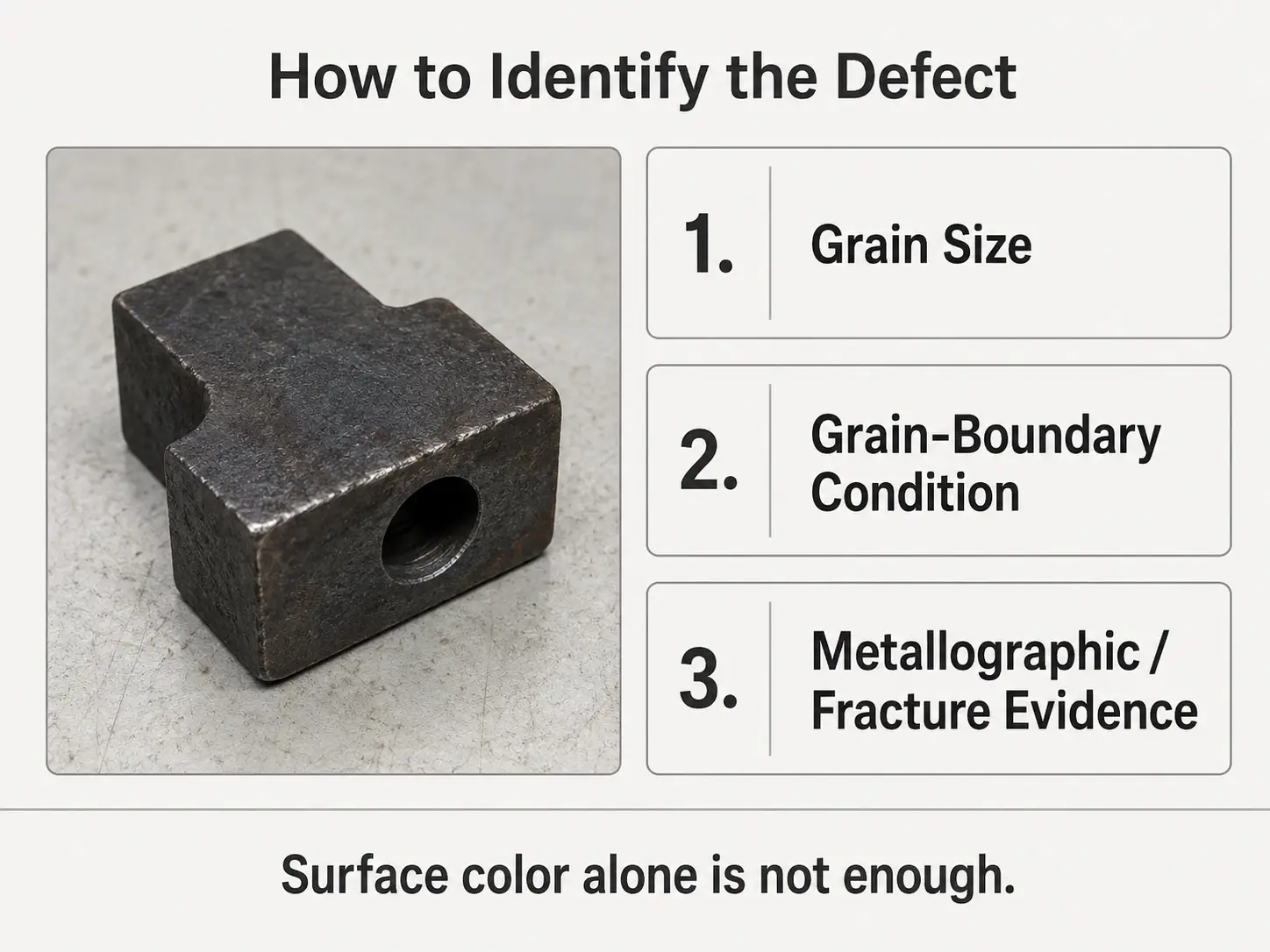
Key takeaway: Overheating makes the austenite grains abnormally coarse; overburning is more severe and damages the grain-boundary regions themselves through oxidation, burning, or local melting. Tell them apart by metallographic examination of grain size and grain-boundary condition, not by how dark the surface looks.
Frequently Asked Questions
Click a question to expand the answer.
What is the main difference between overheating and overburning?
Overheating mainly makes the austenite grains abnormally coarse. Overburning goes further and damages the grain-boundary regions themselves, which may show oxidation, burning, or local melting.
How can I tell if a part has been overburned rather than just overheated?
Check the grain boundaries under metallographic examination. If you mainly see abnormal grain growth, overheating is more likely. If oxidation, burning, local melting, or abnormal grain-boundary structures appear, the condition is more consistent with overburning.
Does a dark or heavily oxidized surface mean the steel is overburned?
Not necessarily. A dark surface can simply be oxide scale from heating in an oxidizing atmosphere. Overburning involves more serious structural changes at the grain boundaries, so treat a dark surface as a clue rather than a final diagnosis.
What evidence should I collect when overheating or overburning is suspected?
Heating temperature and holding time, grain size, metallographic structure, grain-boundary condition, fracture morphology, and any cracks or locally melted regions. Read these together rather than relying on a single visual sign.
Need Help Diagnosing a Heat-Treatment Defect?
Tell us your process and the defect you are seeing, and we will help you identify the cause and the right equipment.


