
Induction Brazing
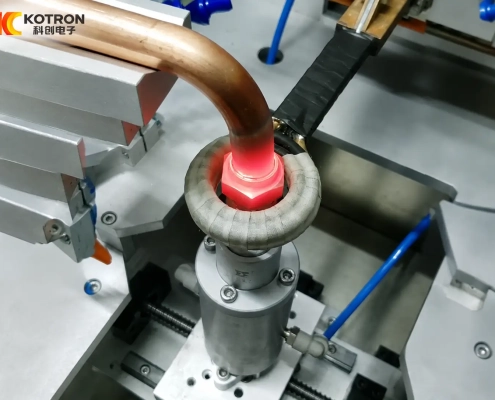
Induction Brazing is a high-efficiency metal joining process based on the principle of electromagnetic induction. Its core working mechanism is that a high-frequency current is passed through an induction coil to generate an alternating magnetic field. This causes the base metal or solder at the welding joint to rapidly generate heat via the eddy current effect. Once the melting or wetting temperature is reached, precise metallurgical bonding of the workpieces is achieved.
Boasting prominent advantages such as fast heating speed, high temperature controllability, minimal welding deformation and stable joint quality, this technology supports non-contact heating, which can effectively avoid open-flame pollution and workpiece damage, making it ideal for automated and mass production needs.
How It Works: Fast, Controlled & Reliable
- Induction Heating
Pass high-frequency alternating current through the coil to generate a focused magnetic field. This field induces eddy currents directly in the joint area, rapidly raising its temperature to the filler metal’s melting point—without melting the base metal itself.
- Prep & Positioning
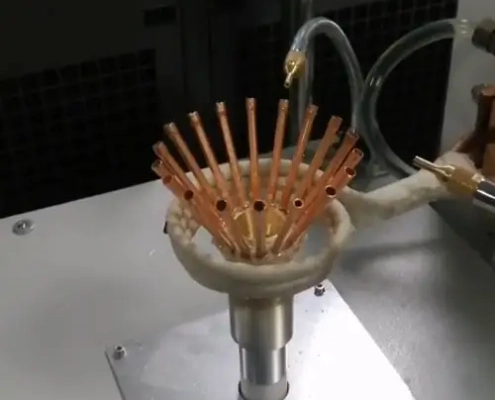
Assemble the target workpieces and pre-place the brazing filler metal at the joint interface—either as a paste, wire, or preform. Then position the assembly inside a custom-designed induction coil that matches the joint’s shape.
- Bond Formation
The molten filler metal flows evenly along the joint gap via capillary action, fully wetting the workpiece surfaces. After a precisely controlled cooling step, the filler metal solidifies to form a leak-proof, high-strength joint with excellent mechanical and corrosion-resistant properties.
Typical Applications
- HVAC and refrigeration industry: It realizes the butt welding of copper and aluminum tubes in heat exchangers, as well as the seal welding of air conditioning pipeline joints, improving the pressure resistance and sealing performance of pipelines.
- Automotive industry: It is suitable for welding automotive exhaust pipes, fuel pipelines and metal housings of sensors, meeting the high reliability and consistency requirements for the production of auto parts.
- Electronics and electrical appliances field: It is applied to the induction soldering of small electronic components and connectors, such as the welding of metal pins on circuit boards, balancing welding efficiency and component safety.
- Pipeline engineering: It is used for the induction fusion welding of oil and natural gas transmission pipelines, enabling efficient butt welding of thick-walled pipes and reducing the rate of welding defects.
- Precision machinery manufacturing: It is used for the induction brazing of components such as bearings, gears and cutting tools—for example, the connection of cemented carbide tool bits and tool shanks—to ensure joint strength and dimensional accuracy.
| Induction Brazing | Traditional Heating Welding (Oxy-fuel/Arc Welding) |
|---|---|
| Non-contact, eddy current internal heating | Open-flame/arc direct external heating |
| High precision (±5℃), localized heating | Low precision, uneven heat distribution |
| Minimal (heat-affected zone <1mm) | Significant, prone to warping |
| 30–60% faster cycle, auto-friendly | Slow, labor-intensive operation |
| 99%+ consistency, low defect rate | Operator-dependent, unstable quality |
| No flame/fumes, minimal post-weld cleaning | Open flame risk, heavy smoke/spatter |
| Precision components (sensors, tool bits, copper tube joints) | Bulky parts (steel frames, heavy machinery) |
Our Products
 https://www.inductionheatingtreatment.com/wp-content/uploads/2026/09/bent-copper-tube-induction-brazing.webp
1086
1448
cui yanan
https://www.inductionheatingtreatment.com/wp-content/uploads/2025/12/kclogo2.webp
cui yanan2026-09-04 03:43:192026-09-08 03:49:35Induction Brazing for HVAC & Refrigeration Copper Components
 https://www.inductionheatingtreatment.com/wp-content/uploads/2025/12/Copper-Tube-Manifold-Welding-1.webp
500
500
inductionheatingtreatment
https://www.inductionheatingtreatment.com/wp-content/uploads/2025/12/kclogo2.webp
inductionheatingtreatment2025-12-18 01:53:592026-08-05 07:23:24Copper Tube Manifold Welding


