
Magnetic Flux Concentrators for Induction Heating Coils: Selection and Machining
Magnetic flux concentrators are often used on induction heating coils to guide the magnetic field toward a selected area of the workpiece. A suitable concentrator can improve magnetic coupling, reduce stray flux and help shape the heating pattern.
The material itself, however, works under demanding conditions. It is exposed to an alternating magnetic field, heat radiation from the workpiece, vibration, cooling water and repeated heating and cooling. A material that performs well at one frequency or on one inductor may not be suitable for another.
For this reason, selecting a magnetic flux concentrator should start with the operating conditions of the induction heating system, not simply with the material that has the highest magnetic permeability.
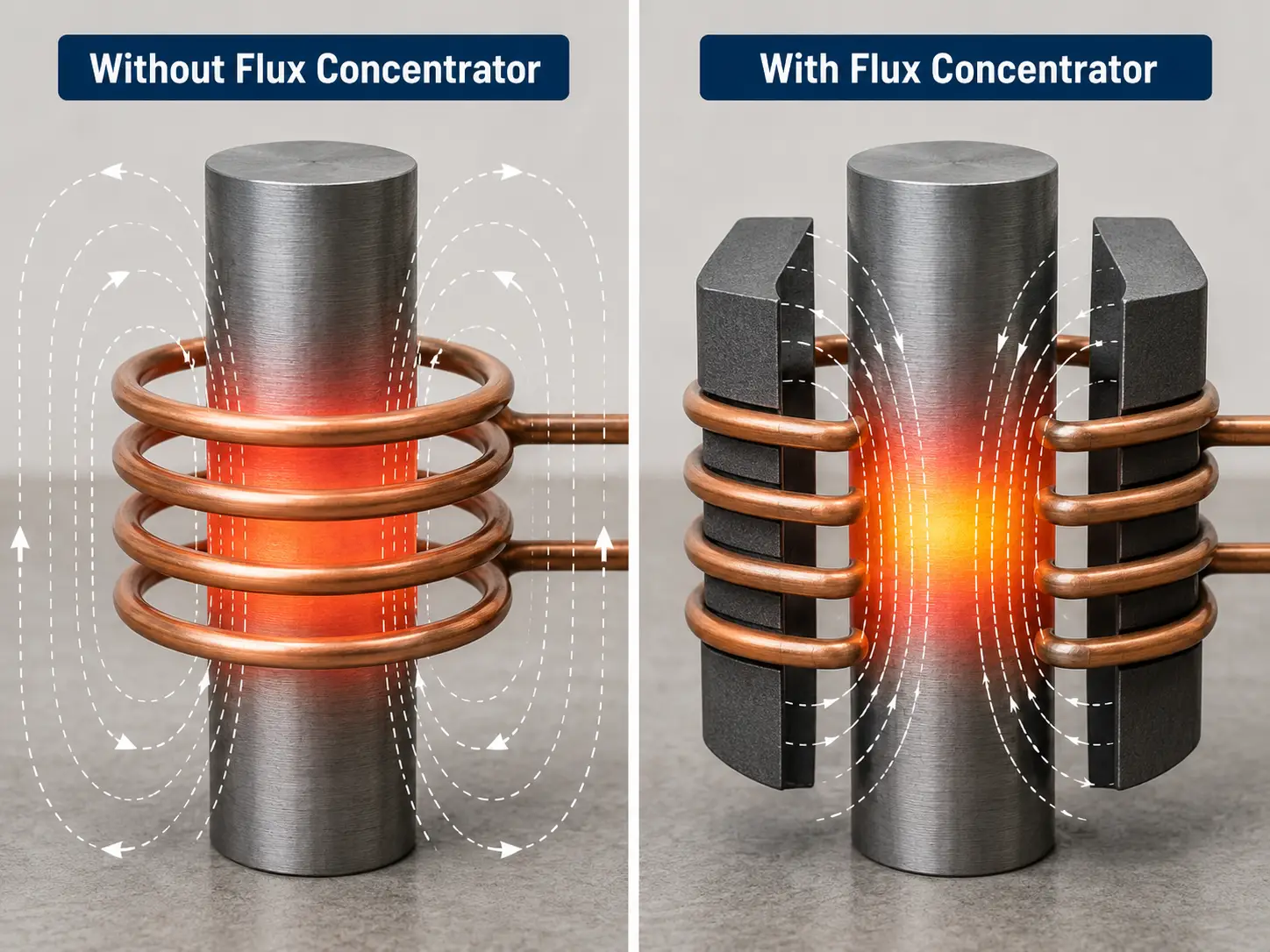
A magnetic flux concentrator directs the magnetic field to a selected area of the workpiece — the same coil shown with and without a concentrator.
| 1. Frequency Comes First | 2. What Properties Matter |
| 3. Ferrite, Silicon Steel or Composite | 4. Machining Precautions |
1. Frequency Comes First
The first question is whether the magnetic material is suitable for the operating frequency of the induction power supply.
Different magnetic materials have different useful frequency ranges. If a concentrator is used above the range for which it is intended, magnetic losses can rise rapidly and the material may begin to heat itself.
The failure mode depends on the material.
Ferrite can lose its magnetic properties when its temperature rises beyond its Curie temperature. Silicon steel laminations may overheat, oxidize or even become visibly red under severe conditions. In machinable magnetic composite materials, excessive temperature can damage the binder that holds the magnetic particles together, eventually causing cracking or fragmentation.
This is why frequency compatibility should be checked before permeability, shape or ease of machining.
The actual allowable frequency should be taken from the material manufacturer’s technical data. It is not advisable to assign one universal frequency range to ferrite, laminated silicon steel or composite magnetic materials, since grades and formulations differ considerably.
Operating frequency is also not the only cause of concentrator heating. Field strength, concentrator thickness, cooling conditions and its position relative to the workpiece all affect losses. A material that is technically within its frequency range can still overheat if the inductor is poorly designed or cooling is inadequate.
2. What Properties Matter When Selecting a Flux Concentrator?
After confirming frequency suitability, several material properties need to be considered together.
Magnetic permeability affects how easily magnetic flux passes through the material. A higher permeability can help direct and concentrate magnetic flux around the required heating zone. It should not, however, be treated as a simple “the higher, the better” specification. The useful value depends on frequency, magnetic field strength, material losses and the geometry of the concentrator.
Electrical resistivity is important because the concentrator itself is located in an alternating magnetic field. Eddy currents generated inside the material cause additional heating. Higher electrical resistivity generally reduces these eddy-current losses. This is one reason silicon is added to electrical steel, and why ferrites and insulated-particle composite materials can be useful in higher-frequency applications.
The material’s saturation behavior should also be considered. When the magnetic flux density becomes too high, a magnetic material approaches saturation and its ability to further concentrate the field decreases. This matters particularly around high-power-density inductors and areas where the magnetic field is strongly concentrated.
Curie temperature is another practical limit. A flux concentrator receives heat from two directions: magnetic losses generate heat inside the material, while the hot workpiece radiates heat toward it. If the material temperature exceeds its Curie point, its magnetic properties deteriorate sharply.
Good thermal conductivity helps control this problem. Concentrators are often installed directly against a copper tube or a copper heat sink. Heat can then be transferred into the water-cooled copper structure. A material with poor heat transfer may continue accumulating heat even when the induction coil itself is adequately cooled.
Mechanical properties are easy to overlook. A concentrator installed on an industrial induction coil may be exposed to vibration, thermal shock, quenching liquid, scale, humidity and repeated temperature cycling. Resistance to cracking, corrosion and thermal shock therefore matters as much as magnetic performance when long service life is required.
Finally, the material needs to suit the required geometry. Induction coils often use concentrators with slots, curved surfaces, U-shaped or Π-shaped sections and other custom profiles. A material that performs well magnetically but cannot be produced in the required shape may not be practical for that inductor.
3. Ferrite, Silicon Steel or Machinable Magnetic Material?
There is no single magnetic material that is best for every induction coil.
Silicon Steel Laminations
Good magnetic properties, widely used in lower-frequency applications. The sheets are laminated to limit eddy-current circulation.
Watch out: complicated three-dimensional shapes are difficult to produce and assemble.
Ferrite
High electrical resistivity and low eddy-current losses, making it useful in some higher-frequency applications.
Watch out: brittle and hard to shape mechanically; keep operating temperature safely below the relevant thermal limit.
Machinable Magnetic Composite
Ferromagnetic particles combined with a binder, machined into complex three-dimensional shapes for precise field control.
Watch out: binder system, thermal properties and frequency capability must match the application.
In practice, material selection normally involves a compromise between magnetic performance, operating frequency, temperature, mechanical strength, cooling, geometry and cost. Simply replacing one type of concentrator with another without considering the complete inductor may change the heating pattern rather than improve it.
4. Machining Precautions for Machinable Magnetic Materials
Machinable magnetic concentrators are generally produced by mixing ferromagnetic powder with a binder, followed by pressing and curing. Some high-density materials can exhibit directional properties, so orientation should be considered when manufacturing shapes such as Π-type concentrators.
A similar issue exists when Π-shaped magnetic circuits are made from oriented silicon steel laminations. The direction of the magnetic material relative to the flux path can affect the final result.
Silicon steel laminations also require attention after stamping. Burrs left on the edges should be removed. If adjacent laminations are electrically connected through burrs, the insulation between sheets can be compromised and eddy-current losses may increase.
Machinable composite magnetic materials can normally be processed using conventional operations such as turning, drilling, milling and grinding.
The cutting tool should be sharp. A relatively small feed and an appropriate cutting speed help reduce chipping and excessive mechanical stress on the material.
Machining is normally performed without conventional cutting fluid unless the material supplier specifies otherwise. The objective is to avoid introducing liquids or contaminants that may affect the porous or bonded structure of the material.
EDM caution: electrical discharge machining and wire EDM require particular care. Many machinable magnetic composites are made from magnetic particles that are individually insulated and held together by a non-conductive or poorly conductive binder. Their electrical characteristics therefore differ substantially from ordinary metal components, making EDM unsuitable for many such materials. Always check the machining method against the specific grade being used.
Key Takeaway
A flux concentrator is only one part of the induction system. Its performance depends on the coil geometry, workpiece position, frequency, power density and cooling arrangement.
For practical selection, follow this order:
1. Operating frequency → 2. Magnetic properties & losses → 3. Temperature resistance & heat dissipation → 4. Mechanical durability & machinability
Choosing the correct material — and installing it in the correct orientation and thermal environment — usually matters more than selecting the material with the highest single specification.
Frequently Asked Questions
Click a question to expand the answer.
Can one concentrator material be used across any frequency range?
No. Each magnetic material has a useful frequency range. Above that range, magnetic losses climb and the concentrator can begin to heat itself — ferrite loses its properties past its Curie point, silicon steel oxidizes, and composite binders can crack. Always check the manufacturer’s data for the specific grade.
Why is EDM or wire EDM often unsuitable for machinable magnetic composites?
These composites are made of individually insulated magnetic particles held together by a poorly conductive binder, so their electrical behavior differs from solid metal. Because EDM relies on electrical conductivity, it is unsuitable for many such grades. Verify the machining method against the specific material before proceeding.
How do I know if a flux concentrator is overheating?
Watch for discoloration, cracking, or a drop in heating efficiency. Overheating can come from excessive field strength, insufficient cooling, or poor placement relative to the workpiece — even when the material is within its rated frequency range.
Need Help Selecting a Flux Concentrator?
Tell us your coil geometry, operating frequency and workpiece, and we will help you choose a concentrator material and profile that holds up in production.


