Based on the frequency of the alternating current (AC) output by the equipment, induction heating technology can be classified into five categories by operating frequency: low-frequency induction heating, medium-frequency induction heating, super-audio frequency induction heating, high-frequency induction heating, and ultra-high-frequency induction heating. Due to the skin effect that occurs when alternating current flows through a conductor, the current tends to flow through the surface layer of the conductor as the current frequency increases.
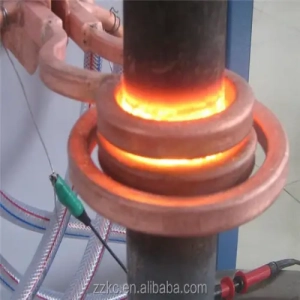
What is the frequency classification of induction heating equipment-1
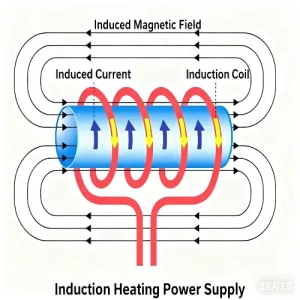
What is the frequency classification of induction heating equipment-2
It has the relatively highest frequency, with a frequency range generally above 200 kHz, which can be as high as several tens of MHz. The heating depth and thickness are the smallest, approximately 0.1–1 mm. It is mostly used for quenching and welding of local tiny parts or extremely thin bars, as well as surface quenching of small workpieces.
- Frequency Range: Above 200kHz, with a maximum of several tens of MHz.
- Heating Characteristics: The shallowest heating depth (approximately 0.1-1mm) and the smallest heating thickness.
- Typical Applications: Quenching and welding of local tiny parts or extremely thin bars; surface quenching of small workpieces.
Its frequency range is generally 40 kHz to 200 kHz, with common frequencies ranging from 40 kHz to 80 kHz. The heating depth and thickness are approximately 1–2 mm. It is mostly used for deep heating, red forging, forging, annealing, tempering, quenching and tempering of small workpieces, surface quenching, heating and welding of medium-diameter pipes, hot assembly, and quenching of small gears.
- Frequency Range: 40kHz to 200kHz, with 40kHz-80kHz being commonly used.
- Heating Characteristics: Relatively shallow heating depth (approximately 1-2mm).
- Typical Applications: Deep heating, red forging, forging, annealing, and surface quenching of small workpieces; heating, welding, and hot assembly of medium-diameter pipes; quenching of small gears.
Its frequency range is generally 20 kHz to 40 kHz (it is called “super-audio frequency” because the audio frequency ranges from 20 Hz to 20 kHz). The heating depth and thickness are approximately 2–3 mm. It is mostly used for deep heating of medium-diameter workpieces and heating of large-diameter thin-walled pipes. For example, it is applied in energy-saving transformation projects of plastic machinery (such as injection molding machines, wire drawing machines, granulators, extruders), food machinery, crude oil transportation, and other similar heating industries.
- Frequency Range: 20kHz to 40kHz (named because it is higher than the audio frequency range of 20Hz-20kHz).
- Heating Characteristics: Heating depth of approximately 2-3mm.
- Typical Applications: Deep heating of medium-diameter workpieces and heating of large-diameter thin-walled pipes; commonly used in energy-saving transformation of plastic machinery (injection molding machines, extruders), food machinery, and crude oil transportation heating.
Its frequency range is generally 1 kHz to 15 kHz, with a typical value of around 8 kHz. The heating depth and thickness are approximately 3–10 mm. It is mostly used for heating, annealing, tempering, quenching and tempering, and surface quenching of large workpieces, large-diameter shafts, large-diameter thick-walled pipes, and large-modulus gears, as well as red forging and forging of small-diameter bars.
- Frequency Range: 1kHz to 15kHz, with a typical value of around 8kHz.
- Heating Characteristics: Medium heating depth (approximately 3-10mm).
- Typical Applications: Heating, annealing, and quenching and tempering of large workpieces (such as large-diameter shafts, thick-walled pipes, and large-modulus gears); red forging and forging of small-diameter bars.
It has the lowest frequency, with a frequency range from power frequency (50 Hz) to approximately 1 kHz, and the commonly used frequency is mostly power frequency. The relative heating depth is the deepest, and the heating thickness is the largest, approximately 10–20 mm. It is mainly used for overall heating, annealing, tempering, and surface quenching of large workpieces.



Leave a Reply
Want to join the discussion?Feel free to contribute!