
Induction in HVAC
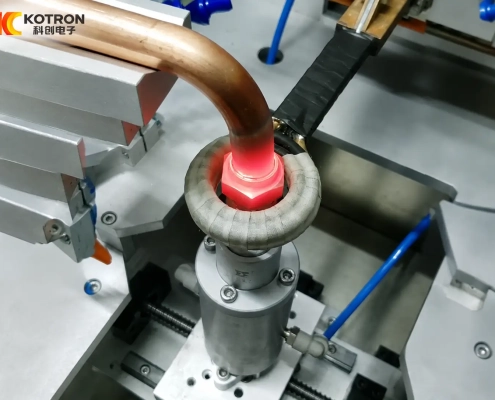
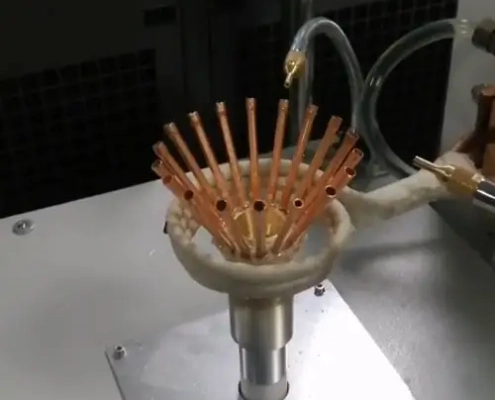
Induction heating has emerged as a pivotal process for enhancing product quality, boosting production efficiency, and elevating system reliability across the HVAC (Heating, Ventilation, and Air Conditioning) industry. It capitalizes on four core advantages: non-contact operation, precise temperature control, high energy efficiency, and seamless automation compatibility. Its applications are concentrated in four key scenarios: brazing connections, finned tube manufacturing, component heat treatment, and on-site maintenance.
I. Core Application Scenarios (By Manufacturing & Operation/Maintenance Processes)
| Application Link | Specific Uses | Technical Key Points | Industry Value |
|---|---|---|---|
| Heat Exchanger Manufacturing | Brazing of copper tubes and fins in condensers/evaporators; plate heat exchanger sealing | Localized rapid heating, strong metallurgical bonding, minimal heat-affected zone | Reduces contact thermal resistance, improves heat exchange efficiency by over 30%, and eliminates leakage risks |
| Pipeline System | Welding of compressor suction/discharge pipes, branch pipes, and valve joints | Precise temperature control at 800℃, oxidation-free process, uniform weld joints | Replaces flame brazing, avoids local overheating, and enhances the airtight reliability of refrigerant systems |
| Finned Tube Production | High-frequency welded finned tubes (metallurgical bonding of base tubes and fins) | Instant heating for forming, fin spacing controllable within 2–10mm | Reduces equipment footprint, ideal for central air conditioning systems in high-rise buildings |
| Component Processing | Preheating and stress relief annealing of valves and compressor components | Rapid temperature rise, stable thermal cycling, compatible with linked temperature control systems | Minimizes welding cracks, extends component service life, and cuts down maintenance costs |
| On-site Maintenance | Rewelding of old pipeline joints and copper tube repair | Handheld/portable equipment, flexible adaptation to complex working conditions | Flameless operation ensures enhanced safety, suitable for work in narrow and confined spaces |
II. Technical Advantages (vs. Traditional Flame/Resistance Heating)
- Precision & Controllability
Localized heating with an ultra-small heat-affected zone prevents deformation or oxidation of thin-walled components such as copper and aluminum parts, thus ensuring the cleanliness of refrigerant systems.
- High Efficiency & Energy Saving
Each joint heating cycle takes only 30–40 seconds. Compared with flame brazing, this technology cuts energy consumption by 40%–60% and generates zero exhaust gas emissions.
- Stability & Consistency
It is fully compatible with automated batch production lines (e.g., plate heat exchanger assembly lines), raising the weld pass rate from 95% to over 99.5%.
- Safety & Environmental Friendliness
Flameless and smoke-free operation complies with workshop safety and environmental regulations, effectively reducing the risk of workplace accidents.
III. Typical Applications
- Commercial Air Conditioning Units
Automated plate heat exchanger brazing lines double daily production capacity while driving defect rates close to zero. The technology is compatible with multiple materials including stainless steel and copper.
- Heat Pump Systems
Welding of four-way valves and heat exchanger joints improves system stability under low-temperature conditions and extends the service life of refrigerant cycles.
- Refrigeration & Cold Storage Equipment
High-frequency induction brazing of evaporator copper tubes and aluminum fins enhances frost resistance and ease of cleaning, extending maintenance intervals by 50%.
- On-site Installation & Maintenance
Handheld induction brazing equipment enables quick repair of pipeline joints, making it ideal for safety-critical locations such as shopping malls and hospitals.
IV. Future Trends
Integration with Sensor of temperature control systems to achieve full-process data traceability, which supports the operation of smart factories.
Expansion into the manufacturing of new HVAC components such as microchannel heat exchangers and hydrocarbon refrigerant systems, facilitating the industry’s low-carbon transformation and upgrading.
 https://www.inductionheatingtreatment.com/wp-content/uploads/2026/09/bent-copper-tube-induction-brazing.webp
1086
1448
cui yanan
https://www.inductionheatingtreatment.com/wp-content/uploads/2025/12/kclogo2.webp
cui yanan2026-09-04 03:43:192026-09-08 03:49:35Induction Brazing for HVAC & Refrigeration Copper Components
 https://www.inductionheatingtreatment.com/wp-content/uploads/2025/12/Copper-Tube-Manifold-Welding-1.webp
500
500
inductionheatingtreatment
https://www.inductionheatingtreatment.com/wp-content/uploads/2025/12/kclogo2.webp
inductionheatingtreatment2025-12-18 01:53:592026-08-05 07:23:24Copper Tube Manifold Welding


